

Home
Class 12
PHYSICS
A rod of mass m and length l is hinged a...

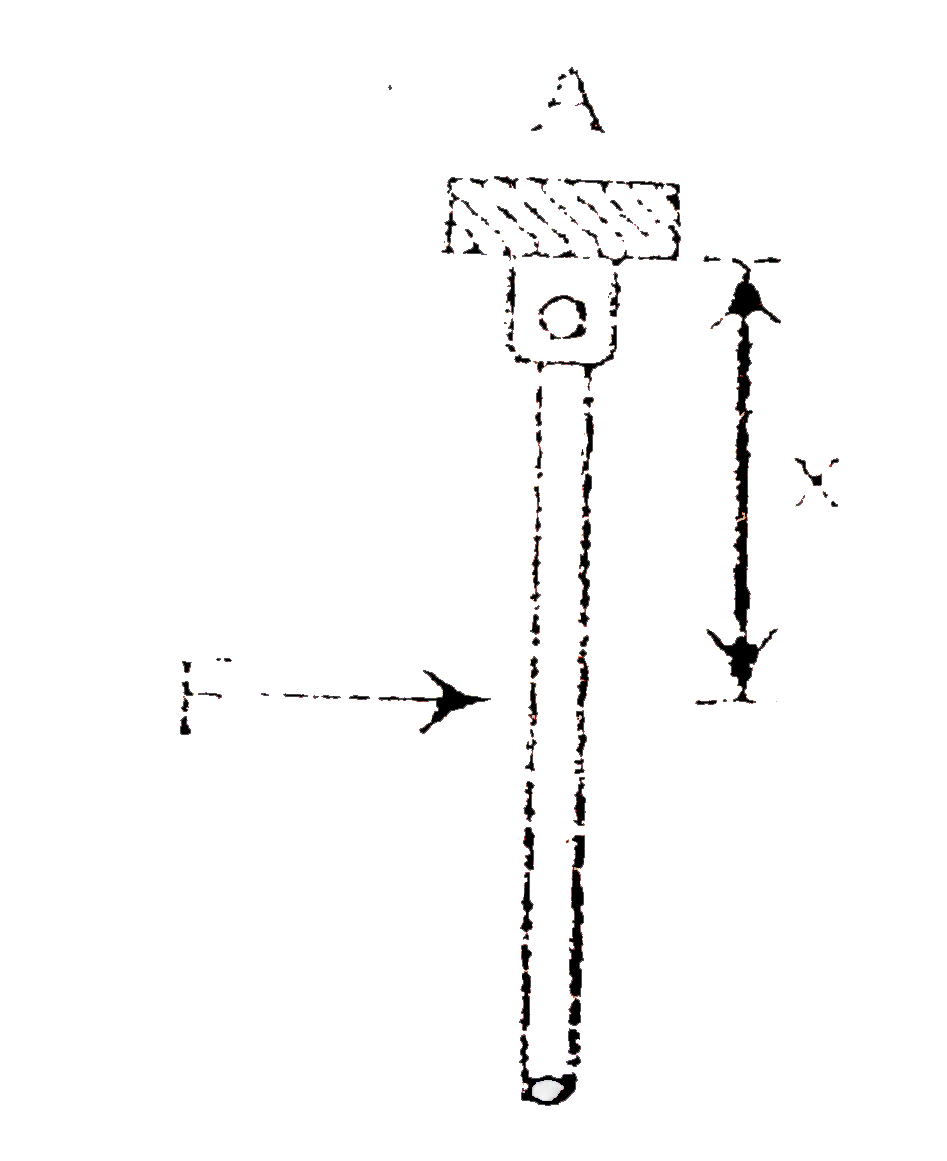
A rod of mass `m` and length `l` is hinged at one of its ends `A` as shown in figure. A force `F` is applied at a distance `x` from `A` . The acceleration of centre of mass varies with `x` as `-`

Promotional Banner

Similar Questions

Explore conceptually related problems

A uniform rod of mass M = 2 kg and length L is suspended by two smooth hinges 1 and 2 as shown in Fig. A force F = 4 N is applied downward at a distance L//4 from hinge 2 . Due to the application of force F , hinge 2 breaks. At this instant, applied force F is also removed. The rod starts to rotate downward about hinge 1 . ( g = 10 m//s^(2) ) The acceleration of the end point of the rod of small mass dm at the end point of the rod, when the rod becomes vertical is

A uniform rod of mass M = 2 kg and length L is suspended by two smooth hinges 1 and 2 as shown in Fig. A force F = 4 N is applied downward at a distance L//4 from hinge 2 . Due to the application of force F , hinge 2 breaks. At this instant, applied force F is also removed. The rod starts to rotate downward about hinge 1 . ( g = 10 m//s^(2) ) The reaction at hinge 1 , before hinge 2 breaks, is

A uniform disc of mass M and radius R is hinged at its centre C. A force F is applied on the disc as shown. At this instant, the angular acceleration of the disc is

A uniform rod of mass m length l is attached to smooth hinge at end A and to a string at end B as shown in figure. It is at rest. The angular acceleration of the rod just after the string is cut is :

A uniform disc of mass M and radius R is hinged at its centre C . A force F is applied on the disc as shown . At this instant , angular acceleration of the disc is

A rod of mass m and length l is hinged at 'its' end and released from rest in position shown. Find the force exerted by the hinge when the rod becomes horizontal

A uniform rod of mass M and length l is hinged at point O and is free to rotate on a horizontal smooth surface. Point O is at a distance of (l)/(4) from one end of the rod. A sharp impulse P_(0) = 2 sqrt(130) kg m//s is applied along the surface at one end of the rod as shown in figure [tan theta = (9)/(7)] (a) Find the angular speed of the rod immediately after the hit (b) Find the impulse on the rod due to the hinge.