

Home
Class 12
PHYSICS
An infinity long uniform line charge dis...

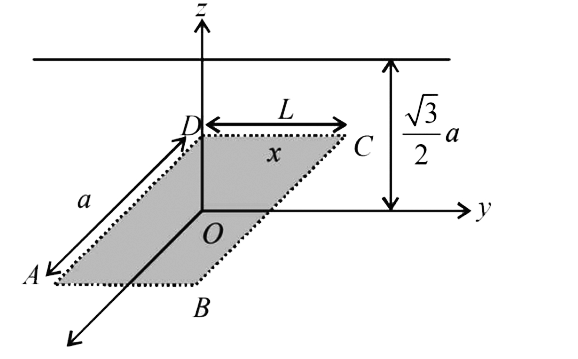
An infinity long uniform line charge distribution of charge per unit length `lambda` lies parallel to the y-axis in the `y-z` plane at `z=sqrt3/2` a(see figure). If the magnitude of the flux of the electric field through the rectangular surface ABCD lying in the `x-y` plane with its centre at the origin is `(lambdaL)/(n epsilon_0)` (`epsilon_0=` permittivity of free space), then the value of n is

Promotional Banner

Similar Questions

Explore conceptually related problems

Find the equation of the plane passing through origin and parallel to the plane x+3y-2z+7=0 .

The electric field in a region of space is given by E=5hati+2hatjN//C . The flux of E due ot this field through an area 1m^2 lying in the y-z plane, in SI units is

The electric field in a region of space is given by E=5hati+2hatjN//C . The flux of E due ot this field through an area 1m^2 lying in the y-z plane, in SI units is

A point charge q is placed at origin. Find the flux of electric,produced due to this charge, through a circle of radius R lying in y-z plane. The centre of the circle lies at (x,0).

A uniformly charged square plate having side L carries a uniform surface charge density sigma . The plate lies in the y - z plane with its centre at the origin. A point charge q lies on the x-axis. The flux of the electric field of q through the plate is phi0 , while the foce on the point charge q due to the plate is F_(0) , along the x-axis. Then,

A uniformly charged square plate having side L carries a uniform surface charge density sigma . The plate lies in the y - z plane with its centre at the origin. A point charge q lies on the x-axis. The flux of the electric field of q through the plate is phi0 , while the foce on the point charge q due to the plate is F_(0) , along the x-axis. Then,

A uniform disc of radius R lies in the x-y plane, with its centre at origin. Its moment of inertia about z-axis is equal to its moment of inertia about line y = x + c . The value of c will be. .

A uniform disc of radius R lies in the x-y plane, with its centre at origin. Its moment of inertia about z-axis is equal to its moment of inertia about line y = x + c . The value of c will be. .