

Home
Class 11
PHYSICS
In first figure a meter stick, half of w...

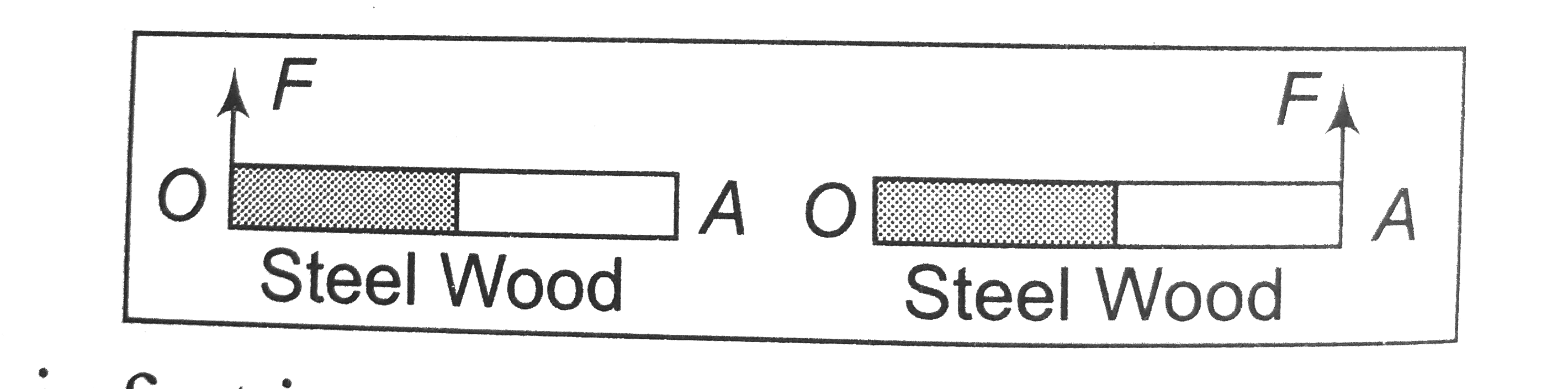
In first figure a meter stick, half of which is wood and the other half steel is pivoted at the wooden end at `A` and a force is applied at the steel and at `O`. On second figure the stick is pivoted at the steel end at `O` and the same force is applied at the wooden end at `A`. The angular acceleration.
.

Promotional Banner

Similar Questions

Explore conceptually related problems

A meter stick, half of which is wood and the other half steel, is pivoted at the wooden end and same force isapplied to the steel end. Next, it is pivoted at the steel end and the same force is applied at the wooden end. Does one getthesame angular acceleration in eachcase ? Explain

Figures 1 and 2 below show a meter stick, haif of which is wood and half of which is steel. (Steel is denser than wood). In figure 1, the stick is pivoted at the wooden end, at O, and a force F is applied to the steel end. In figure 2, the stick is pivoted at the steel end at O, and an identical force is applied to the wooden end. ["Neglect Gravity"] .

Figures 1 and 2 below show a meter stick, haif of which is wood and half of which is steel. (Steel is denser than wood). In figure 1, the stick is pivoted at the wooden end, at O, and a force F is applied to the steel end. In figure 2, the stick is pivoted at the steel end at O, and an identical force is applied to the wooden end. ["Neglect Gravity"] .

In the figure (i) half of the meter scale is made of wood while the other half, of steel. The wooden part is pivoted at O. A force F is applied at the end of steel part. In figure (ii) the steel part is pivoted at O and the same force is applied at the wooden end

In the figure (i) half of the meter scale is made of wood while the other half, of steel. The wooden part is pivoted at O. A force F is applied at the end of steel part. In figure (ii) the steel part is pivoted at O and the same force is applied at the wooden end

The adjacent figure shows a non-uniform metre stick AB having the linear mass density variation lambda = lambda_(0) x , where lambda_(0) is a constant and x is the distance from end A, placed on a smooth horizontal surface. In the first experiment, the rod is pivoted at A and force F is applied perpendicular to the rod at the other end B and in the second experiment, the rod is pivoted at B and the force is applied perpendicular to the rod at the end A. If in the first case angular acceleration is alpha_(A) and in the second case it is alpha_(B) then