

Home
Class 11
PHYSICS
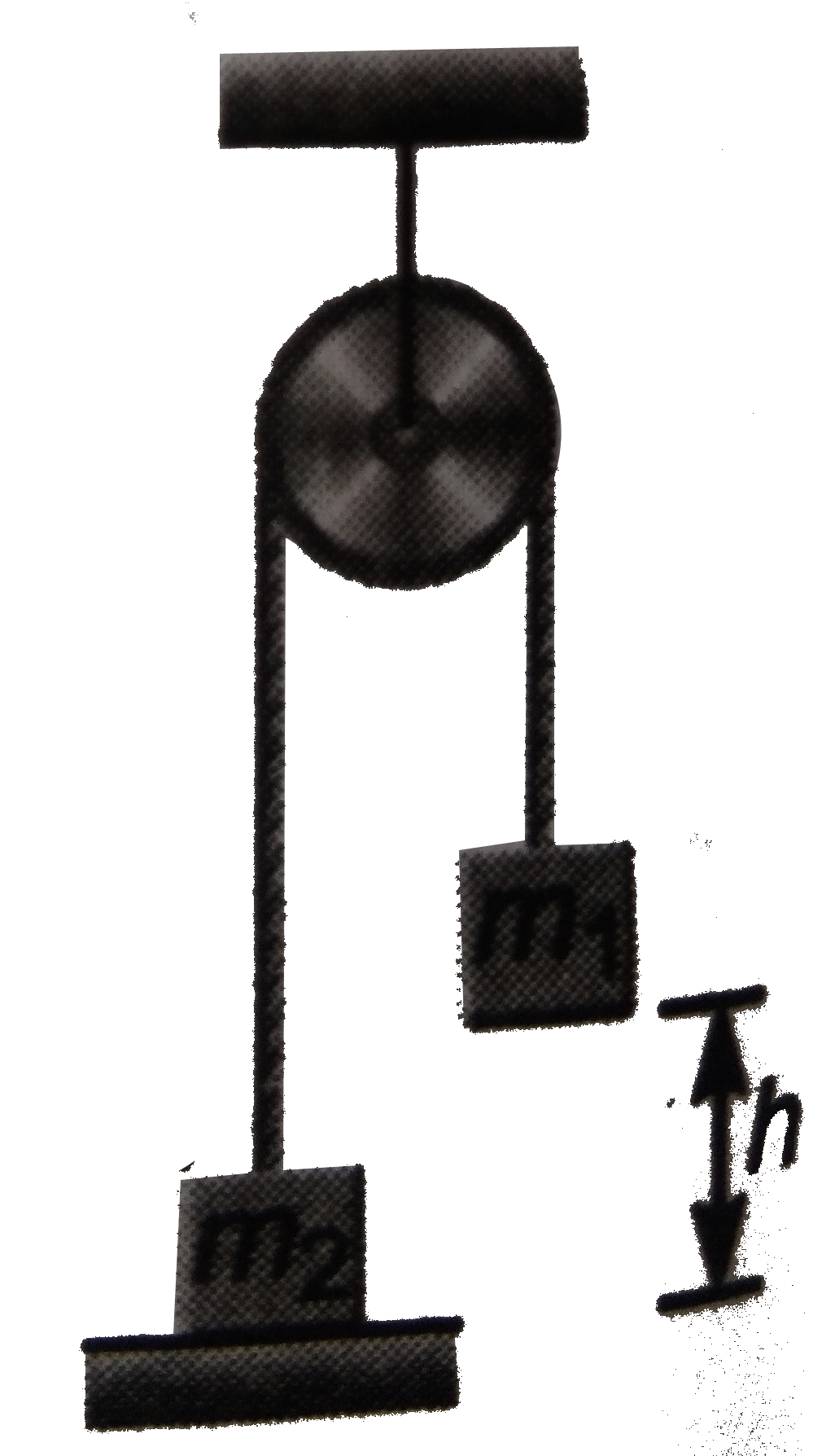
In the figure. (m2) (ltm(1)) are joined ...

In the figure. (m_2) (ltm_(1))` are joined together by a pulley. When the mass `(m_(1))` is released from the height `h` above the floor, it strikes the floor with a speed .

Promotional Banner

Similar Questions

Explore conceptually related problems

A block of mass m is dropped from height h above the ground. Find out the speed of the block when it reaches the ground.

If the masses are released from the position shown in figure then the speed of mass m1 just before it strikes the floor is -

Let m_(1) =1kg, m_(2) =2kg and m_(3) =3kg in figure (5-E12).Find the accelerations of m_(1) , m_(2) and m_(3) .The string from the upper pulley to m_(1) is 20cm when the system is released from rest.How long will it take before m_(1) strikes the pulley?

A block A of mass m is held at rest on a smooth horizontal floor. A light frictionless, small pulley is fixed at a height of 6m from the floor. A light inextensible string of length 16m , connected with A passes over the pulley and another identical block B is hung from the string. Initial height of B is 5m from the floor as shown in figure When the system is released from rest, B starts to move vertically downwards and A slides on the floor towards right. a. If at an instant string makes an angle theta with horizontal, calculate relation between velocity u of A and v of B. b. Calculate v when B strikes the floor. ( g=10ms^-2 ).

A block of mass m is held at rest on a smooth horizontal floor. A light frictionless, small pulley is fixed at a height of 6m from the floor. A light inextensible string of length 16m, connected with A passes over the pulley and another identical block B is hung from the string initial height of B is 5m from the floor as shown in figure -3.130 When the system is released from rest, B starts to move vertically downwards and A slides on the floor towards right (a) if at an instant string makes an angle theta with horizontal, calculate relation between velocity u of A and v of B (b) Calculate c when B strikes the floor.

Two masses m_(1) and m_(2) (m_(1)