

Home
Class 11
PHYSICS
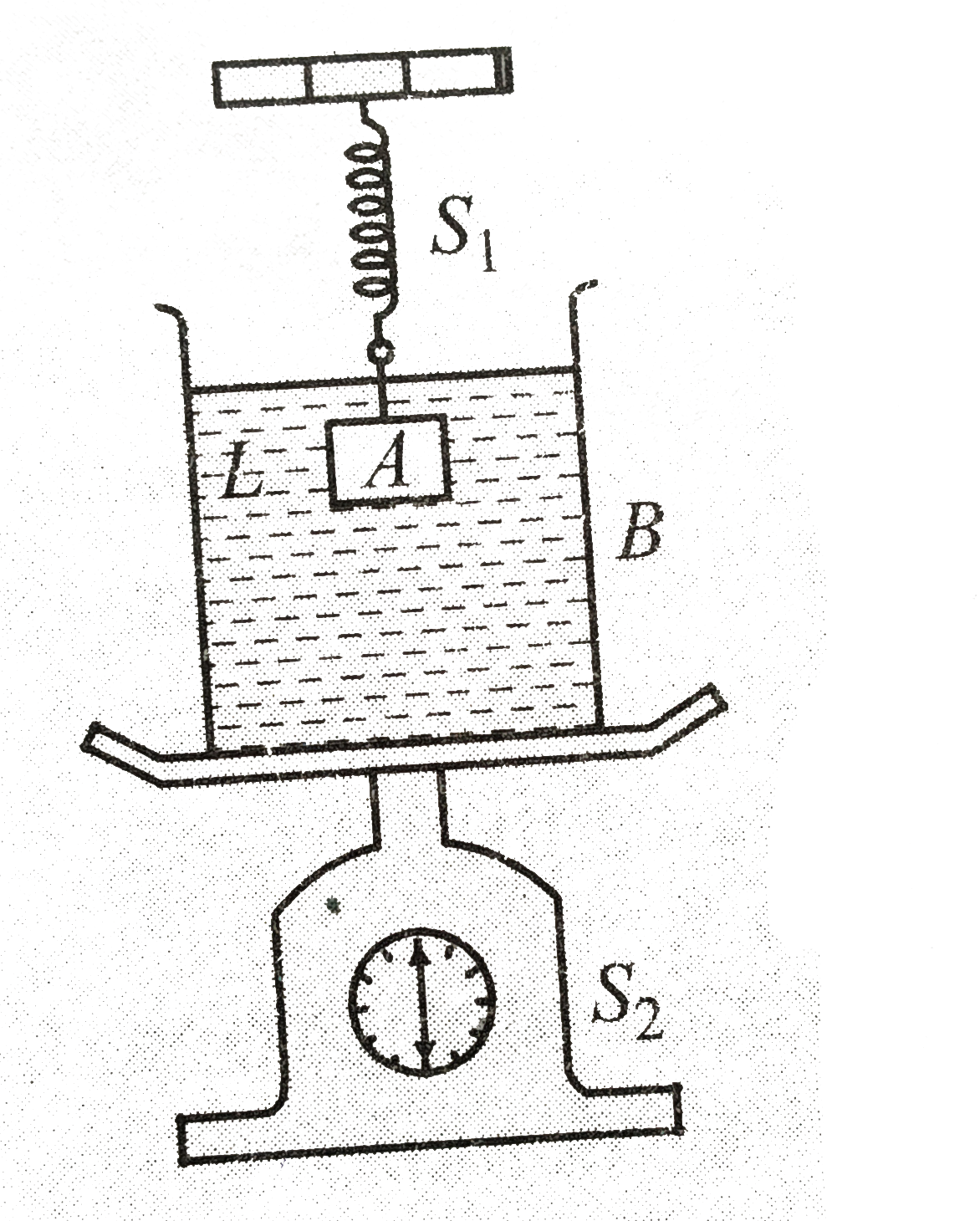
As Fig. shows, S(1) and S(2), are spring...

As Fig. shows, `S_(1)` and `S_(2)`, are spring balances. Block `A` is hanging from spring balance `S_(1)` and immersed in liquid `L` which is contained in beaker `B`. The mass of beaker `B` is `1 kg` and mass of liquid `L` is `1.5 kg`. Balances `S_(1)` and `S_(2)` reads `2.5 kg` and `7.5 kg`, respectively. What will be the readings of `S_(1)` and `S_(2)` when block `A` is pulled up out of the liquid. Find the reading of `S_(1)` and `S_(2)?

Promotional Banner

Similar Questions

Explore conceptually related problems

Reading of spring balance S_1 and S_2 (Pulley are ideal)

Reading of spring balance S_1 and S_2 (Pulley are ideal)

In figure, block A hangs by a cord form spring balance D and it submerged in a liquid C contained in a beaker B . The mass of the beaker is 1 kg . The mass of the liquid is 1.5 kg . Balance D reads 7.5 kg . The volume of block A is 0.003 m^(3) . The mass per unit volume of the liquid is

As, block of mass 5 kg is attached to spring balance reading of spring balance will be

Two masses m_(1) and m_(2) are attached to a spring balance S as shown in figure. m_(1) gt m_(2) then the reading of spring balance will be . .

Reading shown in two spring balances S_(1) and S_(2) is 90kg and 30kg respectively and lft is accelerating upwards with acceleration 10m//s^(2).S_(1) in elongated and S_(2) is compressed. The mass is stationary with respect to life. Then the mass of the block will be

Reading shown in two spring balances S_(1) and S_(2) is 90kg and 30kg respectively and lft is accelerating upwards with acceleration 10m//s^(2).S_(1) in elongated and S_(2) is compressed. The mass is stationary with respect to life. Then the mass of the block will be

A block hangs from a spring balance. The balance reads 40 N in air, 35 N when block is immersed in water and 25 N when block is immersed in another liquid. Find the density of block and other liquid.