Home
Class 11
BIOLOGY
Explain sliding filament theory of muscl...

Explain sliding filament theory of muscle contraction with neat sketches.

Text Solution

Verified by Experts
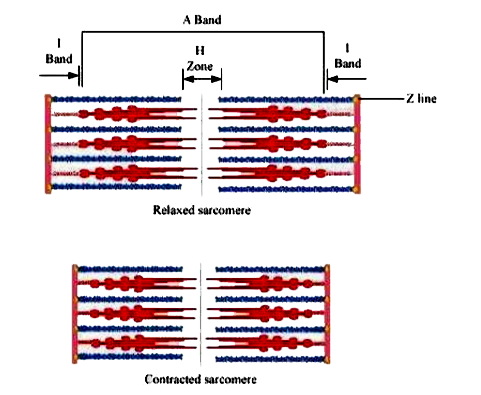
The sliding filament theory explains the process of muscle contraction during which the thin filaments slide over the thick filaments, which shortens the myofibril. Each muscle fibre has an alternate light and dark band, which contains a special contractile protein, called actin and myosin respectively. Actin is a thin contractile protein present in the light band and is known as the I-band, whereas myosin is a thick contractile protein present in the dark band and is known as the A-band. There is an elastic fibre called z line that bisects each I-band. The thin filament is firmly anchored to the z line. The central part of the thick filament that is not overlapped by the thin filament is known as the H-zone. During muscle contraction, the myosin heads or cross bridges come in close contact with the thin filaments. As a result, the thin filaments are pulled towards the middle of the sarcomere. The Z line attached to the actin filaments is also pulled leading to the shortening of the sarcomere. Hence, the length of the band remains constant as its original length and the I-band shortens and the H-zone disappears.
Promotional Banner

Similar Questions

Explore conceptually related problems

Define sliding filament theory of muscle contraction.

Sliding filament theory of muscle contraction was given by

During muscle contraction

During muscle contraction

During muscle contraction

According to sliding filament theory of muscle contraction, the filament that move to shorten a muscle are

Read the following statements is context to muscle tissue and choose the correct answer . (i) Excessive exercise results in anaerobic Respiration and forms lactic acid . (ii) As per sliding filament theory of muscle contraction, the filament that moves to shorten a muscule is actin . (iii) The muscles primarily involved in locomotion is striated muscles .

Basic unit of muscle contraction is

