

Home
Class 12
CHEMISTRY
An ideal gas in a thermally insulated ve...

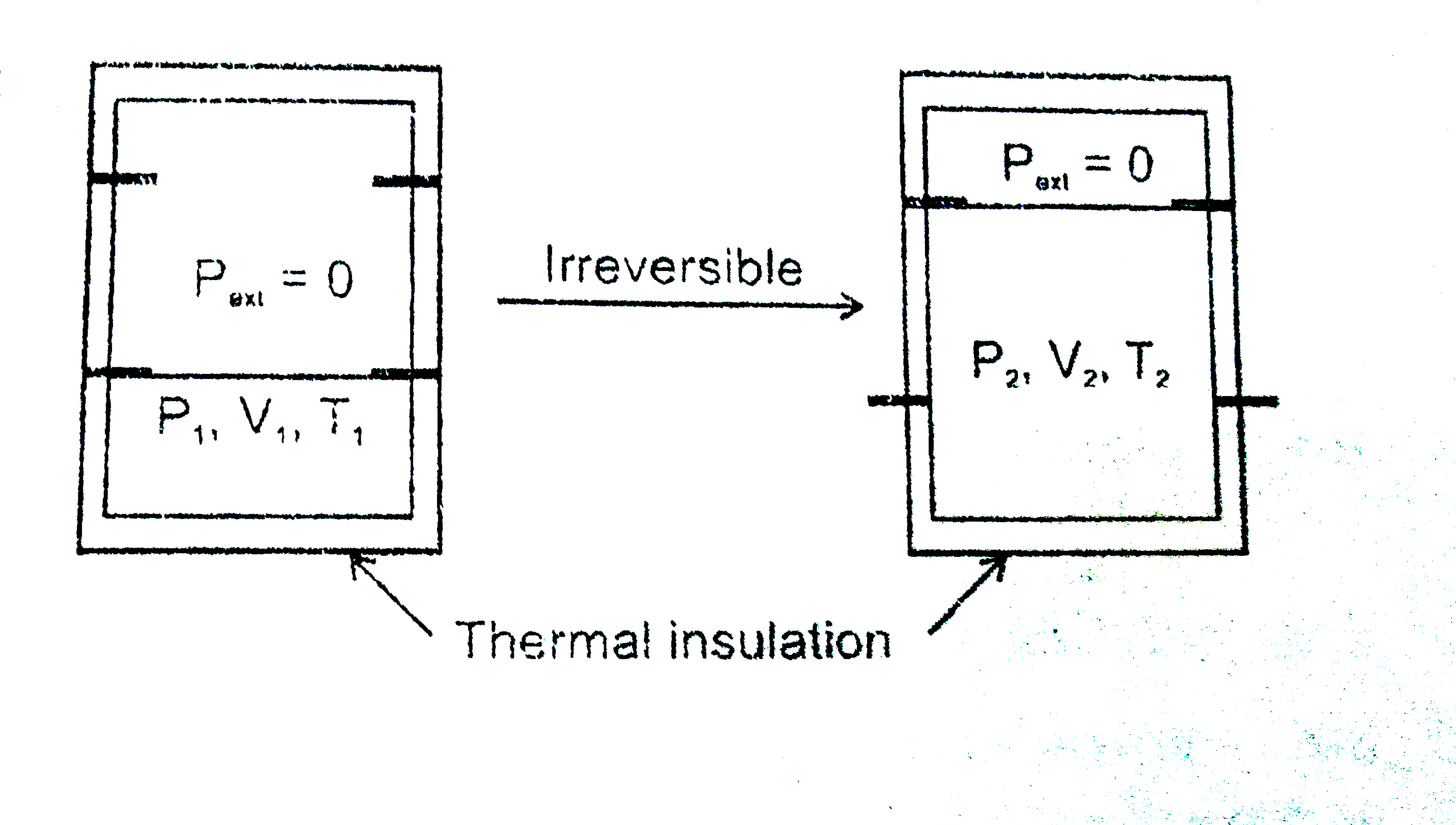
An ideal gas in a thermally insulated vessel at internal pressure `=P_(1)`, volume `=V_(1)` and absolute temperature `=T_(1)` expands irreversibly against zero external pressure, as shown in the diagram. The final internal pressure, volume and absolute temperature of the gas are `P_(2), V_(2)` and `T_(2)` respectively. For this expansion.

Promotional Banner

Similar Questions

Explore conceptually related problems

An ideal gas in thermally insulated vessel at internal (pressure)=P_(1), (volume)=V_(1) and absolute temperature = T_(1) expands irreversiby against zero external, pressure , as shown in the diagram, The final internal pressure, volume and absolute temperature of the gas are p_(2), V_(2) and T_(2) , respectively . For this expansion

An ideal gas in a thermally insulated vessel at internal pressure =p_(1), volume =V_1, and absolute temp =T_1, expands irreversibly against zero external pressure, as shown in the below diagram. The final internal pressure volume and absolute temperature of the gas are p_(2), V_(2), and T_(2), respectively. For this expansion,

Two containers of equal volume contain the same gas at pressure P_(1) and P_(2) and absolute temperature T_(1) and T_(2) , respectively. On joining the vessels, the gas reaches a common pressure P and common temperature T . The ratio P//T is equal to

Two containers of equal volume contain the same gas at pressure P_(1) and P_(2) and absolute temperature T_(1) and T_(2) , respectively. On joining the vessels, the gas reaches a common pressure P and common temperature T . The ratio P//T is equal to

Two containers of equal volume contain the same gas at pressure P_(1) and P_(2) and absolute temperature T_(1) and T_(2) , respectively. On joining the vessels, the gas reaches a common pressure P and common temperature T . The ratio P//T is equal to

A gas enclosed in a vessel has pressure P, volume V and absolute temperature T, write the formula for number of molecule N of the gas.

A gas enclosed in a vessel has pressure P, volume V and absolute temperature T, write the formula for number of molecule N of the gas.