Home
Class 12
CHEMISTRY
The plot given below shows P -T curves (...

The plot given below shows `P -T` curves (where P is the pressure and T is the temperature) for two solvents X and Y and isomolal solutions of NaCl in these solvents. NaCl completely dissociates in both the solvents.
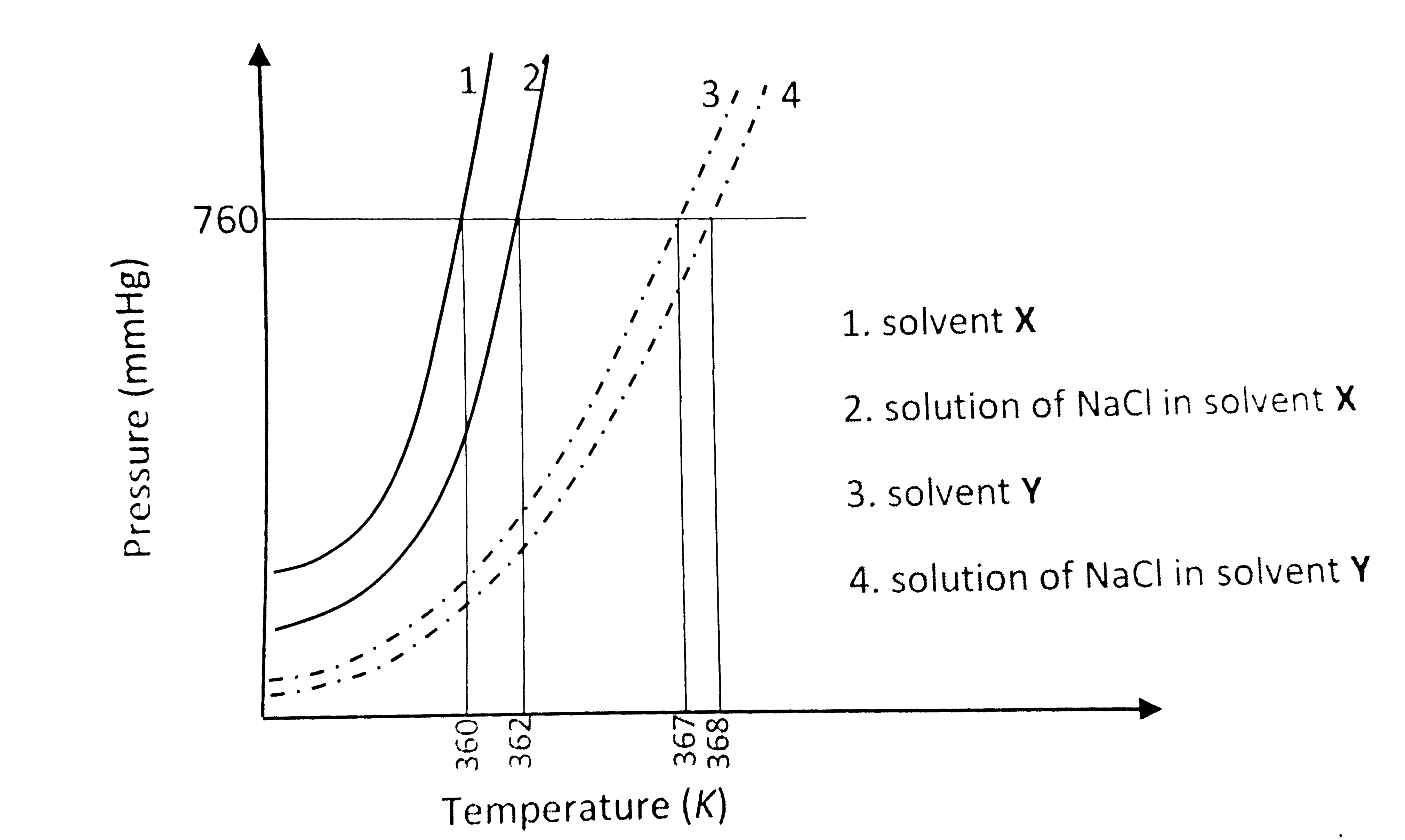
On addition of equal number of moles of a non-volatile solute S in equal amount (in kg) of these solvents, the elevation of boiling point of solvent X is three times that of solvent Y. Solute S is known to undergo dimerization in these solvents. If the degree of dimerization is 0.7 in solvent Y, the degree of dimerization in solvent X is ____.


Text Solution

Verified by Experts

(0.05) From graph
For solven X' `" " Delta T_(bx)=2`
`Delta T_(bx)=m_(NaCl)xx K_(b(x))` …….(i)
For solvent ' Y' `" " Delta T_(by)=1`
`Delta T_(b(y))=m_(NaCl)xxK_(b(y))` …….(ii)
Equation (i)/(ii)
`rArr (K_(b(x)))/(K_(b(y)))=2`
For solute S
`underset(1-alpha)underset("1 ")(2(S))to underset(alpha-2)(S_(2))`
`i=(1-alpha//2)`
`Delta T_(b(x)(s))=(1-(alpha_(1))/(2))K_(b(x))`
`Delta T_(b(y)(s))=(1-(alpha_(2))/(2))K_(b(y))`
Given `Delta T_(b(x)(s))=3Delta T_(b(y)(s))`
`(1-(alpha _(1))/(2))K_(b(x))=3xx(1-(alpha_(2))/(2))xxK_(b(y))`
`2(1-(alpha_(1))/(2))=3(1-(alpha_(2))/(2))`
`alpha_(2)=0.7`
So `alpha_(1)=0.05` .
Promotional Banner

Topper's Solved these Questions

  • SOLUTION

    ERRORLESS |Exercise JEE SECTION (Matrix Match type questions)|1 Videos
  • SOLID STATE

    ERRORLESS |Exercise JEE section (Numeric )|1 Videos
  • SOME BASIC CONCEPTS OF CHEMISTRY

    ERRORLESS |Exercise JEE Section (Matrix Match type questions)|3 Videos

Similar Questions

Explore conceptually related problems

Partial pressure of solvent in solution of non-volatile solute is given by equation.

When 50 g of a nonvolatile solute is dissolved in a certain quantity of solvent, the elevation of boiling point is 2.0 K. What will be the elevation of boiling point when 30 g of solute is dissolved in the same amount of the same solvent?

When non-volatile solute is assed to a pure solvent, the:

If the mass of a nonvolatil, nonelectrolyte dissolved in a solvent is doubled but that of solvent is quadrupled, the elevation in boiling point of the solvent will be