Home
Class 12
CHEMISTRY
Sulphur reacts with chlorine in 1:2 rati...

Sulphur reacts with chlorine in 1:2 ration and forms X . Hydrolysis of X gives a sulphur compound Y. what is the structure and hybridisation of anion of Y


A

Tetrahedral, `sp^(3)`

B

Linear , sp

C

Pyramidal , `sp^(3)`

D

Trigonal planar, `sp^(2)`

Text Solution

Verified by Experts

The correct Answer is:
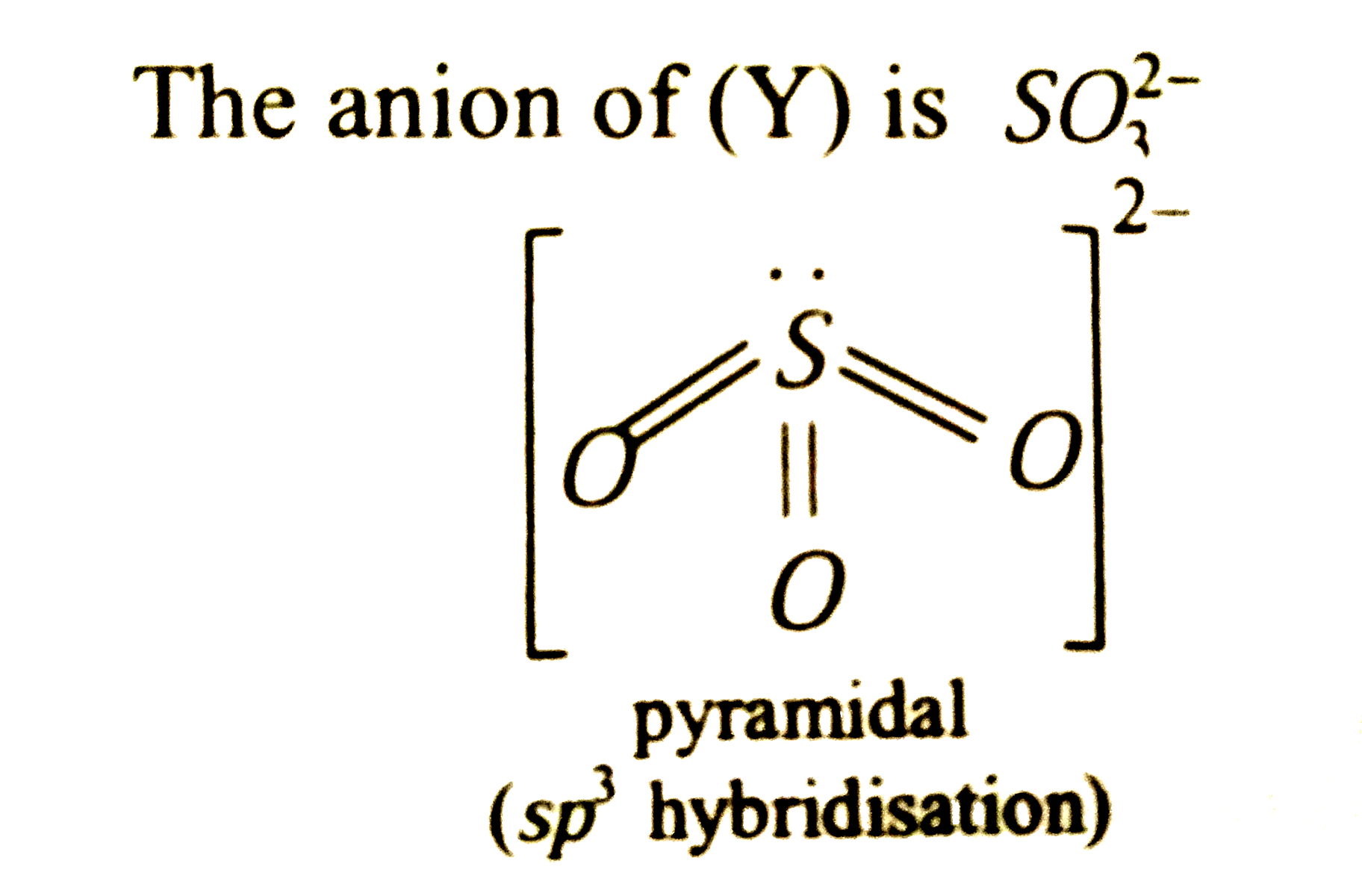
C

When sulphur reacts with chlorine in 1:2 ratio, then `SCl_(4)` is obtained which one hydrolysis gives sulphurous acid `(H_(2)SO_(3))`.
`underset(1)(S)+underset(2)(2Cl_(2))tounderset((X))(SCl_(4))`
`SCl_(4)+4H_(2)O to S(OH)_(4)+4HCl`
`S(OH)_(4) to underset((Y))underset("sulphurous acid")(H_(2)SO_(3))+H_(2)O`
The anion of (Y) is `SO_(3)^(2-)`
Promotional Banner

Similar Questions

Explore conceptually related problems

Sulphur reacts with chlorine in 1:2 ratio and forms X hydrolysis of X gives a sulphure compound Y. What is the hybridisation state od central atom in the compound?

What is the hybridisation of sulphur in H_(2)SO_(4) ?

When sulphur reacts in air (O₂), what is the product formed.

Silica reacts with hydride of superhalogen to form 'X'. On hydrolysis of 'X' another compound 'Y' is formed. 'Y' on heating at 1000^(0)C loses water to form 'Z'. The 'Z' can also be prepared in the following reaction.

Sulphur dioxide reacts with chlorine in the pressure of charcoal (Which acts as a catalyst) to give

White crystalline solid (A) reacts with H_2 to form a highly associated liquid (B) and a monoatomic , colourless gas (C ). The liquid (B) is used for etching glass. Compound (A) undergoes hydrolysis slowly to form (C ), (B) and a diatomic gas (D ) whose IE is almost similar to that of (C ). (B) forms an addition compound with KF to form (E) which is electrolysed in the molten state to form a most reactive gas (F) which combines with (C ) in 2:1 ratio of produce (A). The compound 'A' reacts with sulphur to form a compound in which hybridisation state of sulphur atom is :

X and Y are anhydrides of sulphurous and sulphuric acid respectively. The hybridisation state and the sphape of X and Y are

