

Home
Class 11
PHYSICS
A smooth hemispherical bowl 30 cm diame...

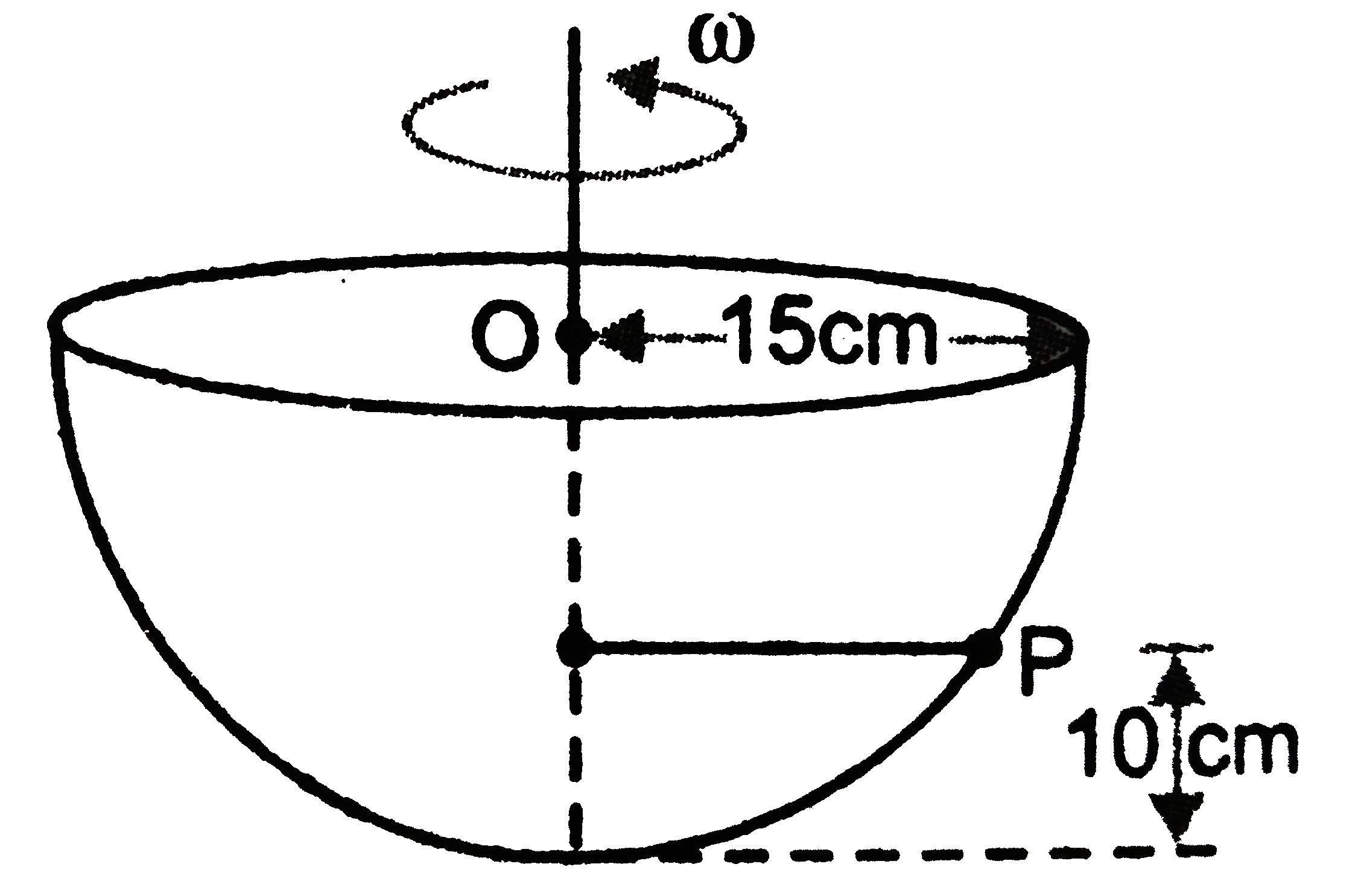
A smooth hemispherical bowl ` 30 cm` diameter potates with a constatn angular velocity `omega`, about its vertical axis of symmetry. A particle at (P) of weighing ` 5 kg`, is onserved to remantn at rest telative to the bowal at a height ` 10 cm` above teh base, Fig. 1 (CF) . 34. The magnitude fo speed of rotation of the bowl is
.

Promotional Banner

Similar Questions

Explore conceptually related problems

A smooth hemispherical bowl 30 cm diameter, rotates with a constant angular velocity omega , about its vertical axis of symmetry Fig. 2 (APC) . 2 (a) . A particle at (P) of weighing 5 kg is observed to remain at rest relative to the bowl at a height 10 cm above the base. Find the magnitude of the force exerted by the bowl on the particle and speed of rotation of the bowl. .

A rough horizontal plate rotates with a constant angular velocity w about its vertical axis. A particle of mass m lies on the plate at a distance (5a)/(4) from the axes. If the coefficient of friction is (1)/(3) and the particle remains at rest relative to the plane, show that w le sqrt((4g)/(15a)) . The particle is now connected to axis by a horizontal elastic string, of natural length a and modulus 3 mg. If the particle remains at rest relative to the plate and at a distance (5a)/(4) , show that the greatest possible angular velocity is sqrt((13)/(15).(g)/(a)) and find the least possible velocity.

A horizontal disc rotates with a constant angular velocity omega=6.0rad//s about a vertical axis passing through its centre. A diameter of the disc with a velocity v^'=50cm//s which is constant relative to the disc. Find the force that the disc exerts on the body at the moment when it is located at the distance r=30cm from the rotation axis.

A horizontal smooth rod AB rotates with a constant angular velocity omega=2.00rad//s about a vertical axis passing through its end A. A freely sliding sleeve of mass m=0.50g moves along the rod from the point A with the initial velocity v_0=1.00m//s . Find the Coriolis force acting on the sleeve (in the reference frame fixed to rotating rod) at the moment when the sleeve is located at the distance r=50cm from the rotation axis.

A smooth hemispherical bowl of radius R=0.1 m is rotating about its own axis (which is vertical) with an angular velocity 0. A particle of mass 10^(-2) kg on the inner surface of the bowl at an angled position theta (with vertical) is also rotating with same ' omega '. The particle is about a height 'h' from the bottom of thebowl. The value of ' theta ' in temis of 'R' and h' is

A uniform solid cone of mass m, base radius ‘R’ and height 2R, has a smooth groove along its slant height as shown in figure. The cone is rotating with angular speed omega , about the axis of symmetry. If a particle of mass ‘m’ is released from apex of cone, to slide along the groove, then angular speed of cone when particle reaches to the base of cone is

A uniform solid cone of mass m, base radius ‘R’ and height 2R, has a smooth groove along its slant height as shown in figure. The cone is rotating with angular speed omega , about the axis of symmetry. If a particle of mass ‘m’ is released from apex of cone, to slide along the groove, then angular speed of cone when particle reaches to the base of cone is

A frame of reference that is accelerated with respect to an inertial frame of reference is called a non-inertial frame of reference. A coordinate system fixed on a circular disc rotating about a fixed axis with a constant angular velocity omega is an example of non=inertial frame of reference. The relationship between the force vecF_(rot) experienced by a particle of mass m moving on the rotating disc and the force vecF_(in) experienced by the particle in an inertial frame of reference is vecF_(rot)=vecF_(i n)+2m(vecv_(rot)xxvec omega)+m(vec omegaxx vec r)xxvec omega . where vecv_(rot) is the velocity of the particle in the rotating frame of reference and vecr is the position vector of the particle with respect to the centre of the disc. Now consider a smooth slot along a diameter fo a disc of radius R rotating counter-clockwise with a constant angular speed omega about its vertical axis through its center. We assign a coordinate system with the origin at the center of the disc, the x-axis along the slot, the y-axis perpendicular to the slot and the z-axis along the rotation axis (vecomega=omegahatk) . A small block of mass m is gently placed in the slot at vecr(R//2)hati at t=0 and is constrained to move only along the slot. The distance r of the block at time is