Home
Class 12
CHEMISTRY
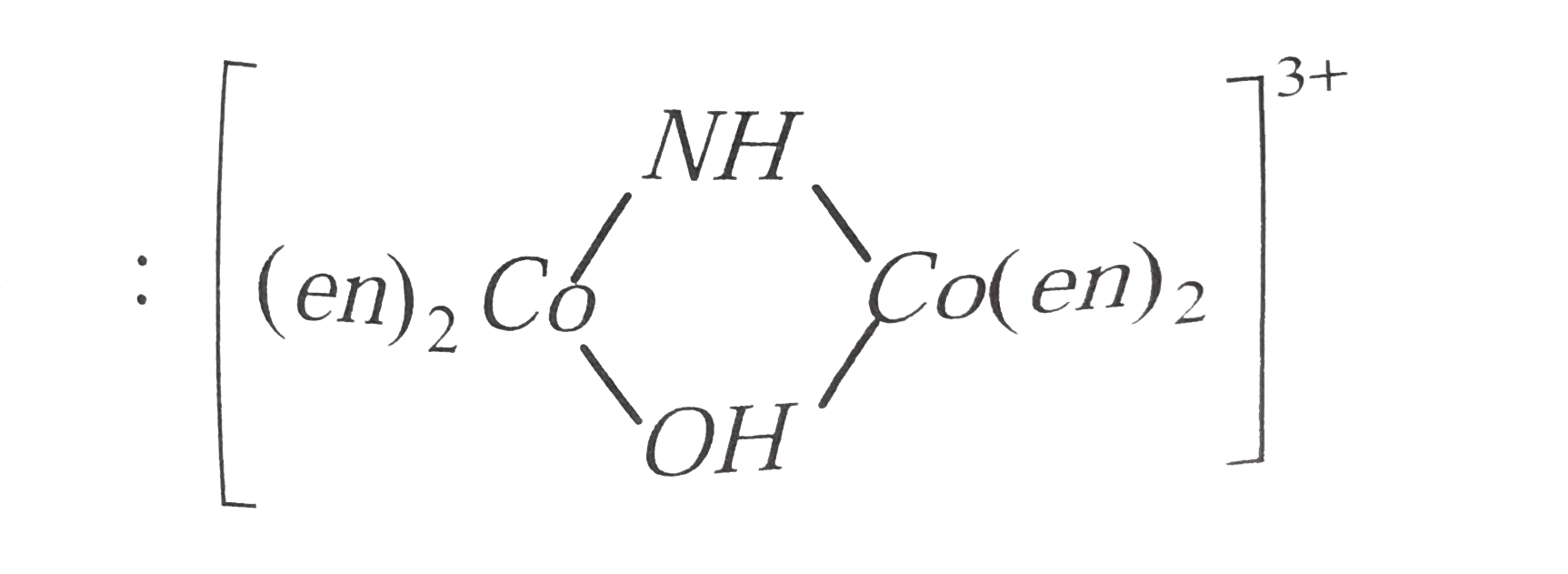
Assertion : is named as tetrakis ( ethy...

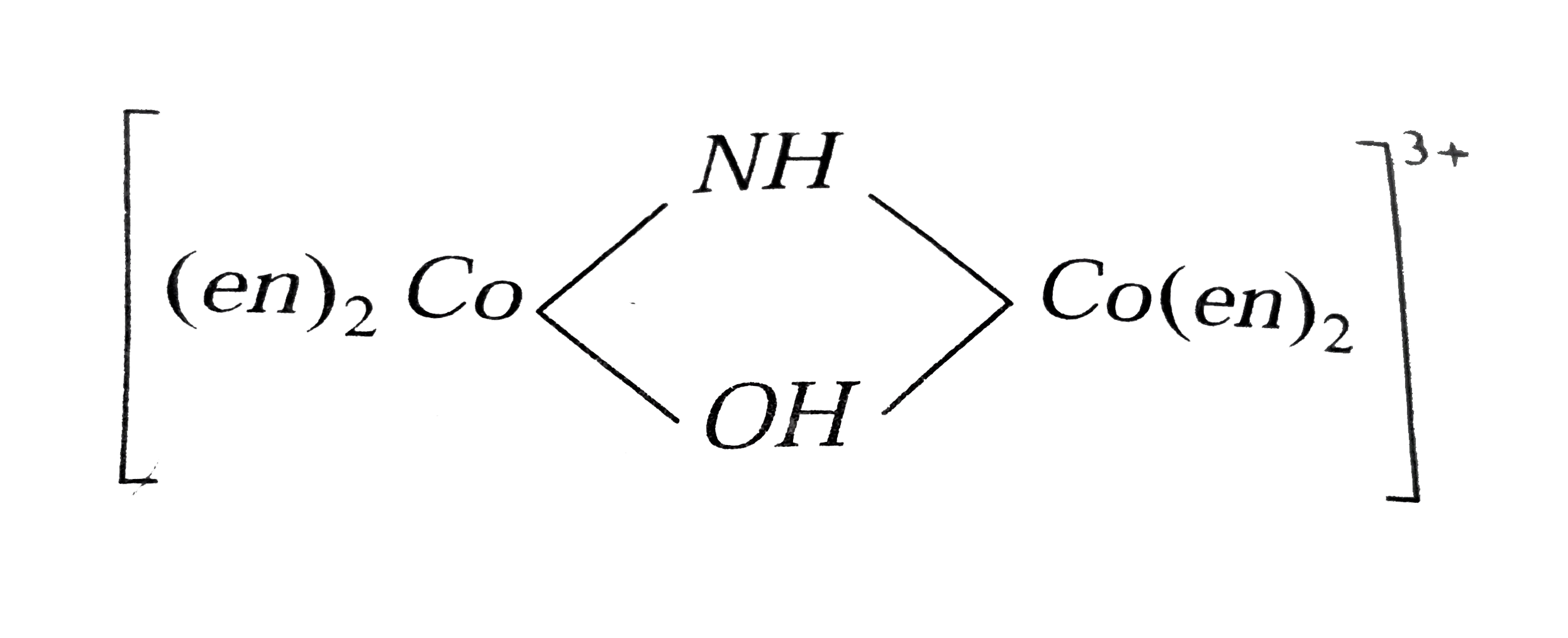
Assertion `:` is named as tetrakis ( ethylene diamine ) `mu`- hydroxo - imido dicobalt (III) ion.
Reason `:` In naming polynuclear complexes i.e., containing two or more metal atoms joined by bridging ligands, the word `mu` is add with hyphen before the name of such ligands.

A

If both assertion and reason are true and the reason is the correct explanation of the asserion.

B

If both assertion and reason are true but reason is not the correct explanation of the assrtion.

C

if assertion is true but reason is false.

D

if assertion is false but reason is true

Text Solution

Verified by Experts

The correct Answer is:
D

Assertion is false but reason is true. is named as tetrakis ( ethylene diamine)- `mu` - hydroxo `- mu - ` imido dicobal (III) ion. For more than one bridging group the word `mu` is repeated before each bridging group.


Promotional Banner

Similar Questions

Explore conceptually related problems

Read the passage given below and answer the following questions : The crystal field theory (CFT) is an electrostatic model which considers the metal-ligand bond to be ionic arising purely from electrostatic interactions between the metal ion and the ligand. Ligands are treated as point charges in case of anions or dipoles in case of neutral molecules. The five d orbitals in an isolated gaseous metal atom/ion have same energy, i.e., they are degenerate. This degeneracy is maintained if a spherically symmetrical field of negative charges surrounds the metal atom/ ion. However, when this negative field is due to ligands (either anions or the negative ends of dipolar molecules like NH_(3) and H_(2)O ) in a complex, it becomes asymmetrical and the degeneracy of the d orbitals is lifted. It results in splitting of the d orbitals. A chelating agent has two or more than two donor atoms to bind to a single metal ion. Which of the following is not a chelating agent ?

Valence bond theory for bonding in transition metal complexes was developed by Pauling. From the valence bond point of view, formation of a complex involves reaction between Lewis bases (ligands) and a Lewis acid (metal atom or metal ion) with the formation of coordination covalent (or dative) bonds between them. The model utilizes hybridization of metal s, p and d valence orbitals to account for the observed structures and magnetic properies of complexes. Valence bond theory is able to deal satisfactorily with many stereo chemical and magnetic properies but is has nothing to say about electronic spectra or the reason for the kinetic inertness of chromium (III) and low spin cobalt (III) octahedral complexes. To understand this and more other features of transition metal we must turn to other theories like crystal field theory etc. Pure crystal field theory assumes that the only interaction between the metal ion and the ligands is an electrostatic or ionic one with the ligands being regarded as negative point charges. This theory is quite successful in interpreting many important properties of complexes. The hybridization of [NiCl_(2)(PPh_(3))_(2)]" and "[NiCl_(2).(Pme_(3))_(2)] are respectively (consider PPh_(3) a bulkier ligand than Pme_(3) ) :

Valence bond theory for bonding in transition metal complexes was developed by Pauling. From the valence bond point of view, formation of a complex involves reaction between Lewis bases (ligands) and a Lewis acid (metal atom or metal ion) with the formation of coordination covalent (or dative) bonds between them. The model utilizes hybridization of metal s, p and d valence orbitals to account for the observed structures and magnetic properies of complexes. Valence bond theory is able to deal satisfactorily with many stereo chemical and magnetic properies but is has nothing to say about electronic spectra or the reason for the kinetic inertness of chromium (III) and low spin cobalt (III) octahedral complexes. To understand this and more other features of transition metal we must turn to other theories like crystal field theory etc. Pure crystal field theory assumes that the only interaction between the metal ion and the ligands is an electrostatic or ionic one with the ligands being regarded as negative point charges. This theory is quite successful in interpreting many important properties of complexes. Which of the following is correct for the complex [Ti(H_(2)O)_(6)]^(3+) ?