Home
Class 12
CHEMISTRY
An aqueous solution of metal ion MI reac...

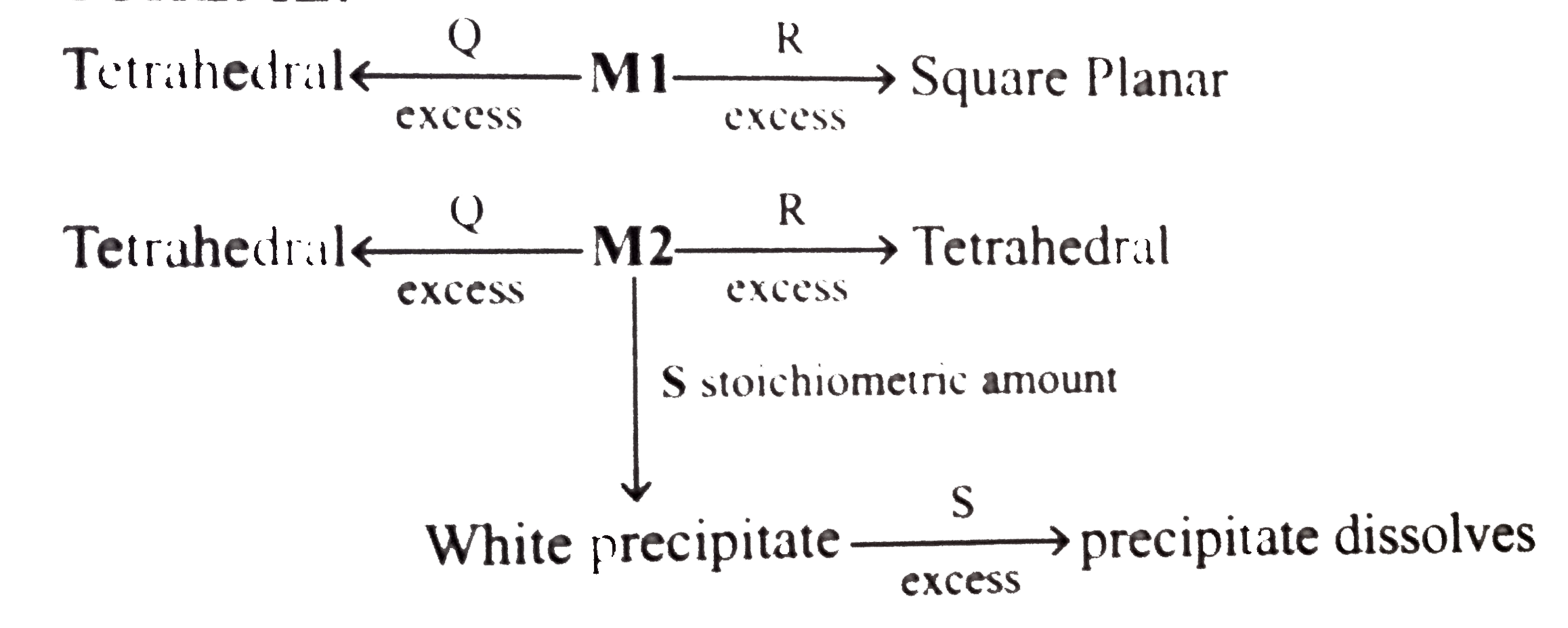
An aqueous solution of metal ion `MI` reacts separately with reagents `Q` and `R` in excess to give tetrahedral and square planar complexes, respectively An aqueous solution of another metal ion `M2` always forms tetrahedral complexs with theses reagents. Aqueous solution of `M2` on reaction with reagent `S` gives white precipitate which dissolves in excess of `S` The reactions are summarised in the scheme given below: SCHEME :

what is M1,Q and R

A

`Zn^(2),KCN` and `HCl`

B

`Ni^(2+),HCl` and `KCN`

C

`Cd^(2+)` , KCN and HCl

D

`Co^(2+)` , HCl and KCN

Text Solution

Verified by Experts

The correct Answer is:
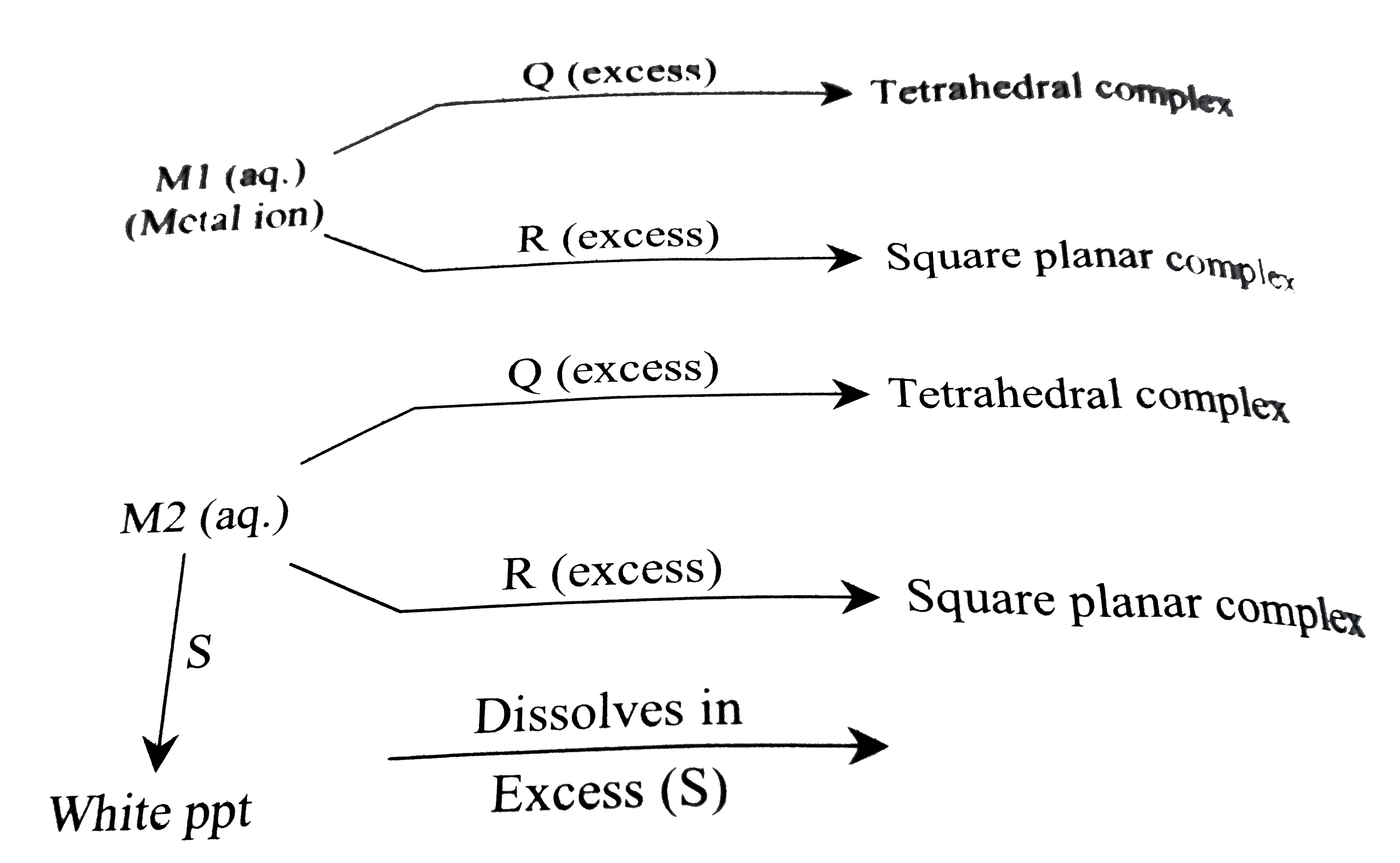
B


Reaction with (S) indicates amphoteric nature of M2. Amongst the options mentioned for (S) in Question, only KOH can give a complexing agent `OH^(-)` , which is its answer
[Note `:` M2 may be `Zn^(2+)`, which (a) is amphoteric (b) has coordination number 4 and (c ) always from tetrahedral complexes. It may be noted that `Be^(2+)` will also qualify with these charactersitics.]
Let us consider the possibility of M1. M1 should be able to form square planner complelx ( `dsp^(2)` hybridization ) as well as tetrahedral `( sp^(3))` . This rules out `Zn^(2+)` and `Cd^(2+)` `[ :' d^(10)` configuration will not allow `dsp^(2)` hybridization ]
`Ni^(2+) (aq.) +4CN^(-)("excess") hArr Ni(CN)_(4)^(2-) ("square planner")`
`Ni^(2+) (aq.) +Cl^(-) ("excess") hArr NiCl_(4)^(2-) ( "tetrahedral")`
[Note `:` `Co^(2+) +6CN^(-)("excess") rarr Co(CN)_(6)^(4-),` an octahedral complex ]
Promotional Banner

Similar Questions

Explore conceptually related problems

On addition of aqueous NaOH to a salt solution, a white gelatinous precipitate is formed, which dissolves in excess of alkali. The salt solution contains

If NaOH is added to an aqueous solution of Zn^(+2) ions white precipitate appears and on adding excess NaOH, the precipitate dissolves. In solution zinc is in the

