

Home
Class 11
PHYSICS
Two independent harmonic oscillators of ...

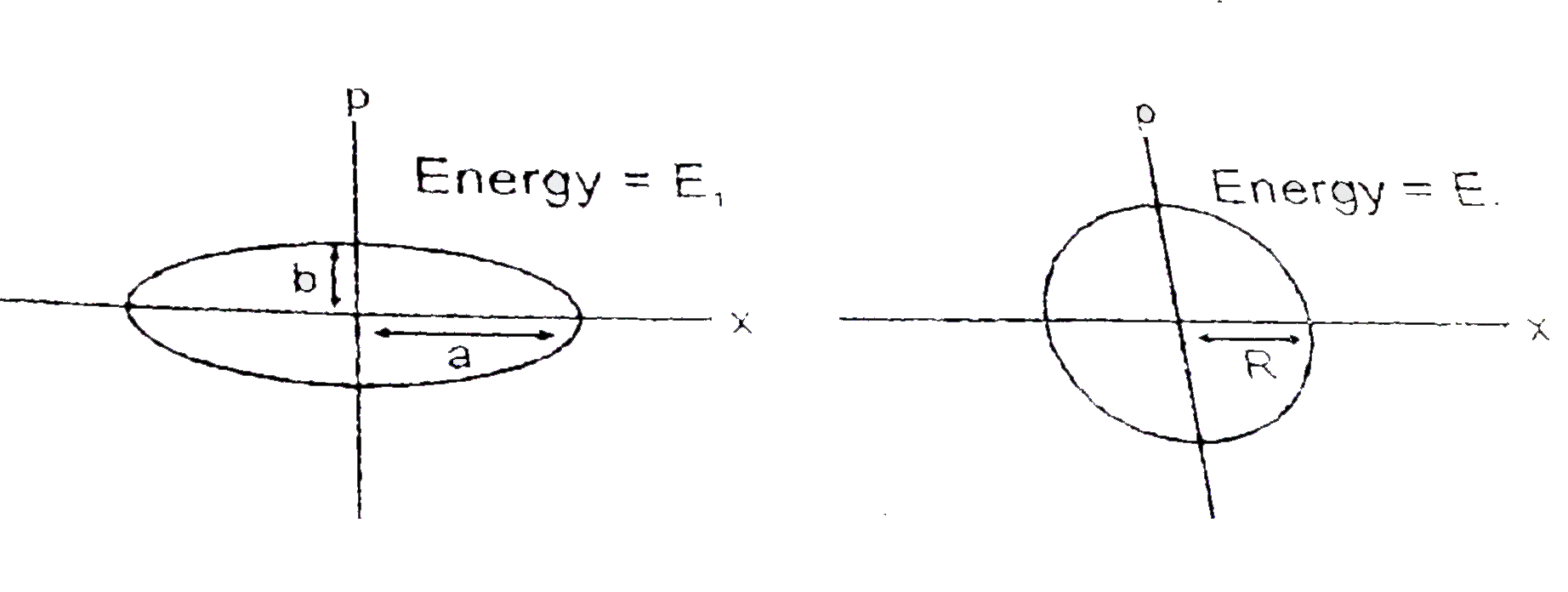
Two independent harmonic oscillators of equal mass are oscillating about the origin with angular frequencies `omega_(1)` and `omega_(2)` and have total energies `E_(1)` and `E_(2)` repsectively. The variations of their momenta `p` with positions `x` are shown in figures. If `(a)/(b) = n^(2)` and `(a)/(R) = n`, then the correc t equation(s) is (are) :

Promotional Banner

Similar Questions

Explore conceptually related problems

Two bodies of different masses m_(1) and m_(2) have equal momenta. Their kinetic energies E_(1) and E_(2) are in the ratio

In R-L-C series circuit, we have same current at angular frequencies omega_(1) and omega_(2) . The resonant frequency of circuit is

Two physical pendulums perform small oscillations about the same horizontal axis with frequencies omega_(1) and omega_(2) . Their moments of inertia relative to the given axis are equal to I_(1) and I_(2) respectively. In a state of stable equilibium the pendulums were fastened rigifly together. What will be the frequency of small oscillations of the compound pendulum ?

The forced harmonic oscillations have equal displacement amplitude at frequencies omega_(1)=400 s^(-1) and omega_(2)=600 s^(-1) . Find the resonance frequency at which the displacement amplitude is maximum.

Two discs A and B are in contact and rotating with angular velocity with angular velocities omega_(1) and omega_(2) respectively as shown. If there is no slipping between the discs, then

A particle performing SHM with angular frequency omega=5000 radian/second and amplitude A=2 cm and mass of 1 kg. Find the total energy of oscillation.

In the given figure, E=12V, R_(1)=3Omega, R_(2)=2Omega" and "r=1Omega . The choose the correct option/s

Two bodies with masses 1 kg and 2 kg have equal kinetic energies. If p_(1) and P_(2) are their repective momenta, then p_(1)//P_(2) is equal to :

A particle of mass m = 1 kg excutes SHM about mean position O with angular frequency omega = 1.0 rad//s and total energy 2J . x is positive if measured towards right from O . At t = 0 , particle is at O and movel towards right.