

Home
Class 11
PHYSICS
Two tunnels - T(1) " and " T(2) are dug...

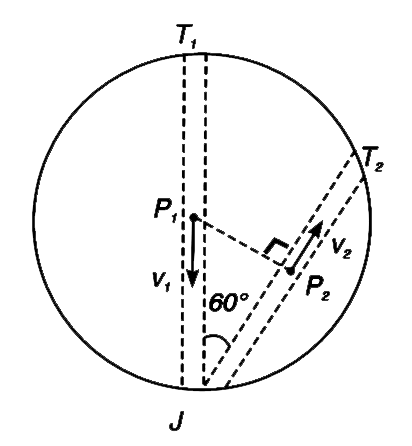
Two tunnels - `T_(1) " and " T_(2)` are dug across the earth as shown in figure. One end of the two tunnels have a common meeting point on the surface of the earth. Two particles `P_(1) " and " P_(2)` are oscillating from one end to the other end of the tunnels. At some instant particles are at mid point of their tunnels as shown in figure. Then -

(a) Write phase difference between the particle `P_(1) " and " P_(2)`. Can the two particles ever meet?
(b) Write the ratio of maximum velocity of particle `P_(1) " and " P_(2)`.

Promotional Banner

Similar Questions

Explore conceptually related problems

Two tunnels are dug across the earth as shown in figure. Two particles P_(1) and P_(2) are oscillating from one end to the other of tunnel T_(1) and T_(2) respectively. At some instant particles are at position shown in figure. Then

a narrow tunnel is dug along the diameter of the earth, and a particle of mass m_(0) is placed at R/2 distance from the centre. Find the escape speed of the particle from that place.

A tunnel has been dug through the centre of the earth and a ball is released in it. It will reach the other end of the tunnel after

Two smooth tunnels are dug from one side of earth's surface to the other side, one along a diameter are dropped from one end of each of the tunnels. Both time particles oscillate simple harmonically along the tunnels. Let T_(1) and T_(2) be the particle along the diameter and along the chord respectively. Then:

Suppose a tunnel is dug along a diameter of the earth. A particle is dropped from a point a distance h directly above the tunnel. The motion of the particle as seen from the earth is

A tunnel is dug along a diameter of the earth. Find the force on a particle of mass m placed in the tunnel at a distance x from the centre.

A particle starts from rest from point P and follow a path PQ on the three smooth surfaces as shown in figures. If time taken by the particle in three cases are t_(1), t_(2) and t_(3) then

A tunnel is dug through the centre of the earth. Shwo that a body of mass m when dropped form rest from one end of the tunnel will execute simple harmonic motion.

A tunnel ois dug along a chord of the earth a perpendicular distance R/2 from the earth's centre. The wall of the tunnel may be assumed to be frictionless. Find the force exerted by the eall on a particle of mass m when it is at a distance x from the centre of the tunnel.