

Home
Class 12
PHYSICS
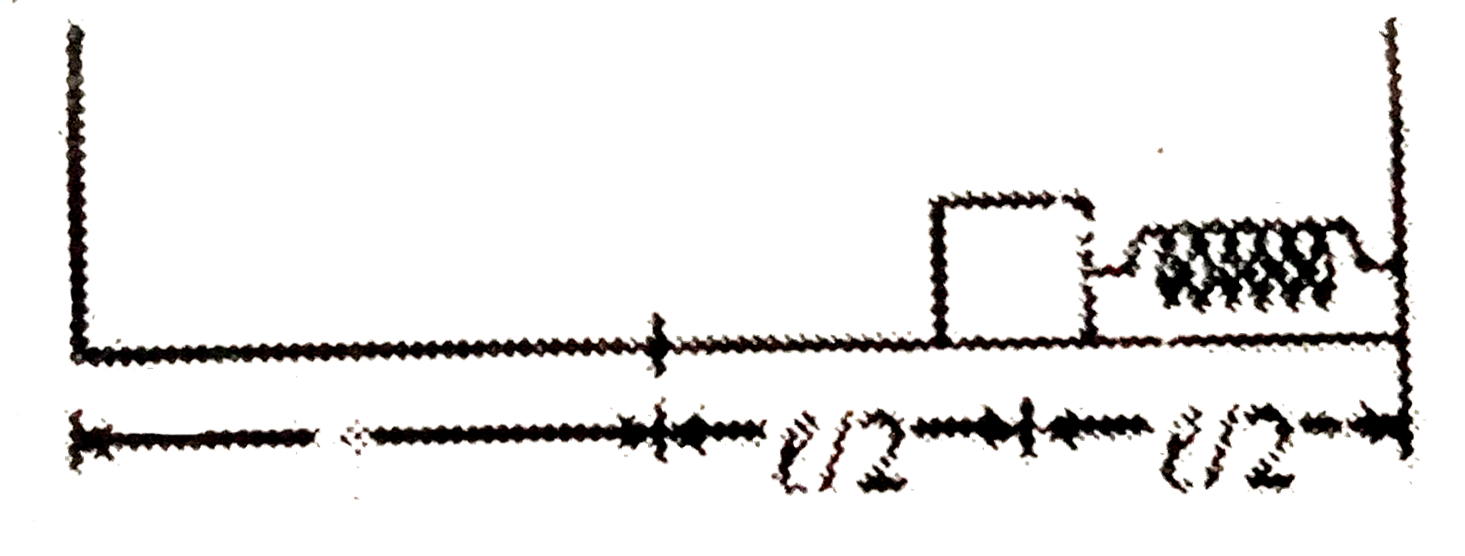
A block of mass m compresses a spring io...

A block of mass m compresses a spring iof stifffness k through a distacne `l//2` as shown in the figure .If the block is not fixed to the spring the period of motion of the block is

Promotional Banner

Similar Questions

Explore conceptually related problems

A block of mass m is at rest on an another block of same as shown in figure lower block is atteched to the spring than the maximum amplitude of motion as than both the block will remain as mat both the block will remain in contact is

A block of mass m moving at a speed v_0 compresses a spring of spring constant k as shown in the figure. Find (a) the maximum compression of spring and (b) speed of the block when the spring is compressed to half of maximum compression.

A block of mass m is attached to a cart of mass 4m through spring of spring constant k as shown in the figure. Friction is absent everywhere. The time period of oscillations of the system, when spring is compressed and then released, is

A block of mass m is released from rest onto a spring. A having stiffness k_A=mg//2h as shown in figure. If the block compresses spring B through a distance h, find the: a. stiffness of the spring B b. equilibrium position of the block c. maximum velocity of the block d. maximum acceleration of the block

A block of mass m is released from rest onto a spring. A having stiffness k_A=mg//2h as shown in figure. If the block compresses spring B through a distance h, find the: a. stiffness of the spring B b. equilibrium position of the block c. maximum velocity of the block d. maximum acceleration of the block

A block of mass m is released from rest onto a spring. A having stiffness k_A=mg//2h as shown in figure. If the block compresses spring B through a distance h, find the: a. stiffness of the spring B b. equilibrium position of the block c. maximum velocity of the block d. maximum acceleration of the block

A block of mass m, lying on a smooth horizontal surface, is attached to a spring (of negligible mass) of spring constant k. The other end of the spring is fixed, as shown in the figure. The block is initally at rest in its equilibrium position. If now the block is pulled withe a constant force F, the maximum speed of the block is :

A block of mass m, lying on a smooth horizontal surface, is attached to a spring (of negligible mass) of spring constant k. The other end of the spring is fixed, as shown in the figure. The block is initally at rest in its equilibrium position. If now the block is pulled withe a constant force F, the maximum speed of the block is :