

Home
Class 12
PHYSICS
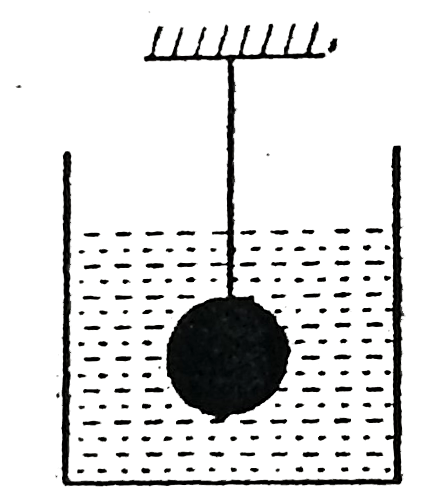
A solid sphere of mass m, suspended thro...

A solid sphere of mass m, suspended through a string in a liquid as shown. The string has some tension Magnitudes of net force due to liquid on upper hemisphere and that on lower hemisphere are `F_(A)` and `F_(B)` respectively. Which of the following is // are true.

Promotional Banner

Similar Questions

Explore conceptually related problems

A solid sphere of mass m , is suspended by means of a string in a liquid as shown.The string has some tension. Magnitudes of net force due to liquid on upper hemisphere and that on lower hemisphere are F_(A) and F_(B) respectively. Which of the following is/are true.

Two solid spheres of same size, of one iron and other of copper, are suspended by strings and submaerged in a beaker containing a certain liquid (the density of liquid is less than that of both iron and copper). If the density of copper is greater than that of iron, which of the following statements are true? (a) The upthrust on copper sphere is greater than that on the iron sphere. Upthrust is equal on both spheres. (c) Tension in the string supporting copper sphere is greater than that in the string supporting iron sphere. (d) Tension in both the strings is equal.

There are four forces acting at a point P produced by strings as shown in , which at rest . The forces F_(1) and F_(2) respectively:

Three particles A, B and C of mass m, m and 2m lie in a straight line as shown. The only force acting on these particles is due to the gravitational attraction towards each other. Let the magnitude of net force on them be F_(A), F_(B) and F_(C ) respectively. Then, F_(A):F_(B):F_(C ) is equal to :

Three particles A, B and C of mass m, m and 2m lie in a straight line as shown. The only force acting on these particles is due to the gravitational attraction towards each other. Let the magnitude of net force on them be F_(A), F_(B) and F_(C ) respectively. Then, F_(A):F_(B):F_(C ) is equal to :

Two blocks A and B of the same mass are joined by a light string and placed on a horizontal surface. An external horizontal force P acts on A. The tension in the string is T. The forces of static friction acting on A and B are F_(1) and F_(2) respectively. The limiting value of F_(1) and F_(2) is F_(0) . As P is gradually increased.

Two blocks A and B of the same mass are joined by a light string and placed on a horizontal surface. An external horizontal force P acts on A. The tension in the string is T. The forces of static friction acting on A and B are F_(1) and F_(2) respectively. The limiting value of F_(1) and F_(2) is F_(0) . As P is gradually increased.

When a solid moves through a liquid, the liquid opposes the motion with a force F. The magnitude of F depends on the coefficient of viscosity eta of the liquid, the radius r of the sphere and the speed v of the sphere. Assuming that F is proportional to different powers of these quantities, guess a formula for F using the method of dimension.

A uniform solid sphere of mass M and radius R is rotating with respect to its diameter, with a constant angular velocity omega in free space (i.e., there is no one to exert any force on sphere). Consider an hemispherical part of the sphere (such that axis of rotation lies in the place dividing the sphere in two hemisphere). Net force on this hemisphere due to another hemisphere is (nMomega^(2)R)/(16) . Here n is an integer. Find n

A uniform solid sphere of mass M and radius R is rotating with respect to its diameter, with a constant angular velocity omega in free space (i.e., there is no one to exert any force on sphere). Consider an hemispherical part of the sphere (such that axis of rotation lies in the place dividing the sphere in two hemisphere). Net force on this hemisphere due to another hemisphere is (nMomega^(2)R)/(16) . Here n is an integer. Find n