

Home
Class 12
PHYSICS
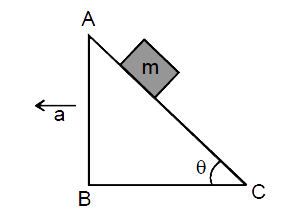
A block of mass m resting on a wedge of ...

A block of mass m resting on a wedge of angle `theta` as shown in the figure. The wedge is given an acceleration a. What is the minimum value of a so that the mass m falls freely ?

Promotional Banner

Similar Questions

Explore conceptually related problems

A block of mass m is placed on a smooth inclined wedge ABC of inclination theta as shown in the figure. The wedge is given an acceleration a towards the right. The relation between a and theta for the block to remain stationary on the wedge is.

A block of mass m is placed on a smooth inclined wedge ABC of inclination theta as shown in the figure. The wedge is given an acceleration a towards the right. The relation between a and theta for the block to remain stationary on the wedge is

A block of mass m is placed on a smooth inclined wedge ABC of inclination theta as shown in the figure. The wedge is given an acceleration 'a' towards the right. The relation between a and theta for the block to remain stationary on the wedge is

A block of mass m is placed on a smooth inclined wedge ABC of inclination theta as shown in the figure. The wedge is given an acceleration a towards the right. The relation between a and theta for the block to remain stationary on the wedge is.

A block of mass m is place on a sm ooth inclined wedge ABC of inclination 0 as shown in figure. The wedge is given an acceleration ‘a’ towards the right. The relation between a and theta for the block to rem ain stationary on the wedge is

A small block of mass m rests on a smooth wedge of angle theta . With what horizontal accelaration a should the wedge be pulled, as shown in fig, so that the block falls freely?

A small block of mass m rests on a smooth wedge of angle theta . With what horizontal accelaration a should the wedge be pulled, as shown in fig, so that the block falls freely?

A small block of mass m rests on a smooth wedge of angle theta . With what horizontal accelaration a should the wedge be pulled, as shown in fig, so that the block falls freely?

A block of mass m is placed on a wedge of mass M. Coefficient between then is mu lt cot theta . The wedge is given an acceleration to its left. Find the maximum acceleration at which block apears stationary relative to wedge.