

Home
Class 11
CHEMISTRY
A bulb of constant volume is attached to...

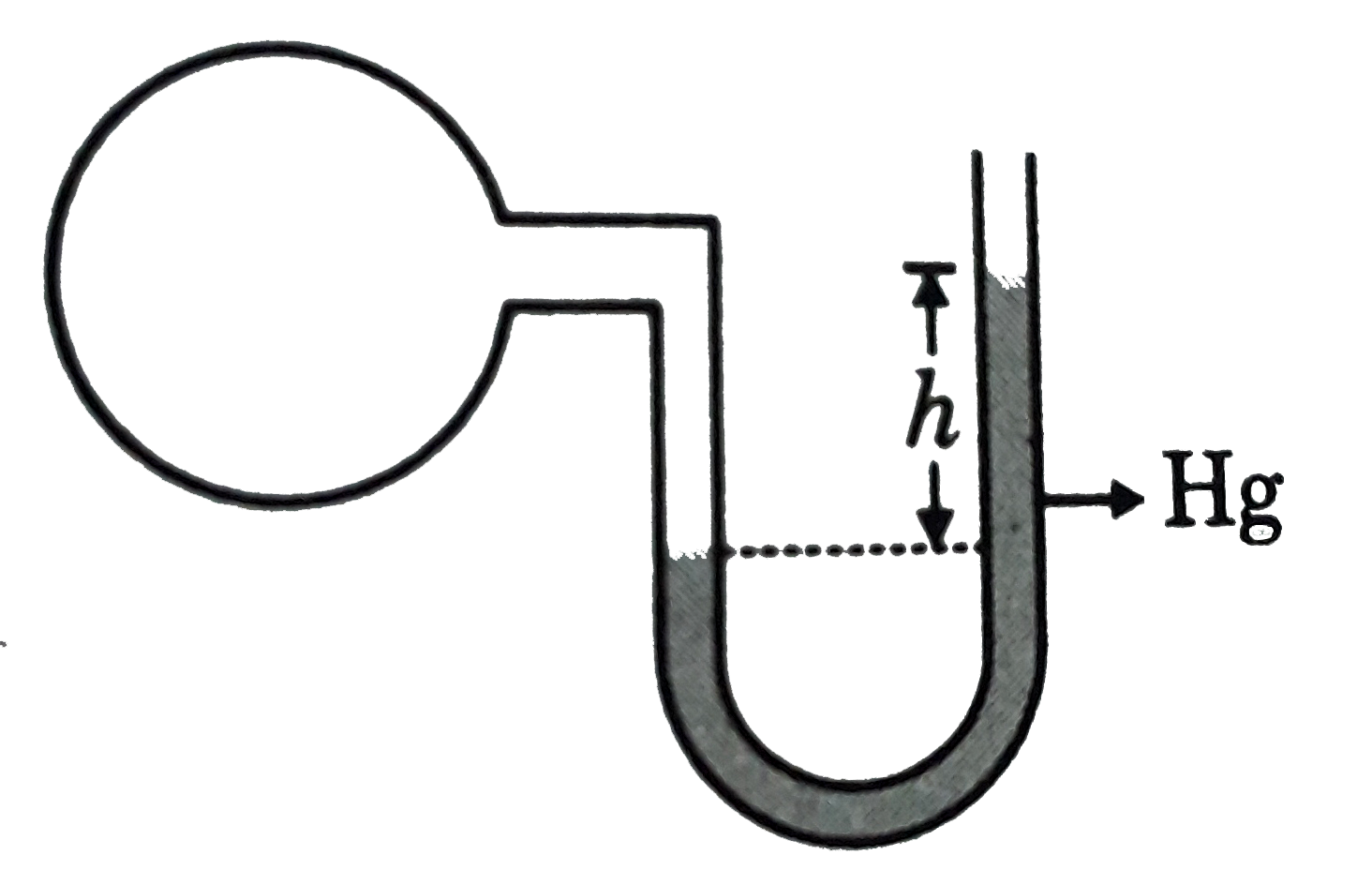
A bulb of constant volume is attached to a very thin manometer tube as shown in figure. Gas starts leaking through a small hole in the bulb causing change in pressure as :
`(dp)/(dt)=-kP^(2)`

When `k` is constant and `P is pressure at any instant
Initial height difference 'h' was 76 cm and after 10 mm 'h' was 38 cm.

Promotional Banner

Similar Questions

Explore conceptually related problems

A bulb of constant volume is attached to a manometer tube open at other end as shown in figure. The manometer is filled with a liquid of density (1//3)^("rd") that of mercury. Initially h was 228 cm. Through a small hole in the bulb gas leaked assuming pressure decreases as (dP)/(dt)=-kp. If value of h is 114 cm after 14 minutes, what is the value of k (in "hour"^(-1) )? [ Use : In (4/3) =0.28 and density of Hg =13.6 g/mL.].

A bulb of constant volume is attached to a manometer tube open at other end as shown in figure. The manometer is filled with a liquid of density (1//3)^("rd") that of mercury. Initially h was 228 cm. Through a small hole in the bulb gas leaked assuming pressure decreases as (dP)/(dt)=-kp. If value of h is 114 cm after 14 minutes, what is the value of k (in "hour"^(-1) )? [ Use : In (4/3) =0.28 and density of Hg =13.6 g/mL.].

A manometer reads the pressure of a gas in an enclosure as shown in figure (a) When a pump removes some of the gas , the manometer reads as in figure (b). The liquid used in the manometers is mercury and the atmospheric pressure is 76 cm of mercury. (a) Give the absolute and gauge pressure of the gas in the enclosure for cases (a) and (b) , in units of cm of mercury. (b) How would the levels change in case (b) if 13.6 cm of water (immiscible with mercury) are poured into the right limb of the manometer ? (Ignore the small change in the volume of the gas).

The heights of mercury surfaces in the tow arms of the manometer shown in figure are 2 cm and 8cm. Atmospheric pressure =1.01xx10^5Nm^-2 . Find a. the pressure of the gas in the cylinder and b. the pressure of mercury at the bottom of the U tube.

The heights of mercury surfaces in the two arms of the manometer shown in figure are 2 cm and 8cm. Atmospheric pressure =1.01xx10^5Nm^-2 . Find (a). the pressure of the gas in the cylinder and (b). the pressure of mercury at the bottom of the U tube.

The heights of mercury surfaces in the tow arms of the manometer shown in figure are 2 cm and 8cm. Atmospheric pressure =1.01xx10^5Nm^-2 . Find a) the pressure of the gas in the cylinder b) the pressure of mercury at the bottom of the U tube.

The heights of mercury surfaces in the two arms of the manometer shown in figure are 2 cm and 8cm. Atmospheric pressure =1.01xx10^5Nm^-2 . Find (a). the pressure of the gas in the cylinder and (b). the pressure of mercury at the bottom of the U tube.

The figure shows a crude type of perfume atomizer. When bulb at A is compressed, air flows swifty through the tiny BC with uniform speed v , there by causing a reduced pressure at the position of verticall tube DE . The liquid of density 500kg//m^(3) , then rises in the tube, enters tube BC and sprayed out. When bulb is in natural position the air in the bulb and tube are at atmospheric pressure P_(0=15)^(5)N//m^(2) . When bulb A is compressed, it creates an exces pressure Deltap=0.001P_(0) inside the bulb A . Density of air is 1.3 kg//m^(3) . If the magnitude of minimum value of speed v required to cause the liquid to rise to tube BC is 5km//s . Find the value of k . ( g=10m//s^(2) )

The figure shows a crude type of perfume atomizer. When bulb at A is compressed, air flows swifty through the tiny BC with uniform speed v , there by causing a reduced pressure at the position of verticall tube DE . The liquid of density 500kg//m^(3) , then rises in the tube, enters tube BC and sprayed out. When bulb is in natural position the air in the bulb and tube are at atmospheric pressure P_(0=15)^(5)N//m^(2) . When bulb A is compressed, it creates an exces pressure Deltap=0.001P_(0) inside the bulb A . Density of air is 1.3 kg//m^(3) . If the magnitude of minimum value of speed v required to cause the liquid to rise to tube BC is 5km//s . Find the value of k . ( g=10m//s^(2) )

Water flows through a tube shown in figure. The areas of cross section at A and B are 1cm^2 and 0.5 cm^2 respectively. The height difference between A and B is 5m. If the speed of water at A is 10 cms^-1 find a the speed at B and b the difference in pressures at A and B.