

Home
Class 11
CHEMISTRY
The figure given below shows three glass...

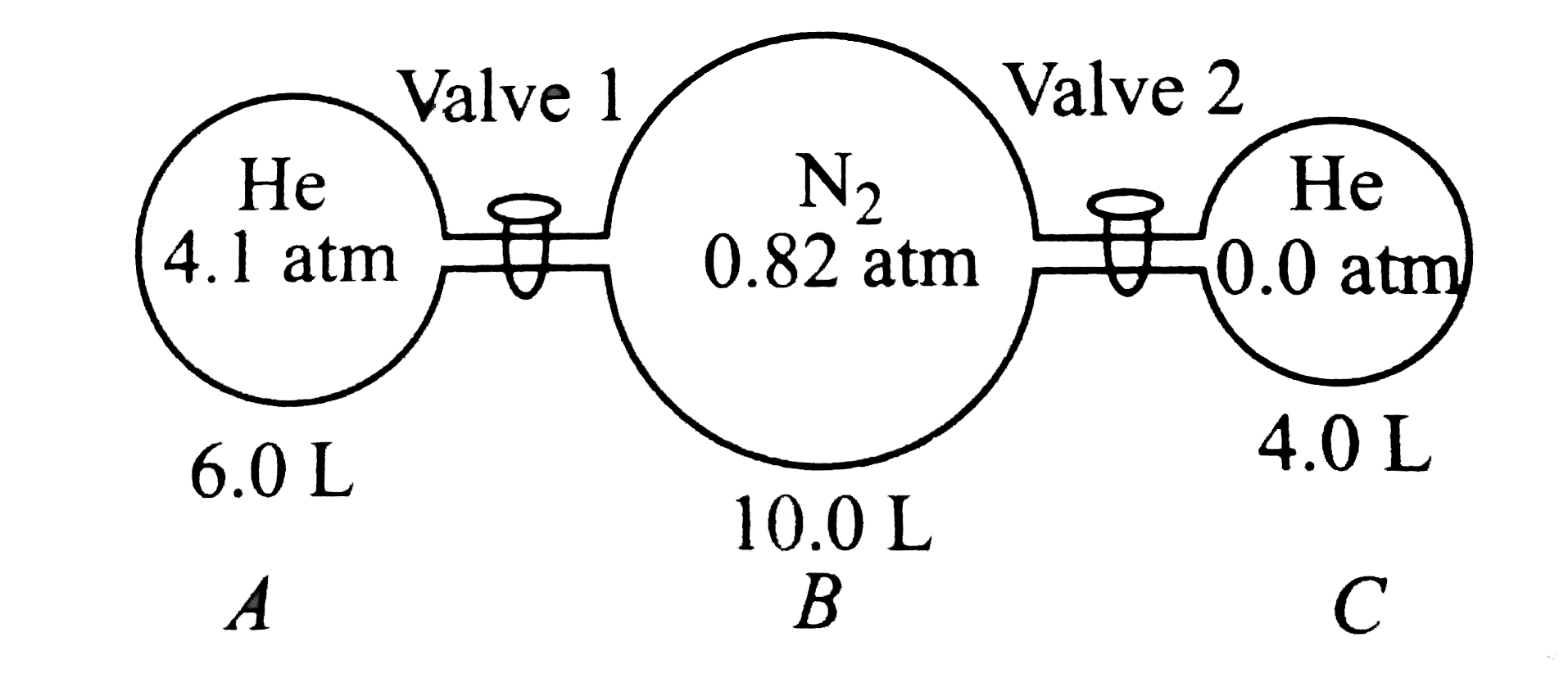
The figure given below shows three glass chambers that are connected by valves of negligible volume. At the outset of an experiment, the valves are closed and the chambers contain the gases as detailed in the diagram. All the chambers are at the temperature of `300 K` and external pressure of `1.0 atm`.

What is the total pressure in chamber `B` after valve `1` is opened?

Promotional Banner

Similar Questions

Explore conceptually related problems

The figure given below shows three glass chambers that are connected by valves of negligible volume. At the outset of an experiment, the valves are closed and the chambers contain the gases as detailed in the diagram. All the chambers are at the temperature of 300 K and external pressure of 1.0 atm . What will be the work done by N_(2) gas when valve 2 is opened and value 1 remains closed?

The figure given below shows three glass chambers that are connected by valves of negligible volume. At the outset of an experiment, the valves are closed and the chambers contain the gases as detailed in the diagram. All the chambers are at the temperature of 300 K and external pressure of 1.0 atm . Which of the following represents the total kinetic energy of all the gas molecules after both valves are opened? ( R=0.082 atm L K^(-1) mol^(-1)=8.314 JK^(_1)mol^(-1) )

The figure given below shows three glass chambers that are connected by valves of negligible volume. At the outset of an experiment, the valves are closed and the chambers contain the gases as detailed in the diagram. All the chambers are at the temperature of 300 K and external pressure of 1.0 atm . Which of the following represents the total kinetic energy of all the gas molecules after both valves are opened? ( R=0.082 atm L K^(-1) mol^(-1)=8.314 JK^(_1)mol^(-1) )

A given amount of gas A is confined in a chamber of constant volume. When the chamber is immersed in a bath of melting ice, the pressure of the gas is 100 cm Hg. What is the temperature when the pressure is 10 cm Hg ?

Three closed rigid vessels, A, B and C, which initially contain three different gases at different temperatures are connected by tube of negligible volume, without any energy transfer with surroundings. The vessel A contain 2 mole Ne gas, at 300 K, vessel 'B' contain 2 mole SO_(2) gas at 400 K and vessel 'C' contain 3 mole CO_(2) gas at temperature 500 K. What is the final pressure (in atm) attained by gases when all valves of connecting three vessels are opened and additional 15.6 kcal hear supplied to vessels through valve. The volume of A, B and C vessel is 2, 2 and 3 litre respectively Given :R =2 calorie/mol-K, C_(v)(Ne)=3//2R,C_(v)(CO)=5//2R and C_(v)(SO_(2))=3R

Three closed rigid vessels, A, B and C, which initially contain three different gases at different temperatures are connected by tube of negligible volume, without any energy transfer with surroundings. The vessel A contain 2 mole Ne gas, at 300 K, vessel 'B' contain 2 mole SO_(2) gas at 400 K and vessel 'C' contain 3 mole CO_(2) gas at temperature 500 K. What is the final pressure (in atm) attained by gases when all valves of connecting three vessels are opened and additional 15.6 kcal hear supplied to vessels through valve. The volume of A, B and C vessel is 2, 2 and 3 litre respectively Given :R =2 calorie/mol-K, C_(v)(Ne)=3//2R,C_(v)(CO)=5//2R and C_(v)(SO_(2))=3R