

Home
Class 12
PHYSICS
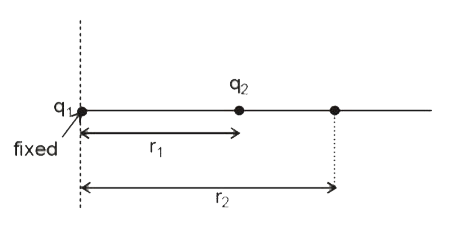
If charge q1 is fixed and q2 is free to ...

If charge q1 is fixed and q2 is free to move then find out the velocity of q2 when it reaches distance r2 after it is release from a distance of `r_(1)` from `q_(1)` as shown in figure Assume friction is absent).

Find v of `q_(2)` when it reaches stance r2 after it is released from rest.

Promotional Banner

Similar Questions

Explore conceptually related problems

q charge is projected towards a charge Q (fixed) . With the velocity v for the minimum distance r. What is the distance if the velocity of projection be 2V?

A point charge of charge -q and mass m is released with negligible speed from a distance sqrt(3) R on the axis of a fixed uniformly charged ring of charge Q and radius R. Find out its velocity when it reaches it reaches at the centre of the ring.

A point charge of charge -q and mass m is released with negligible speed from a distance sqrt(3) R on the axis of a fixed uniformly charged ring of charge Q and radius R. Find out its velocity when it reaches it reaches at the centre of the ring.

Two charge Q_1 and Q_2 are placed in xy plane at a distance x_1 and x_2 from origin a shown in figure. if electric field at O is same for both charge then find ratio Q_1 and Q_2 .

Two charge Q_1 and Q_2 are placed in xy plane at a distance x_1 and x_2 from origin a shown in figure. if electric field at O is same for both charge then find ratio Q_1 and Q_2 .

Charge q_(1) is fixed and another point charge q_(2) is placed at a distance r_(0) from q_(1) on a frictionless horizontal surface. Find the velocity of q_(2) as a function of seperation r between them (treat as point charges and mass of q_(2) is m)

Charge q_(1) is fixed and another point charge q_(2) is placed at a distance r_(0) form q_(1) on a frictionless horizontal surface.Find the velocity of q_(2) as a function of seperation r between them (treat the changes as point charges and mass of q_(2) is m)

A charge particle q is released at a distance R_(@) from the infinite long wire of linear charge density lambda . Then velocity will be proportional to (At distance R from the wire)

A charge particle q is released at a distance R_(@) from the infinite long wire of linear charge density lambda . Then velocity will be proportional to (At distance R from the wire)