

Home
Class 12
PHYSICS
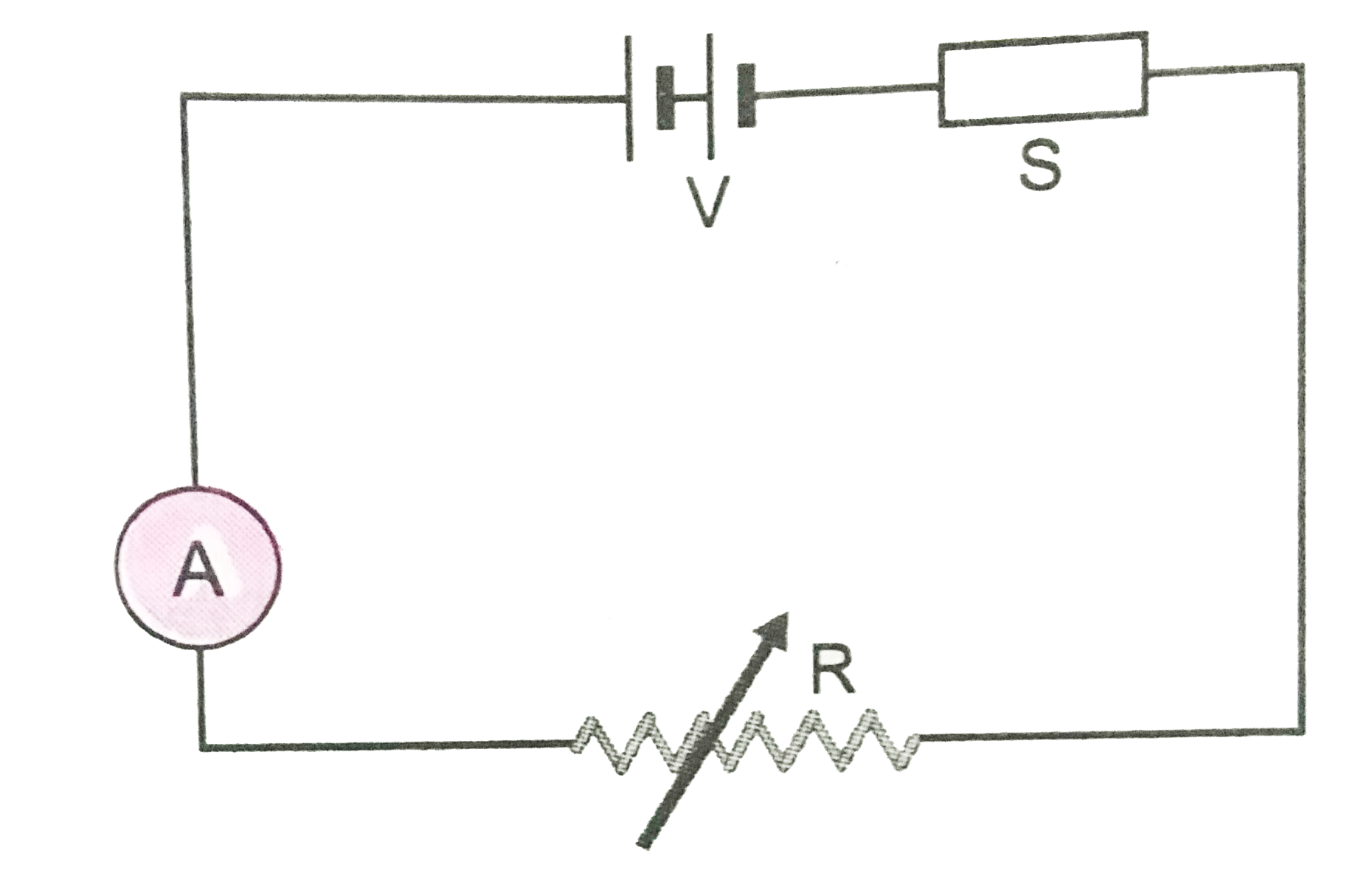
The diagram Fig.12 shown a piece of pure...

The diagram Fig.12 shown a piece of pure semiconductor S in series with a variable resistor R, and a source of constant voltage V. Would you increase or decrease the value of R to keep the reading of ammeter constant, when semi-conductor S is heated? Give reason.

Promotional Banner

Similar Questions

Explore conceptually related problems

The diagram shows a piece of pure semiconductor S, in series with a varaible resistor R and a source of constant voltage V. Would you increase or decrease the value of R to keep the reading of ammeter (A) constant, when semiconductor S is heated? Give reason.

Figure shows a piece of semiconductor (pure one) S in series with a variable resistor R and a source of constant voltage V. S is heated and the current is kept constant by adjustment R . Which of the following factors will decrease during this process? (1) The drift velocity of the conduction electrons in S . (2) The DC resistance of S (3) The number of conduction electrons in S . which of the following is correct?

A 6 V, 12 W lamp is connected in series with a resistor R and a source of voltage 12 V. Calculate the value of the resistor R, for the proper working of the lamp.

A constant voltage V_(0) is applied to a potentiometer of resistance R connected to an ammeter. A constant resistor r is connected to the sliding contact of the potentiometer and the fixed end of the potentiometer. If the reading of ammeter vary as the sliding contact is moved from one end of the potentiometer to the other. The resistance of ammeter is assumed to be negligible. Find the minimum reading of the Ammeter.

The time constant of an inductor is tau_(1) . When a pure resistor of R Omega is connected in series with it, the time constant is found to decrease to tau_(2) . The internal resistance of the inductor is

A constant voltage V_0 is applied to a potentiometer of resistance R connected to an ammeter. A constant resistor r is connected to the sliding contact of the potentiometer and the fixed end of the potentiometer. How will the reading of ammeter vary as the sliding contact is moved from one end of the potentiometer to the other ? The resistance of ammeter is assumed to be negligible.

A voltmeter is connected in parallel with a variable resistance R which is in series with an ammeter and a cell as shown in the figure . For one value of R=2Ω,the reading are 0.25A and 1.0 V. What is the internal resistance of the cell ?