

Home
Class 12
PHYSICS
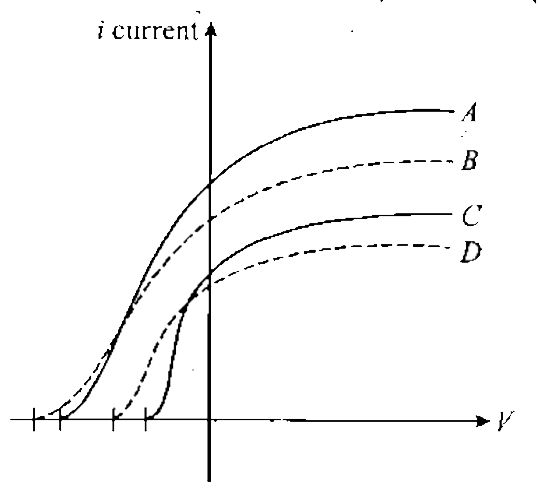
Thefigure shows the results of an experi...

Thefigure shows the results of an experiment involving photoelectric effect. The graphs A, B,C and D relate to a light beam having different wavelengths. Select the correct alternative.

Promotional Banner

Similar Questions

Explore conceptually related problems

The figure shows the results of an experiment involving photoelectric effect. The graphs A, B,C and D relate to a light beam having different wavelengths. Select the correct alternative.

The figure shows the results of an experiment involving photoelectric effect. The graphs A, B,C and D relate to a light beam having different wavelengths. Select the correct alternative.

Figure shows a results of an experiment inolving photoelectric effect. The graph A,B,C,D are related to light beams having differents wavelength. Choose incorrect option:

Pick the odd one out Figure shows results of an experiment involving photoelectric effect.

For photoelectric effect with incident photon wavelength lamda , the stopping potential is V_0 Select the correct graph.

In an experiment on photoelectric effect, the stopping potential is measured for monochromatic light beams corresponding to different wavelength. The data collected are as follows: wavelength (nm): 350 400 450 500 550 stopping potential (V): 1.45 1.00 0.66 0.38 0.16 Plot the stopping potential against inverse of wavelength on a graph paper and find (a) the Planck constant, (b) the work function of the emitter and (c) the threshold wavelength .

In an experiment on photoelectric effect, the stopping potential is measured for monochromatic light beams corresponding to different wavelength. The data collected are as follows: wavelength (nm): 350 400 450 500 550 stopping potential (V): 1.45 1.00 0.66 0.38 0.16 Plot the stopping potential against inverse of wavelength on a graph paper and find (a) the Planck constant, (b) the work function of the emitter and (c) the threshold wavelength .

In an experiment on photoelectric effect, the stopping potential is measured for monochromatic light beams corresponding to different wavelength. The data collected are as follows: wavelength (nm): 350 400 450 500 550 stopping potential (V): 1.45 1.00 0.66 0.38 0.16 Plot the stopping potential against inverse of wavelength on a graph paper and find (a) the Planck constant, (b) the work function of the emitter and (c) the threshold wavelength .