

Home
Class 11
PHYSICS
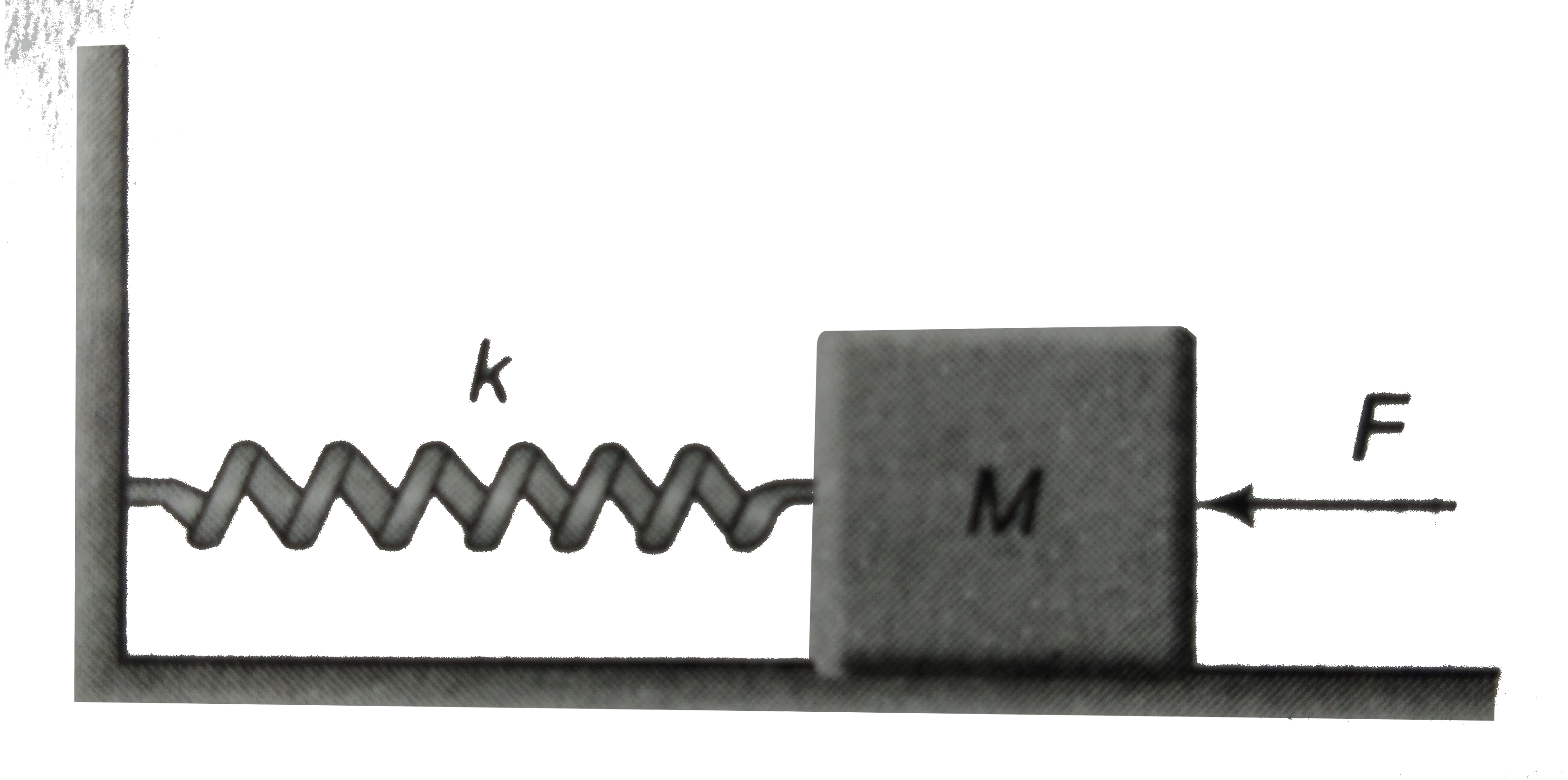
In figure, k = 100 N//m, M = 1kg and F =...

In figure, `k = 100 N//m, M = 1kg` and `F = 10 N`

(a) Find the compression of the spring in the equilibrium position
(b) A sharp blow by some external agent imparts a speed of `2 m//s` to the block towards left. Find the sum of the potential energy of the spring and the kinetic energy of the block at this instant.
(c) Find the time period of the resulting simple harmonic motion.
(d) Find the amplitude.
(e) Write the potential energy of the spring when the block is at the left estreme.
(f) Write the potential energy of the spring when the block is at the right extreme.
The answers of (b), (e) and (f) are different. Explain why this does not violate the principle of conservation of energy ?

Promotional Banner

Similar Questions

Explore conceptually related problems

The spring shown in figure is unstretched when a man starts pulling on the cord. The mass of the block is M . If the man exerts a constant force F , find (a) the amplitude and the time period of the motion of the block, (b) the energy stored in the spring when the block passes through the equilibrium position and (c) the kinetic energy of the block at this position.

The spring shown in figure is unstretched when a man starts pulling on the cord. The mass of the block is M . If the man exerts a constant force F , find (a) the amplitude and the time period of the motion of the block, (b) the energy stored in the spring when the block passes through the equilibrium position and (c) the kinetic energy of the block at this position.

The spring shown in figure is unstretched when a man starts pulling on the cord. The mass of the block is M . If the man exerts a constant force F , find (a) the amplitude and the time period of the motion of the block, (b) the energy stored in the spring when the block passes through the equilibrium position and (c) the kinetic energy of the block at this position.

The spring shown in figure is unstretched when a man starts pulling on the cord. The mass of the block is M . If the man exerts a constant force F , find (a) the amplitude and the time period of the motion of the block, (b) the energy stored in the spring when the block passes through the equilibrium position and (c) the kinetic energy of the block at this position.

Each of the blocks shown in figure has mass 1 kg. The rear block moves with a speed of 2 m/s towards the front block kept at rest. The spring attached to the front block islight and has a spring constant 50 N/m. find the maximum compression of the spring.

Each of the blocks shown in figure has mass 1 kg. The rear block moves with a speed of 2 m/s towards the front block kept at rest. The spring attached to the front block islight and has a spring constant 50 N/m. find the maximum compression of the spring.

The block shown in figure is released from rest. Find out the speed of the block when the spring is compressed by 1 m

In figure shown if 2 kg block is moving at an acceleration 2 m//s^(2) , find the elongationin spring and acceleration of 4 kg block at this instant. Take g= 10m//s^(2) .