Home
Class 12
PHYSICS
A particle starts from rest, accelerates...

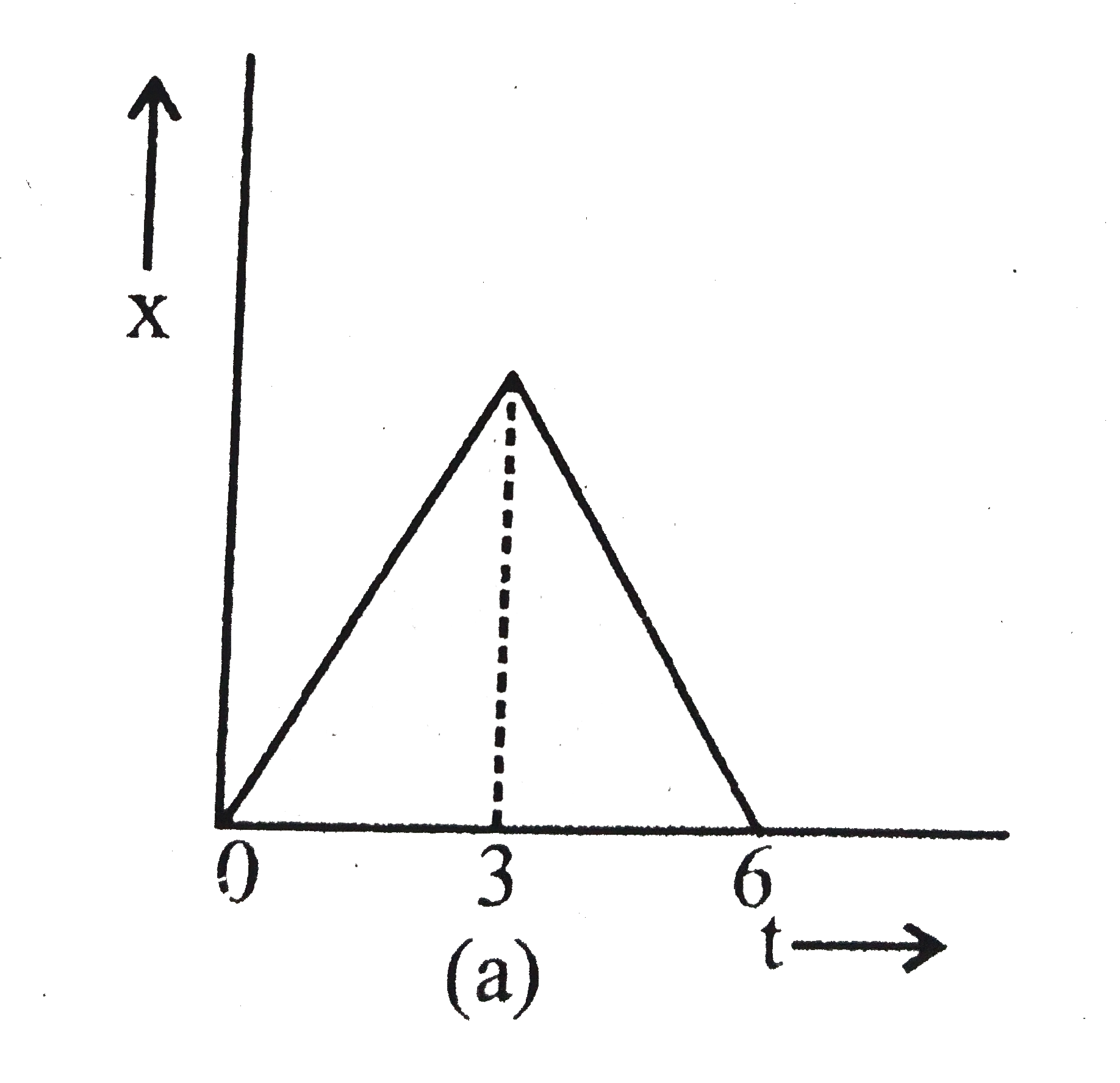
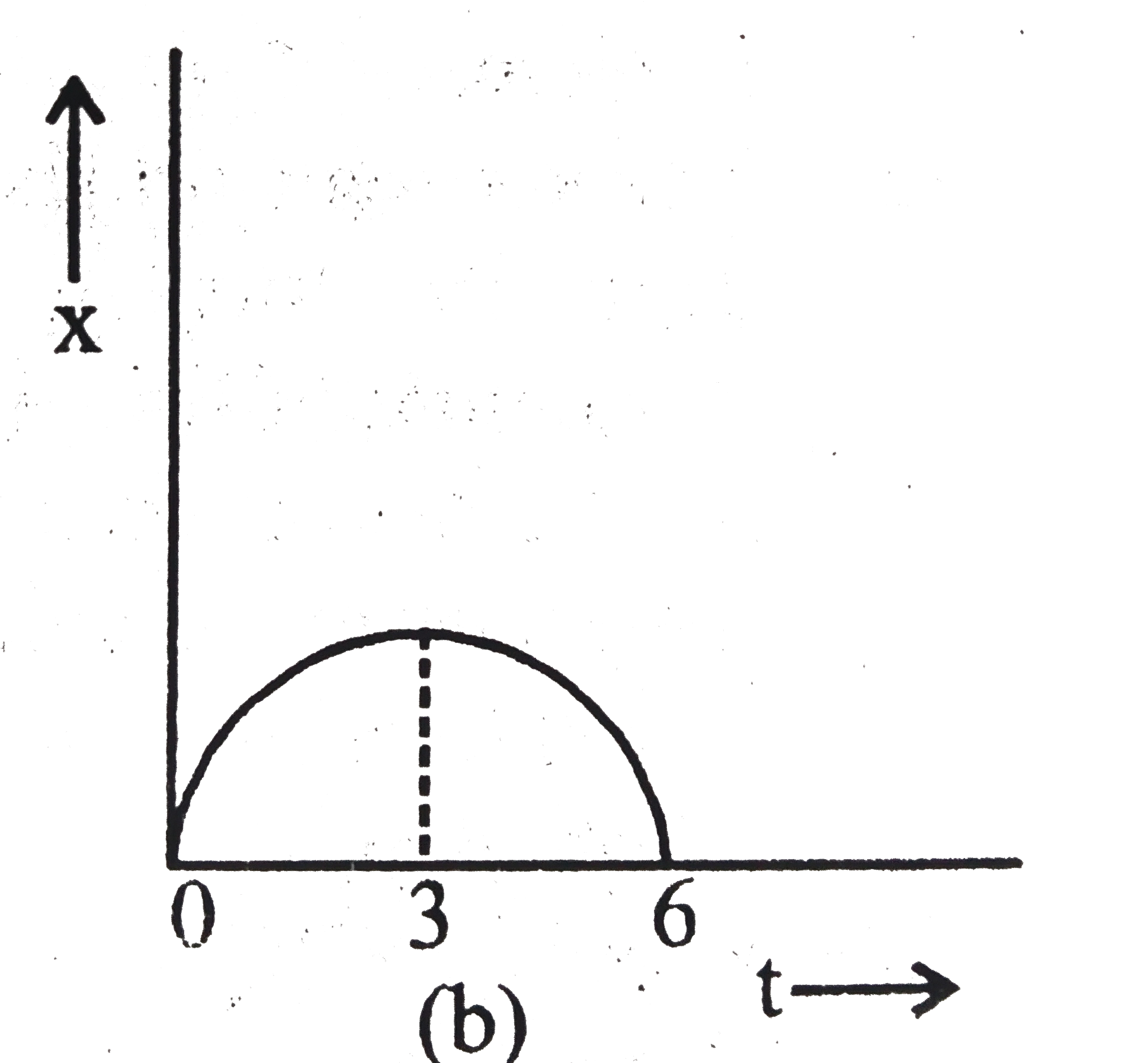
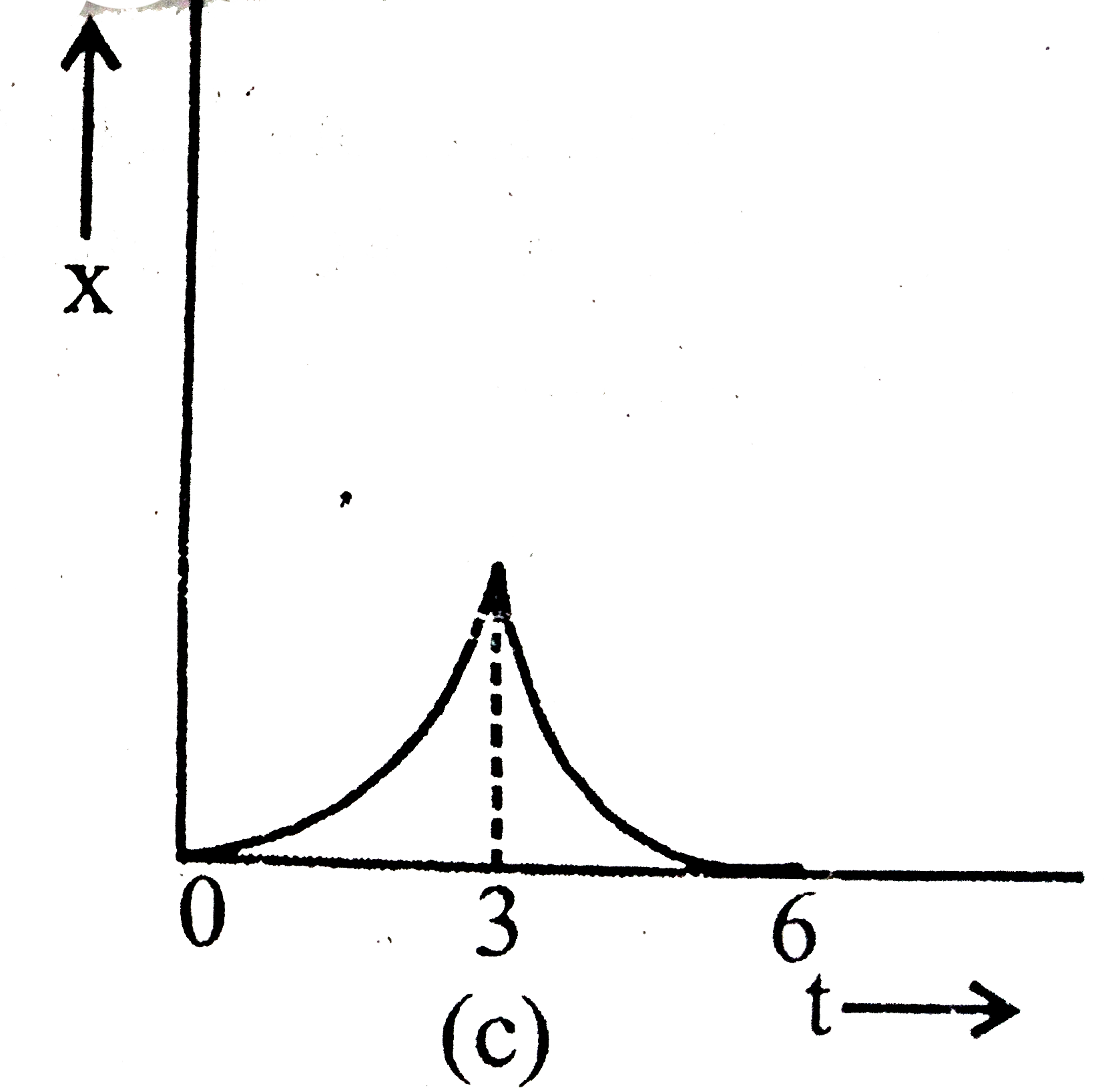
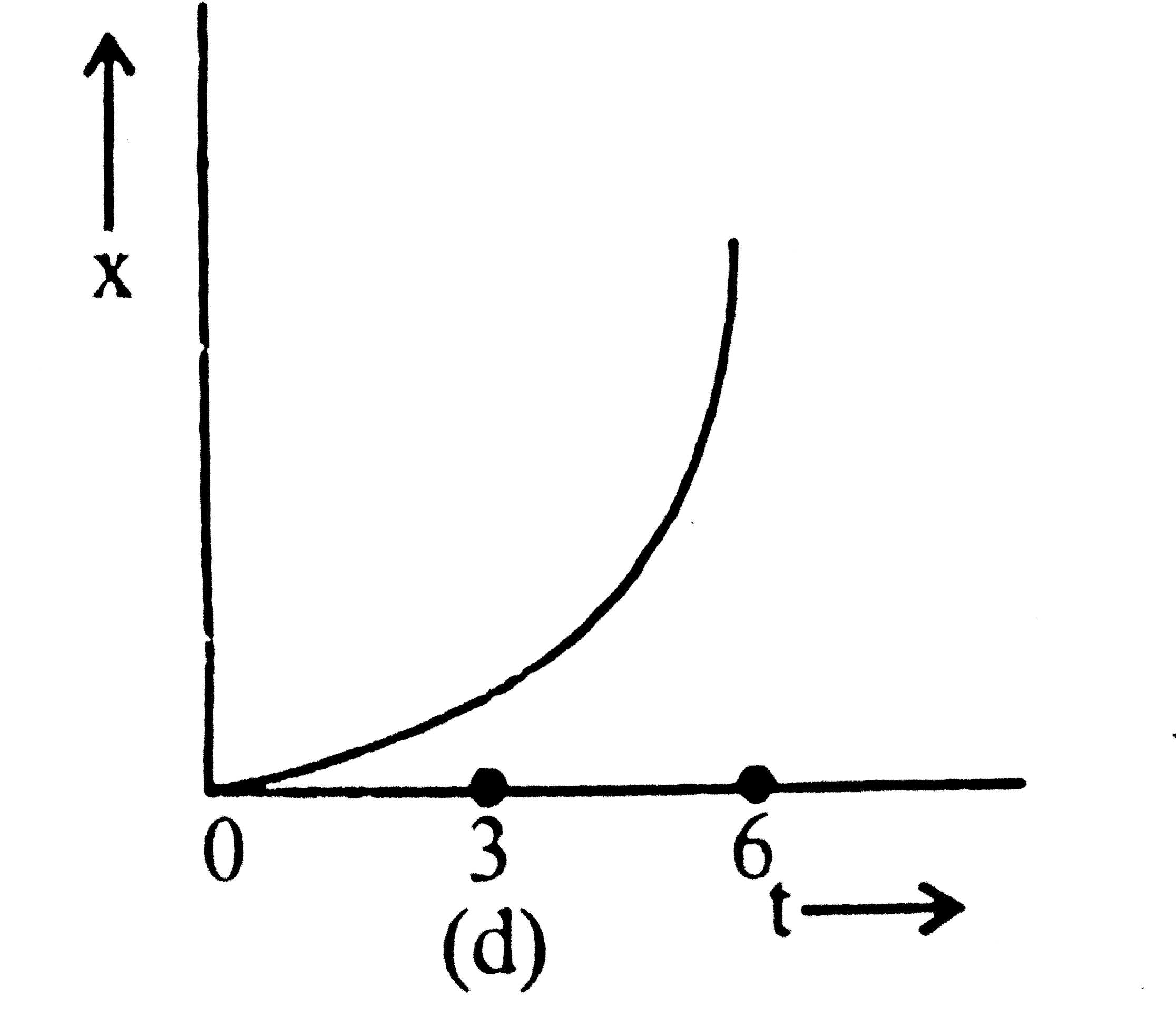
A particle starts from rest, accelerates uniformly for 3 seconds and then decelerates uniformly for 3 seconds and comes to rest. Which one of the following displacement (x)-time (t) graphs represents the motion of the particle?

A

B

C

D

Text Solution

AI Generated Solution

The correct Answer is:

To solve the problem, we need to analyze the motion of the particle step by step. ### Step 1: Understanding the Motion The particle starts from rest, accelerates uniformly for 3 seconds, and then decelerates uniformly for another 3 seconds until it comes to rest. ### Step 2: Acceleration Phase During the first 3 seconds, the particle accelerates from rest. - Initial velocity (u) = 0 m/s - Time (t) = 3 seconds - Since the particle accelerates uniformly, we can use the equations of motion. - The displacement (s) during this phase can be calculated using the formula: \[ s = ut + \frac{1}{2} a t^2 \] Here, \(u = 0\), so: \[ s = 0 + \frac{1}{2} a (3)^2 = \frac{9a}{2} \] - The final velocity (v) at the end of this phase can be calculated using: \[ v = u + at = 0 + 3a = 3a \] ### Step 3: Deceleration Phase In the next 3 seconds, the particle decelerates uniformly to come to rest. - Initial velocity (u) = 3a (from the end of the first phase) - Final velocity (v) = 0 m/s - Time (t) = 3 seconds - The deceleration (a') can be calculated using: \[ v = u + a't \implies 0 = 3a + a' (3) \implies a' = -a \] - The displacement (s') during this phase can be calculated as: \[ s' = ut + \frac{1}{2} a' t^2 = 3a(3) + \frac{1}{2} (-a)(3^2) = 9a - \frac{9a}{2} = \frac{9a}{2} \] ### Step 4: Total Displacement The total displacement during the entire motion is: \[ s_{total} = s + s' = \frac{9a}{2} + \frac{9a}{2} = 9a \] The particle starts from rest, accelerates for 3 seconds, reaches a maximum displacement, and then decelerates for another 3 seconds, returning to rest. ### Step 5: Graph Analysis Now, we need to analyze the displacement-time (x-t) graph: - For the first 3 seconds, the graph will be a curve that increases (since the particle is accelerating). - For the next 3 seconds, the graph will be a curve that decreases (since the particle is decelerating). - The graph should start at the origin (0,0) and return to the x-axis at the end of 6 seconds. ### Conclusion The correct displacement-time graph will show a curve that rises for the first 3 seconds and then falls for the next 3 seconds, forming a parabolic shape.

To solve the problem, we need to analyze the motion of the particle step by step. ### Step 1: Understanding the Motion The particle starts from rest, accelerates uniformly for 3 seconds, and then decelerates uniformly for another 3 seconds until it comes to rest. ### Step 2: Acceleration Phase During the first 3 seconds, the particle accelerates from rest. - Initial velocity (u) = 0 m/s ...
Promotional Banner

Topper's Solved these Questions

  • Heat & Thermodynamics

    NDA PREVIOUS YEARS|Exercise Physics|64 Videos
  • MODERN PHYSICS

    NDA PREVIOUS YEARS|Exercise MCQ|42 Videos

Similar Questions

Explore conceptually related problems

A particle starting from rest travels a distance x in first 2 seconds and a distance y in next two seconds, then

A particle starts from rest and accelerates constantly with 2m//s^(2) for 10 s and then retards uniformly with same rate till it comes to rest. Draw the x-t, v-t and a-t graphs.

A particle starts from rest with uniform acceleration and covers 26m in 7th second find its displacement in 9th sec

A particle accelerates from rest with uniform acceleration alpha then decelerates to rest witha constant deceleration beta . Find total displacement. Given time is T

A particle starting from rest has a constant acceleration of 4 m//s^2 for 4 s. It then retards uniformly for next 8 s and comes to rest. Find during the motion of particle (a) average acceleration (b) average speed and (c) average velocity.

A particle starts from rest with uniform acceleration and it's velocity after n seconds is v . The displacement of the body in last two seconds is.

A particle starts from rest. Its acceleration is varying with time as shown in the figure. When the particle comes to rest, its distance from its starting point is

A particle starts from rest with uniform acceleration a.Its velocity after "n" seconds is "v" .The displacement of the body in the last two seconds is:

A particle starts from rest with uniform acceleration a . Its velocity after 'n' second is 'v'. The displacement of the body in the last two second is

A particle starts from rest with uniform acceleration a . Its velocity after n seconds is v . The displacement of the particle in the two seconds is :

NDA PREVIOUS YEARS-Mechanics-Physics
  1. Consider the following statements: 1. The gravitational force exerte...

    Text Solution

    |

  2. A stone is thrown vertically upwards with an initial velocity u from t...

    Text Solution

    |

  3. A particle starts from rest, accelerates uniformly for 3 seconds and t...

    Text Solution

    |

  4. Which one of the following correctly represents the variation between...

    Text Solution

    |

  5. A mass m(1) is moving on a plane surface along a straight path under t...

    Text Solution

    |

  6. In the system shown, the masses are released from rest. What shall be ...

    Text Solution

    |

  7. A motorcycle, a car and a bus all have-the same kinetic energy. If equ...

    Text Solution

    |

  8. Two teams are pulling a rope with equal and opposite forces each of 5 ...

    Text Solution

    |

  9. Consider the following statements. Work is not done, when: 1. a man ...

    Text Solution

    |

  10. Consider the following statements: A body weighs less at the equator t...

    Text Solution

    |

  11. The value of which one of the following quantities remains same in all...

    Text Solution

    |

  12. What would be the power of an engine which supplies 18 kJ of energy pe...

    Text Solution

    |

  13. If the linear momentum of a body is increased by 5%, by what percentag...

    Text Solution

    |

  14. A bus moving at a speed of24m/s begins to slow at a rate of 3 mis each...

    Text Solution

    |

  15. A bullet travelling horizontally hits a block kept at rest on a horizo...

    Text Solution

    |

  16. A cord is used to lower vertically a block of mass M through a distanc...

    Text Solution

    |

  17. A body starting from the the rest moves along a straight line with con...

    Text Solution

    |

  18. A rubber ball dropped from 24 m height loses its kinetic energy by 25%...

    Text Solution

    |

  19. A car accelerates from rest with acceleration 1.2 m//s^(2). A bus move...

    Text Solution

    |

  20. If a body travels half the distance with velocity v(1) and next half w...

    Text Solution

    |
