Home
Class 12
PHYSICS
Two forces, one of 3 newton and another ...

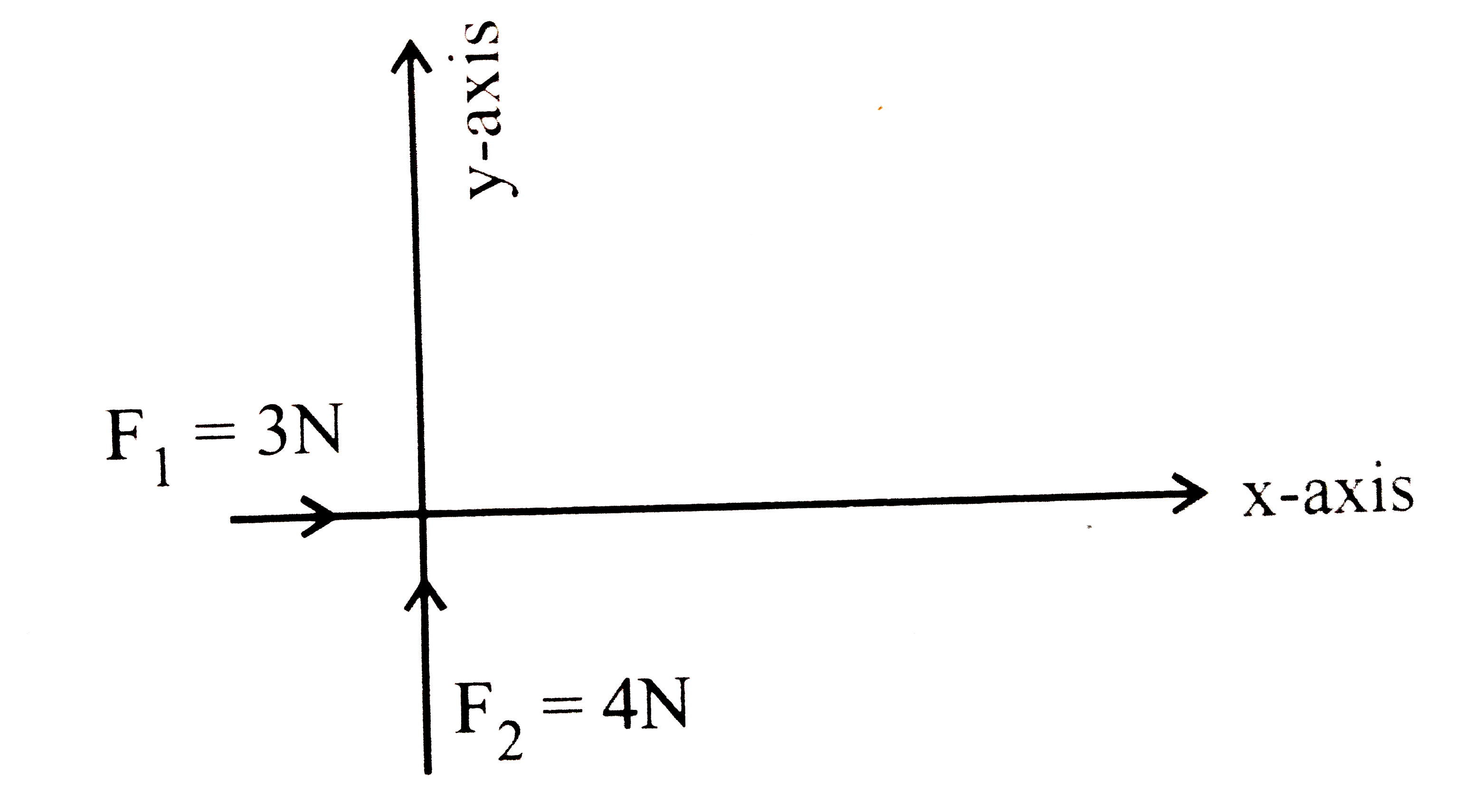
Two forces, one of 3 newton and another of 4 newton are applied on a standard 1 kg body, placed on a horizontal and frictionless surface, simultaneously along the x-axis and the y-axis, respectively, as shown below:

The magnitude of the resultant acceleration is:

A

`7 m/s^(2)`

B

`1 m/s^(2)`

C

`5 m/s^(2)`

D

`sqrt(7) m/s^(2)`

Text Solution

Verified by Experts

The correct Answer is:

C

Final force will be along the Z axis.
`F=sqrt((3)^(2))+(4)^(2)`
`=sqrt(9)+16=sqrt(25)=5`
Acceleration (a) `=F//m=5//1=5m//s^(2)`
Promotional Banner

Topper's Solved these Questions

  • Heat & Thermodynamics

    NDA PREVIOUS YEARS|Exercise Physics|64 Videos
  • MODERN PHYSICS

    NDA PREVIOUS YEARS|Exercise MCQ|42 Videos

Similar Questions

Explore conceptually related problems

Two unit vectors hati and hatj are directed along x-axis and y-axis respectively. What is the magnitude and direction of the vectors hati+hatj and hati-hatj ?

Two forces act on a 4.5 kg block resting on a frictionless surface as shown in the given figure. What is the magnitude of the horizontal acceleration of the block ?

A block of mass sqrt(3) kg rests on a horizontal frictionless surface. What will be the acceleration of the block if it is subjected to two forces as shown in the figure.

Two forces f_(1)=4N and f_(2)=3N are acting on a particle along positve X- axis and negative y- axis respectively. The resultant force on the particle will be -

Force is applied on an object of mass 2 kg at rest on a frictionless horizontal surface as shown in the graph. The speed of object at t=1 s will be

A horizontal force of 129.4 N is applied on a 10 kg block which rests on a horizontal surface. If the coefficient of friction is 0.3, the acceleration should be

Forces of 4 N and 5 N are applied at origin along X-axis and Y-axis respectively. The resultant force will be

A body starts from the origin with an acceleration of 6 ms^-1 along the x - axis and 8 ms^-1 along the y - axis. Find its distance from the origin after 4 s .

NDA PREVIOUS YEARS-Mechanics-Physics
  1. A man is sitting in a train which is moving with a velocity of 60 km/h...

    Text Solution

    |

  2. Conservation of momentum in a collision between particles can be under...

    Text Solution

    |

  3. Two forces, one of 3 newton and another of 4 newton are applied on a s...

    Text Solution

    |

  4. In SI unit of force 'Newton' (N) is given by (where m stands for metre...

    Text Solution

    |

  5. The acceleration due to gravity'g' for objects on or near the surface ...

    Text Solution

    |

  6. Suppose the force of gravitation between two bodies of equal masses is...

    Text Solution

    |

  7. A body has a free fall from a height of 20 m. After falling through a ...

    Text Solution

    |

  8. Mass of a particular amount of substance 1. is the amount of matter ...

    Text Solution

    |

  9. Two bod'ies A and B are moving with equal velocities. The mass of B is...

    Text Solution

    |

  10. A glass vessel is filled with water to the rim and a lid is fixed to i...

    Text Solution

    |

  11. A racing car accelerates on a straight road from rest to a speed of 50...

    Text Solution

    |

  12. A man weighing 70 kg is coming down in a lift. If the cable of the lif...

    Text Solution

    |

  13. The impulse on a particle due to a force acting on it during a given t...

    Text Solution

    |

  14. The motion of a car along a straight path is shown by the following fi...

    Text Solution

    |

  15. The speed of a car travelling on a straight road is listed below at su...

    Text Solution

    |

  16. The following figure shows displacement versus time curve for a partic...

    Text Solution

    |

  17. The time period of a simple pendulum made using a thin copper wire of ...

    Text Solution

    |

  18. Which one of the following physical quantity has the same unit as that...

    Text Solution

    |

  19. Which one of the following statements is true for the relation F=(Gm(1...

    Text Solution

    |

  20. Why is it difficult to measure the coefficient of expansion ofa liquid...

    Text Solution

    |
