

Home
Class 12
PHYSICS
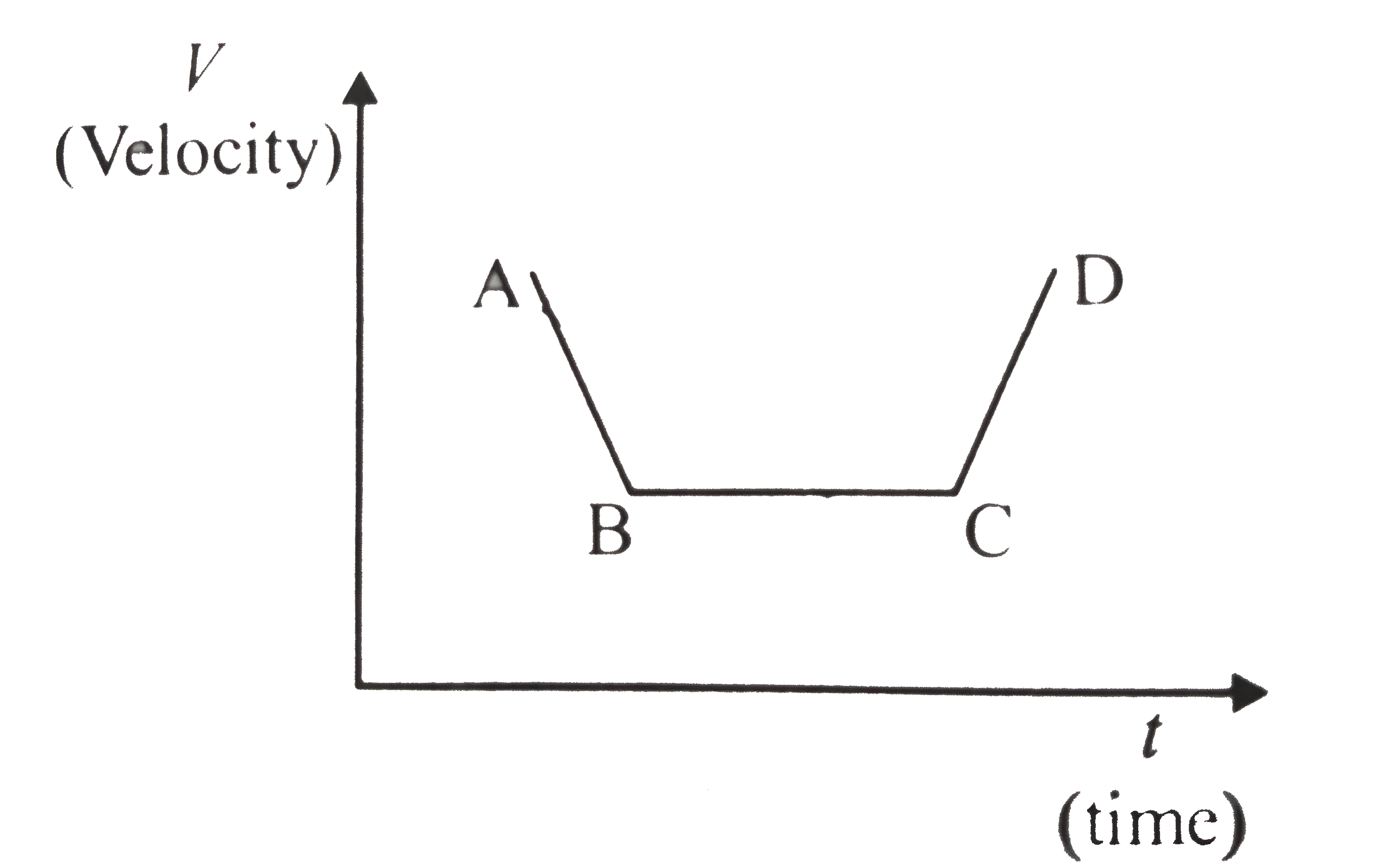
In the given velocity (V) versus time (t...


In the given velocity (V) versus time (t) graph, accelerated and decelerated motions are respectively represented by line segments

A

CD and BC

B

BC and AB

C

CD and AB

D

AD and CD

Text Solution

Verified by Experts

The correct Answer is:
C

In path A `rarr` B velocity is decreasmg with time, therefore AB represents deceleration. In path B `rarr` C velocity is constant with time. In path C `rarr` D velocity is increasmg with time, therefore CD represents acceleration.
Promotional Banner

Topper's Solved these Questions

  • Heat & Thermodynamics

    NDA PREVIOUS YEARS|Exercise Physics|64 Videos
  • MODERN PHYSICS

    NDA PREVIOUS YEARS|Exercise MCQ|42 Videos

Similar Questions

Explore conceptually related problems

Represent the velocity-time graph for a uniformly accelerated motion when acceleration is positive.

Position (x) versus time (t) graph of a particle is as shown. The velocity is zero at?

Given below is a graph drawn on the parameters of growth versus time A,B and C respectively represent.

Velocity (v) versus position (x) graph of a particle is shown.The acceleration of the particle at x=1m is ?

A stone is projected at an angle 45^@ with horizontal above horizontal x-axis as shown in figure (and y-axis is vertical). Four graphs representing the magnitude of horizontal (v_x) or magnitude of vertical (v_y) component of velocity of stone w.r.t. time t as shown. Then which of the following magnitude of velocity versus time graph best represents v_x versus t and v_y versus t respectively for the stone.

The graph below shws the velocity versus time graph for a body Which of the following graph represents the corresponding acceleration v//s time graph?

Consiedr the following x-t garaph to be parabolic. Draw the velocity-time graph and acceleration-time graph analyze the motion of the particle regarding its velocity and acceleration. .

Given below is a graph on the parametes of growth versus time A,B , C respectively represent

NDA PREVIOUS YEARS-Mechanics-Physics
  1. If some object is weighed when submerged in water, what will happen to...

    Text Solution

    |

  2. Which one of the following statements about energy is correct?

    Text Solution

    |

  3. If an object moves with constant velocity then which one of the follow...

    Text Solution

    |

  4. An object is moving with uniform acceleration a. Its initial velocity ...

    Text Solution

    |

  5. Which one of the following has maximum inertia?

    Text Solution

    |

  6. Which one of the following statements about gravitational force is NOT...

    Text Solution

    |

  7. Whether an object will float or sink in a liquid, depends on

    Text Solution

    |

  8. Which one of the following statements about the mass of a body is corr...

    Text Solution

    |

  9. A ball balanced on a vertical rod is an example of

    Text Solution

    |

  10. Which of the following statements about a fluid at rest in a cup is/ar...

    Text Solution

    |

  11. A planet has a mass M(1) and radius R(1). The value of acceleration- d...

    Text Solution

    |

  12. Consider the following velocity and time graph: Which one of the ...

    Text Solution

    |

  13. A ball is released from rest and rolls down an inclined plane, as show...

    Text Solution

    |

  14. The coefficient of a real expansion of a material is 1.6xx10^(-5)K^(-1...

    Text Solution

    |

  15. Which one of the following energy is stored in the links between the a...

    Text Solution

    |

  16. The correct sequence of energy transfer that occurs when an apple fall...

    Text Solution

    |

  17. Which one of the following forces is non-central and non- conservative...

    Text Solution

    |

  18. Suppose there are two planets, 1 and 2, having the same density but th...

    Text Solution

    |

  19. 1 dyne (a unit of force in CGS system) equals to

    Text Solution

    |

  20. In the given velocity (V) versus time (t) graph, accelerated and decel...

    Text Solution

    |