


Similar Questions
Explore conceptually related problems
Recommended Questions
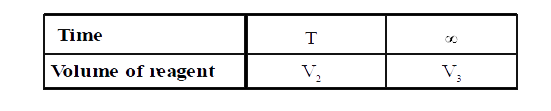
- A to B+ C is a first order reaction Reagent reacts with all A, ...
Text Solution
|
- The reagents (A), (B), and (C ) are:
Text Solution
|
- In the following first order reactions: A+ "Reagent" overset(K(1))(rar...
Text Solution
|
- A(aq)rarrB(aq)+C(aq) is first order reaction. "Time"" "t" "oo "...
Text Solution
|
- Fnd the reagents a,b,c & d for the following reactions.
Text Solution
|
- The molecular formula of a compound (A) is C(3)H(7)NO . The Compound (...
Text Solution
|
- The rate of reaction A+B+C to product is given by r= K[A]^(1/...
Text Solution
|
- The rate of reaction A + B + C to Products is given Rate = K[A]^(1/2)[...
Text Solution
|
- The rate of reaction , A + B+C to product is given by : rate =K...
Text Solution
|