

Home
Class 12
PHYSICS
An isosceles glass prime ( refractive i...

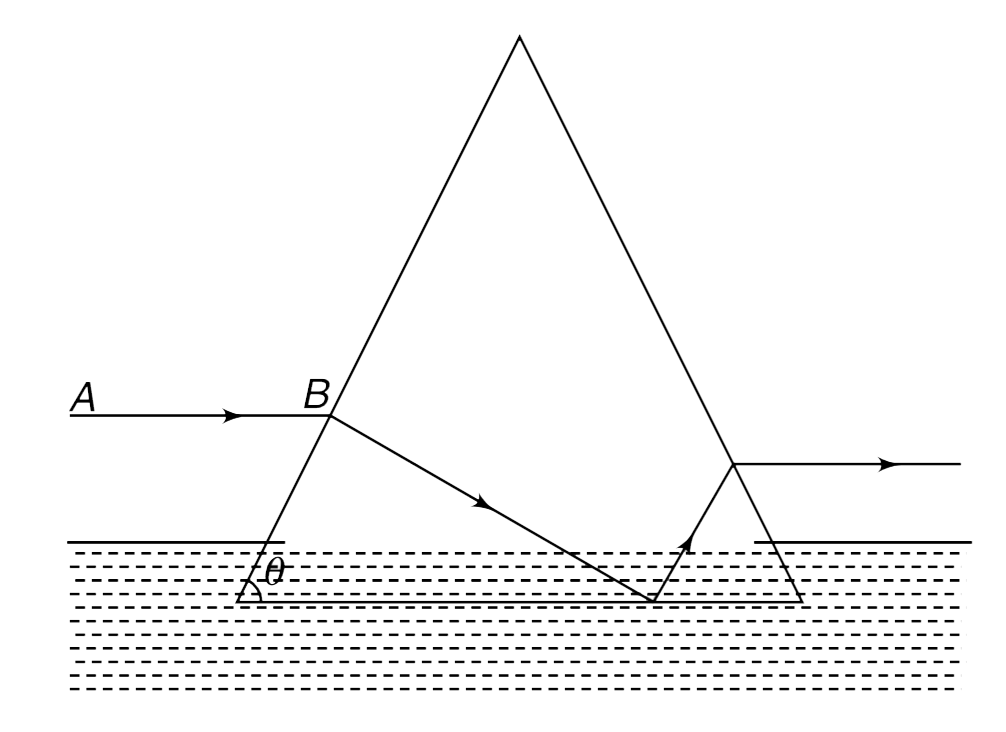
An isosceles glass prime ( refractive index `=(3)/(2)`) has its base just submerged in water ( refractive index `= (4)/(3)`) . The base of the prism is horizontal. A horizontal light ray AB is incident on the prism and takes a path shown in figure to emerge out of the prism. Find the maximum value of base angle `theta` of the prism for which total internal reflection can take place at the base.

Promotional Banner

Similar Questions

Explore conceptually related problems

Light is incident normally on face AB of a prism as shown in Figure. A liquid of refractive index mu is placed on face AC of the prism. The prism is made of glass of refractive indes 3//2 . Find the limits of mu for which total internal reflection takes place on the face AC.

An isosceles glass prism has one of its faces silvered. A light ray is incident normally on the other face which is identical in size to the silvered face. The light ray is reflected twice on the same sized faces and emerges through the base of the prism perpendicularly. Find the minimum value of refractive index of the material of the prism.

An isosceles glass prism has one of its faces silvered. A light ray is incident normally on the other face which is identical in size to the silvered face. The light ray is reflected twice on the same sized faces and emerges through the base of the prism perpendicularly. Find the minimum value of refractive index of the material of the prism.

A ray of light is incident horizontally on the face AB of the.right angled prism as shown in the figure. If the ray emerges grazing the surface AC, find the value of phi . Refractive index of the material of the prism is given to be n.

The refractive angle of prism is A. A ray is incident normally on one of the refracting faces of a prism and emerges out. If D be the deviation of the ray then refractive index of the material of the prism is—