

Home
Class 12
MATHS
Question 13 and 14 refer to the gaph abo...


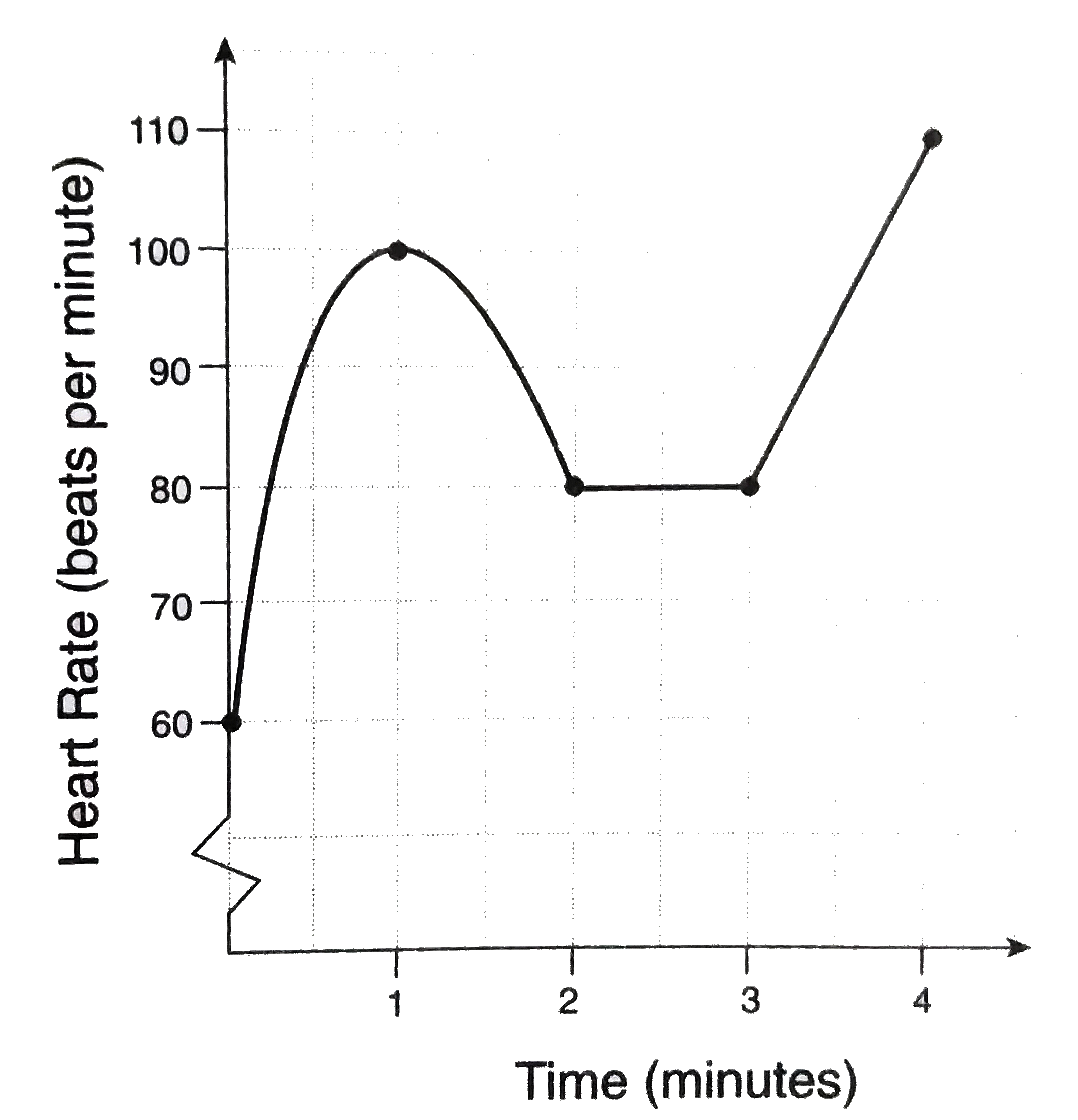
Question 13 and 14 refer to the gaph above which shows the heart rate, in veats per minutes, of a jogger during a 4-minutes interval.
Q. The greatest percent of increase in the jogger's heart rate occured over what interval of time, in minutes?

Promotional Banner

Similar Questions

Explore conceptually related problems

Question 13 and 14 refer to the gaph above which shows the heart rate, in veats per minutes, of a jogger during a 4-minutes interval. Q. Overr what interval of time, in minutes, was the jogger's heart rate changing at a constant rate?

What is the averages rate of the heart beats (per minute) in an adult?

Abhi's heart beat is 72 per minute. Then what is his pulse rate?

The graph above represents a jogger's speed during her 20-minutes jog around her neighbourhood. Which statement best describes what the jogger was doing during the 9-12 minutes interval of her jog?

When there are x milligrams of a certain drug in a patient's bloodstream, a patient's heart rate, h, in beats per minute, can be modeled by the equation h=60+0.5x . Which statements are true? I. 10 minutes after taking the drug, the patient's heart rate increase to 75 beats per minute. II. When the drug is not in the bloodstream, the patient's heart rate is 70 beats per minute. III. For each 10 milligram increase of the drug in the patient's bloodstream, the patient's heartbeat increase 5 beats per minute.

In an experiment, a heated cup of coffee is removed from a heat source, and the cup of coffee is then left in a room that is kept at a constant temperature. The graph above shows the temperature, in degrees Fahrenheit (.^@F) , of the coffee immediately after being removed from the heat source and at 10-minute intervals thereafter. During which of the following 10-minute intervals does the temperature of the coffee decrease at the greatest average rate?

A certain drug raises a patient's heart rate, h, in beats per minute, according to the equation h(x)=65+0.2x , where x is the number of milligrams of the drug in the patient's bloodstream. After t hours, the level of the drug in the patient's bloodsteam decrease exponentially according to the equation x(t)=512(0.7)^(t) . After 5 hours, what is the number of beats per minute in the patient's heart rate, correct to the nearest whole number?

John runs at different speeds as part of his training program. The graph shows his target heart rate at different times during his workout. On which interval is the target heart rate strictly increasing then strictly decreasing?