

Home
Class 11
CHEMISTRY
An open ended mercury mnometer is used t...

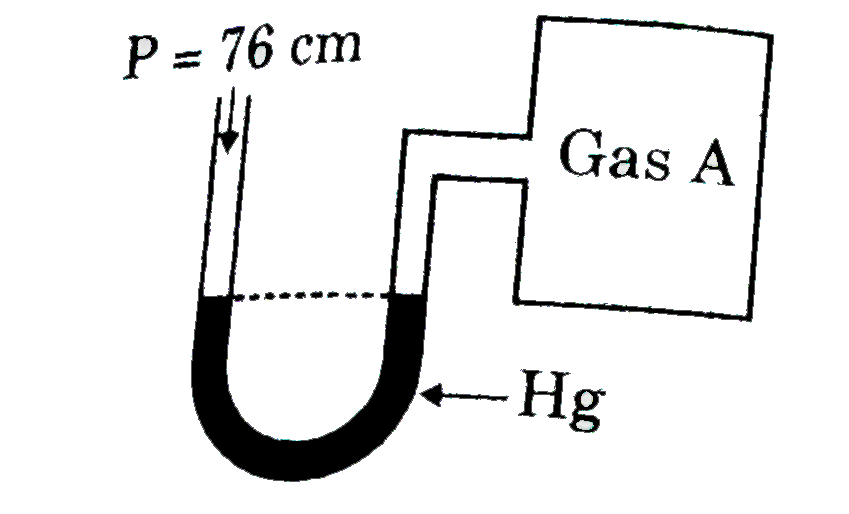
An open ended mercury mnometer is used to measure the pressure exerted by a trapped gas as shown in the figure. Initially manometer shows no difference in mercury level in both columns as shown in diagram.

After sparking A dissociates according to following reaction:
`2A(g)rarr3B(g)+2C(g)` ltbr. If pressure of Gas A decreases to 0.8 atm. Then:
(Assume temperature to be constant at 300K)

Promotional Banner

Similar Questions

Explore conceptually related problems

A open ended mercury manometer is used to measure the pressure exerted by a trapped gas as shown in the figure. Initially manometer shows no difference in mercury level in both columns as shown in diagram. After sparking 'A' dissociates according to following reaction 2A(g)rarr 3B(g)+2C(g) If pressure of Gas "A" dissociates to 0.8 atm, then (Assume temperature to be constant and is 300 K)

A open ended mercury manometer is used to measure the pressure exerted by a trapped gas as shown in the figure. Initially manometer shows no difference in mercury level in both columns as shown in diagram. After sparking 'A' dissociates according to following reaction A(g)rarrB(g)+3C(g) If pressure of Gas "A" dissociates to 0.9 atm, then (Assume temperature to be constant and is 300 K)

A open ended mercury manometer is used to measure the pressure exerted by a trapped gas as shown in the figure. Initially manometer shows no difference in mercury level in both columns as shown in diagram. After sparking 'A' dissociates according to following reaction A(g)rarrB(g)+3C(g) If pressure of Gas "A" dissociates to 0.9 atm, then (Assume temperature to be constant and is 300 K)

To measure the pressure exerted by a trapped gas A, an open ended mercury manometer is used. After sparking the gas A, it dissociates as, A(g) to B(g) + 3C(g). If the pressure of A decreases to 0.9 atm, then (assume temperature to be constant, 300K)

A manometer attached to a flask contains with ammonia gas have no difference in mercury level initially as shown in diagram. After sparking into the flask, ammonia is partially dissociated as 2NH_(3)" (g)"rarr N_(2)" (g)"+3H_(2)" (g)" now it have difference of 6 cm in mercury level in two columns, what is partial pressure of H_(2)" (g)" at equilibrium?

A manometer attached to a flask contains with ammonia gas have no difference in mercury level initially as shown in diagram. After sparking into the flask, ammonia is partially dissociated as 2NH_(3)" (g)"rarr N_(2)" (g)"+3H_(2)" (g)" now it have difference of 6 cm in mercury level in two columns, what is partial pressure of H_(2)" (g)" at equilibrium?

For a first order gas phase reaction : " "A(g)rarr2B(g)+C(g) P_(0) be initial pressure of A and P_(t) the total pressure at time 't' . Integrated rate equation is -