

Home
Class 11
PHYSICS
Two separate cylinders of masses m(=1 kg...

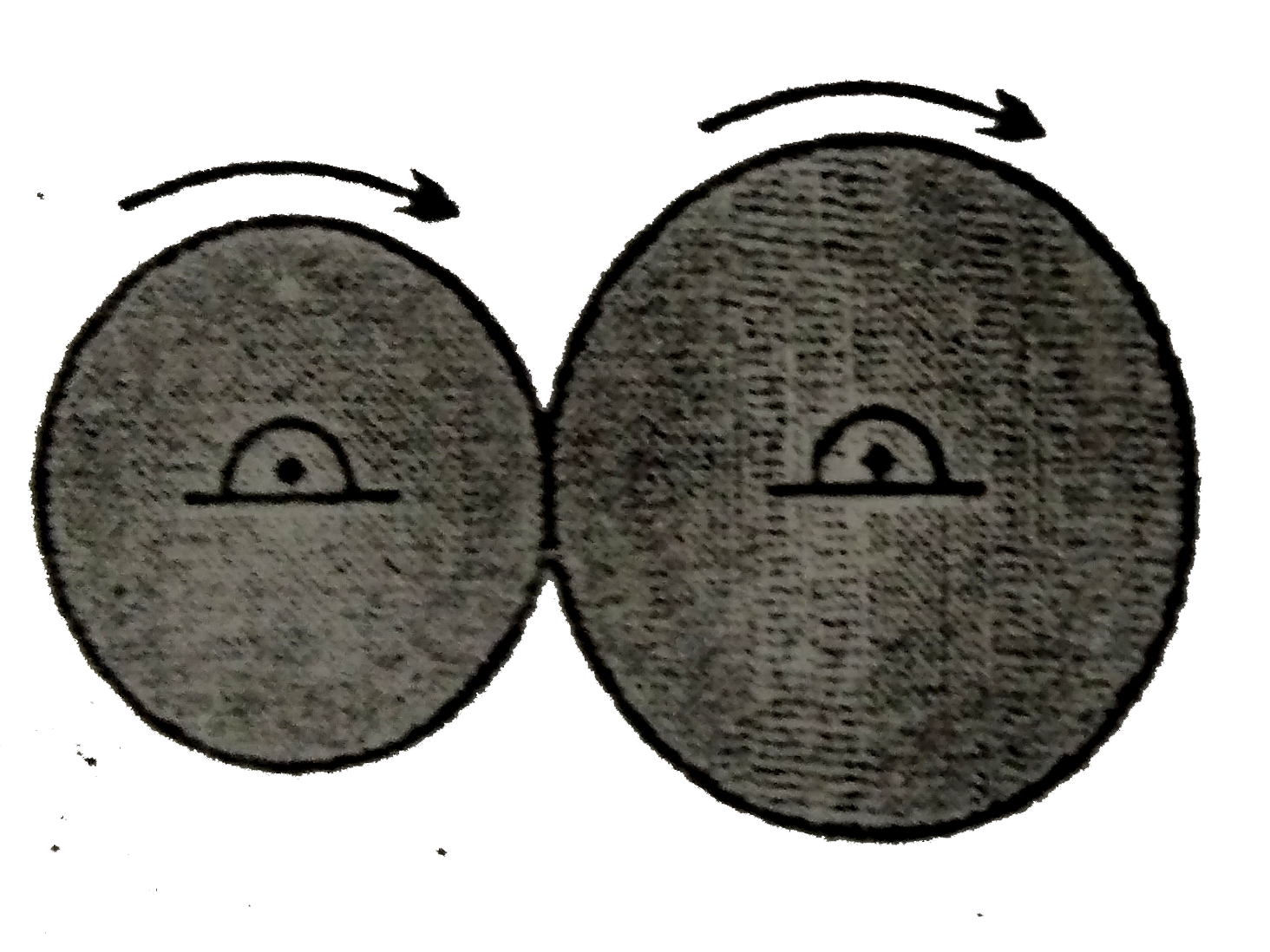
Two separate cylinders of masses `m(=1 kg ) & 4m` radii `R(=10cm)` and `2R` rotating in clockwise direction with `omega_(1)=100rad //sec` and `omega_(2)=200 rad//sec` respectively. Now they are held in contact with each other as in figure. Determine their angular velocities after the slipping after the slipping between the cylinders. stops.

Promotional Banner

Similar Questions

Explore conceptually related problems

Two discs A and B are in contact and rotating with angular velocity with angular velocities omega_(1) and omega_(2) respectively as shown. If there is no slipping between the discs, then

Two discs A and B are in contact and rotating with angular velocity with angular velocities omega_(1) and omega_(2) respectively as shown. If there is no slipping between the discs, then

Two cylinders having radiii R_(1) and R_(2) and rotational inertia I_(1) and I_(2) respectively, are supported by fixed axes perpendicular to the plane of figure-5.52. The large cylinder is initially rotating with angular velocity omega_(0) . The small cylinder is moved to the right until it touches the large cylinder and is caused to rotate by the frictional force between the two. Eventually, slipping ceases, and the two cylinders rotate at constant rates in opposite directions, (a) Find the final angular velocity omega_(2) of the small cylinder in terms of I_(1) , I_(2) , R_(1) , R_(2) and omega_(0) . (b) Is total angular momentum conserved in this case ?

Two disks A and B are free to rotate about their respective vertical smooth axis passing through their centre as shown. (R_(A) = 2R_(B), I_(A) = 16 I_(B)) . Disc is rotating about its axis with an angular velocity of 5 rad//sec . The two disks are moved near to each other till they are in contac. What will be the angular velocity of the smaller disk when slipping between two stops ?

Two horizontal discs A and B of radii r and 2r having moments of inertia I and 4I about their axes. Initially, disc A is rotating with omega_(0) and disc B is at rest. Their rims are now brought in contact. The discs first slip over each other at the contact but slipping finally ceases due to the fricition between them. Find the angular speeds of the discs after the slipping ceases. Also, find the loss in kinetic energy.

Figure shows two cylinders of radii r_1 and r_2 having moments of inertia I_1 and I_2 about their respective axes. Initially the cylinders rotate about their axes with angular speed omega_1 and omega_2 as shown in the figure. The cylinders are moved closer to touch each other keeping the axes parallel. The cylinders first slip over each other at the contact but the slipping finally ceases due to the friction between them. Find the angular speeds of the cylinders after the slipping ceases.

Figure shows two cylinders of radii r_1 and r_2 having moments of inertia I_1 and I_2 about their respective axes. Initially the cylinders rotate about their axes with angular speed omega_1 and omega_2 as shown in the figure. The cylinders are moved closer to touch each other keeping the axes parallel. The cylinders first slip over each other at the contact but the slipping finally ceases due to the friction between them. Find the angular speeds of the cylinders after the slipping ceases.

Figure shows two cylinders of raddi r_1 and r_2 having moments of inertia I_1 and I_2 about their respective axes. Initially the cylinders rotate about their axes with angular speed omega_1 and omega_2 as shown in the figure. The cylinders are moved closer to touch each other keeping the axes parallel. The cylinders first slipover each other at the contact but the slipping finally ceases due to the friction between them. Find the angular speeds of the sylinders after the slipping ceases.

A cylinder A rolls without slipping on a plank B.The velocities of center of the cylinder and that of the plank are 4m/s and 2m/s respectively in same direction,with respect to the ground.Find the angular velocity ( in rad /sec) of the cylinder if its radius is 1m .