

Home
Class 11
PHYSICS
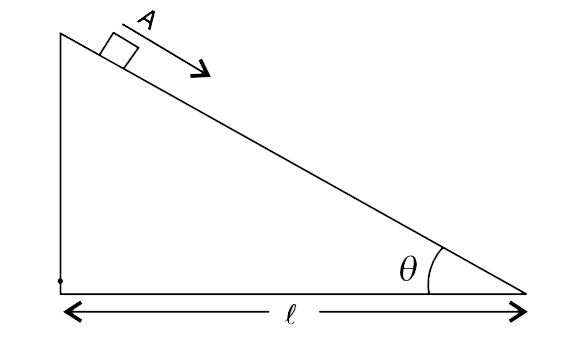
A small body A starts sliding down from ...

A small body A starts sliding down from the top of a wedge (see fig) whose base is equal to l. The coefficient of friction between the body and wedge surface is `mu= 1.0`. At what value of angle q will the time of sliding be least?

Promotional Banner

Similar Questions

Explore conceptually related problems

A small body A starts sliding down from the top of a wedge (figure) whose base is equal to l=2.10m . The coefficient of friction between the body and the wedge surface is k=0.140 . At what value of the angle alpha will the time of sliding be the least? What will it be equal to?

A body is sliding down an inclined plane forming an angle 30^(@) with the horizantal. If the coefficient of friction is 0.3 then acceleration of the body is

A block is at rest on an inclined plane making an angle alpha with the horizontal . As the angle alpha of the incline is increased the block starts slipping when the angle of inclination becomes theta . The coefficient of static friction between the block and the surface of the inclined plane is or A body starts sliding down at an angle theta to the horizontal. Then the coefficient of friction is equal to

In figure, the pulley shown is smooth. The spring and the string are light. Block B slides down from the top along the fixed rough wedge of inclination theta . Assuming that the block reaches the end of the wedge, find the speed of the block at the end. Take the coefficient of friction between the block and the wedge to be mu and that the spring was relaxed when the block was released from the top of the wedge.

In figure, the pulley shown is smooth. The spring and the string are light. Block B slides down from the top along the fixed rough wedge of inclination theta . Assuming that the block reaches the end of the wedge, find the speed of the block at the end. Take the coefficient of friction between the block and the wedge to be mu and that the spring was relaxed when the block was released from the top of the wedge.

A block of mass 5 kg is kept against an accelerating wedge with a wedge angle of 45^(@) to the horizontal. The coefficient of friction between the block and the wedge is mu = 0.4 . What is the minimum absolute value of the acceleration of the wedge to keep the block steady? [Assume, g = 10 m/s^(2) ]