Home
Class 12
MATHS
Let y=f(x) be a curve passing through...

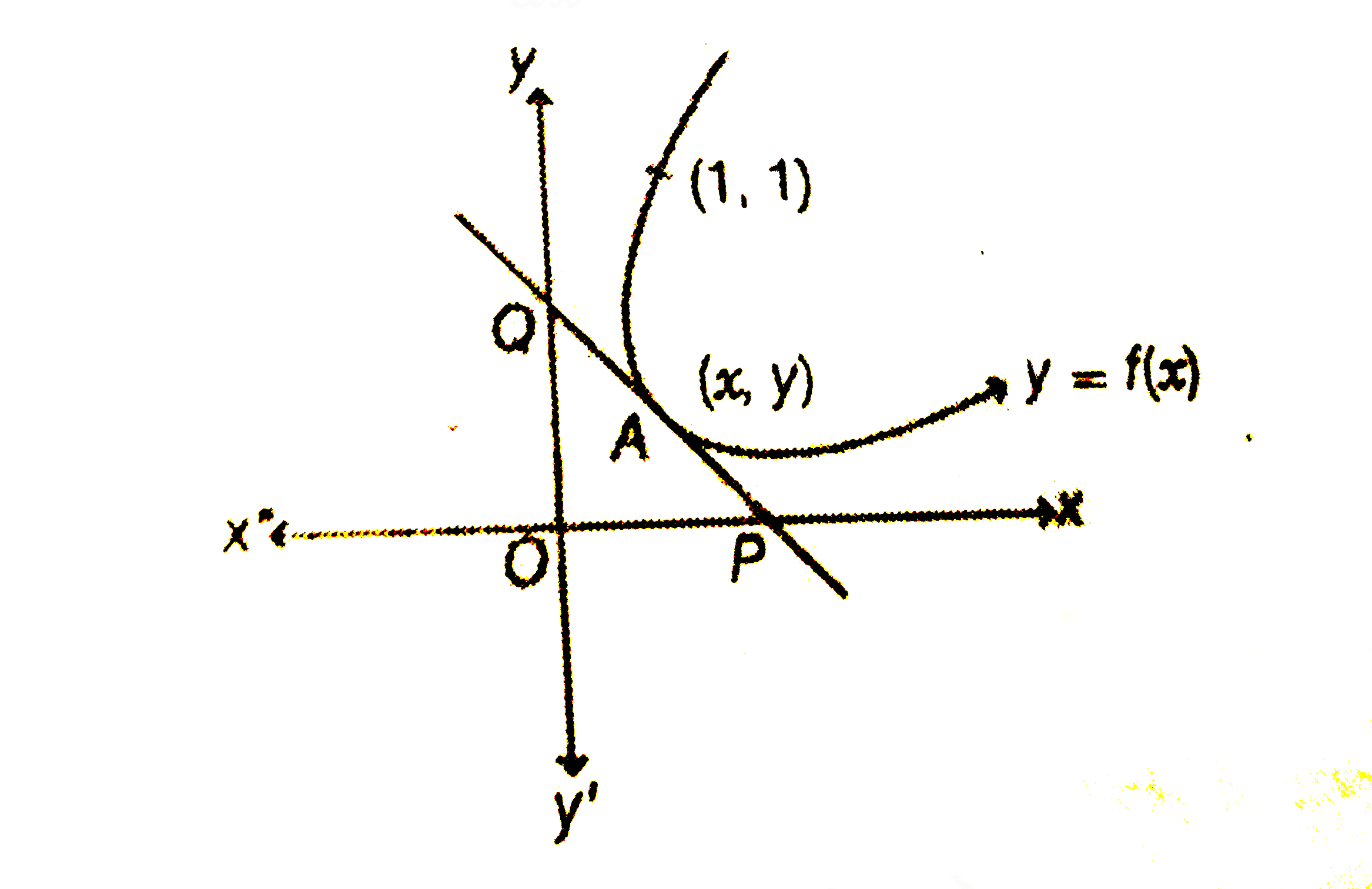
Let `y=f(x)` be a curve passing through `(1,1)` such that the triangle formed by the coordinate axes and the tangent at any point of the curve lies in the first quadrant and has area 2. Form the differential equation and determine all such possible curves.

Text Solution

Verified by Experts

The correct Answer is:
Differential Equation: `(d^(2)y)/(dx^(2))=0, x^(2) dy/dx + 1 = 0`
curvers: `x+ y = 2, xy =1`

Equation of tangent to the curve y= f(x) at point
`A(x,y) is Y-y=dy/dx(X-x)`
whose, x-intercept `(x-y cdot dx/dy, 0)`
y-intercept `(0,y-xdy/dx)`
Given, `Delta OPQ=2`
`rArr 1/2 (x-ydx/dy)(y-xdy/dx)=2`
`rArr (x-y 1/p)(y-xp)=4, where p=dy/dx`
`rArr p^(2) x^(2)-2pxy +4p+y^(2)=0`
`rArr (y-px)^(2) + 4p=0`
`therefore y-px =2 sqrt(-p)`
`rArr y=px+2 sqrt(-p) …(i)`
on differentiating w.r.t.x, we get
`p=p+(dp)/dx cdot x+ 2 cdot (1/2)(-P) ^(1//2) cdot (-1) (dp)/dx`
`rArr (dp)/dx{x-(-P)^(1//2)}=0`
`rArr (dp)/dx= 0 or x=(-p)^(-1) `
If `(dp)/dx= 0 rArr P=c`
On putting this value in Eq. (i), we get `y=cx+2sqrt(-c)`
This curve passes through (1,1).
`rArr 1=c+2sqrt(-c)`
`rArr c=-1`
`therefore y=-x+2`
`rArr x+y= 2 `
Again, if `x=(-p)^(-1//2)`
`rArr -p=1/x^(2)` putting in Eq. (i)
`y=(-x)/x^(2) + 2 cdot 1/x rArr xy=1`
Thus, the two curves are xy = 1 and x+ y = 2.
Promotional Banner

Similar Questions

Explore conceptually related problems

The area of the traingle formed by the coordinate axes and a tangent to the curve xy=a^2 at the point (x_1,y_1) is

The area of the triangle formed by the tangent to the curve xy=a^(2) at any point on the curve with the coordinate axis is

The equation of the curve,passing through (2, 5) and having the area of triangle formed by the X-axis,the ordinate of a point on the curve and the tangent at the point 5 sq.units as

A normal at any point (x,y) to the curve y=f(x) cuts a triangle of unit area with the axis,the differential equation of the curve is

Equation of the tangent to the curve y=2x^(2)+5x , at the point where the line y=3 cuts the curve in the first quadrant , is

The slope of the tangent to the curve y=x^(2) -x at the point where the line y = 2 cuts the curve in the first quadrant, is

The area of the triangle formed by normal at the point (1,0) on the curve x=e^( sin y with ) axes is

