

Home
Class 11
PHYSICS
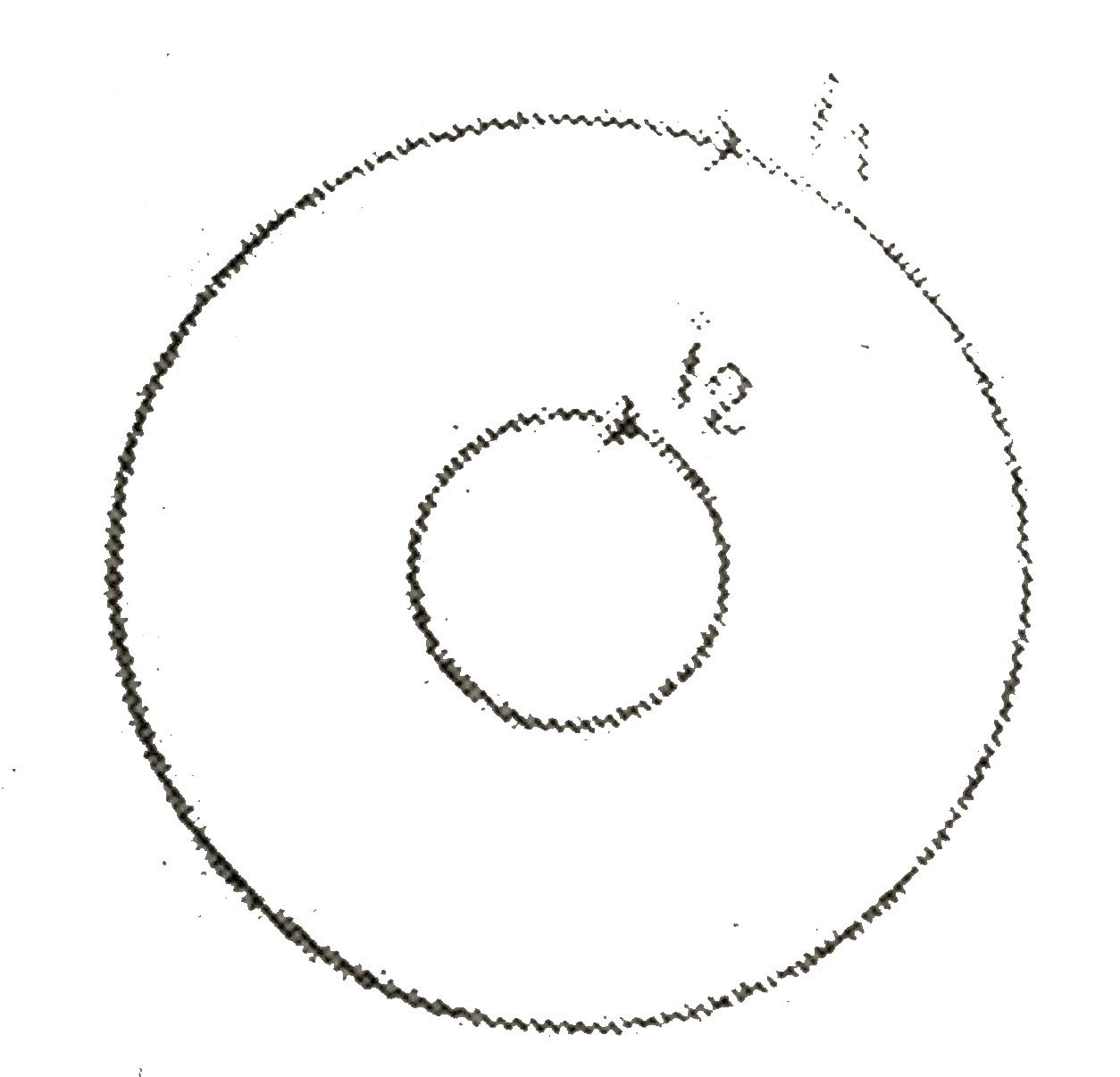
Two concentric circular coils of radii R...

Two concentric circular coils of radii R and r `(lt lt R)` carry currents of `i_(1)` and `i_(2)` respectively. If the smaller coil is rotated slightly about one of its diameter, it starts oscillating. Then, which of the following statement(s) `is//are` correct ?

Promotional Banner

Similar Questions

Explore conceptually related problems

Two circular coils P & Q are coaxially & carry currents I_1 and I_2 respectively (all direction are w.r.t. the observer)

Two circular coils P & Q are coaxially & carry currents I_1 and I_2 respectively (all direction are w.r.t. the observer)

Two concentric circular loops of radii r_(1) and r_(2) carry clockwise and anticlockwise currents i_(1) and i_(2) . If the centre is a null point, i_(1)//i_(2) must be equal to

Two circular loops A and B of radii R and 4R are kept concentrically in the same plane. The loops carry currents I_(1) and I_(2) respectively. If the magnetic field at a point on the common axis of the loops at a distance 2R from their common centre is zero, the ratio (I_(1))/(I_(2)) is _________.

A circular coil of radius 'r' having N turns carries a current ''I''. What is its magnetic moment ?

The figure represents two concentric shells of radii R_(1) and R_(2) and masses M_(1) and M_(2) respectively. The gravitational field intensity at the point A at distance a (R_(1) lt a lt R_(2)) is

The figure represents two concentric shells of radii R_(1) and R_(2) and masses M_(1) and M_(2) respectively. The gravitational field intensity at the point A at distance a (R_(1) lt a lt R_(2)) is

Two concentric and coplanar coils have radii a and b ( gt gt a) as shows in Fig. Resistance of the inner coil is R . Current in the outer coil is increased from 0 to i , then the total charge circulating the inner coil is

The concentric, thin metallic spheres of radii r_(1) and r_(2) (r_(1) gt r_(2)) carry charges q_(1) and q_(2) respectively. Then the electric potential at distance r (r_(2) lt r lt r_(1)) will be (1)/(4pi epsilon_(0)) times