Home
Class 10
MATHS
A B C is a right triangle right-angle...

`A B C` is a right triangle right-angled at `C` . Let `B C=a ,\ \ C A=b ,\ \ A B=c` and let `p` be the length of perpendicular from `C` on `A B` , prove that (i) `c p=a b` (ii) `1/(p^2)=1/(a^2)+1/(b^2)`

Text Solution

Verified by Experts
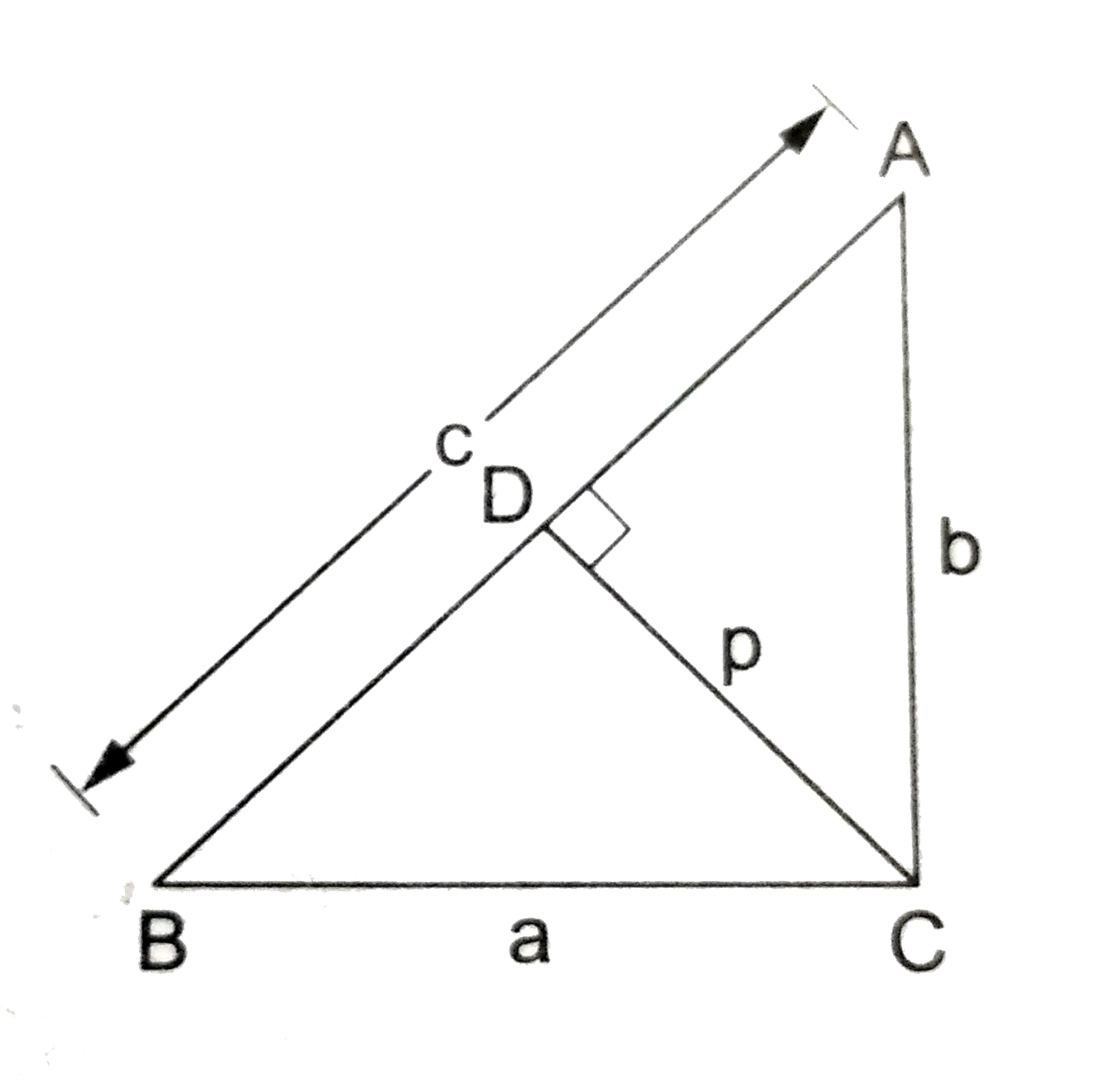
(i) We have
`ar (Delta ABC)=(1)/(2)xx(1)/(2)xxABxxCD=(1)/(2)cp` [ taking BC as base]
`:. (1)/(2)cp=(1)/(2) ab rArr cp =ap`.

Hence, cp= ab.
`(ii) cp=ab rArr (1)/(p)=(c)/(ab)`
` :. (1)/p^(2)=(c^(2))/(a^(2)b^(2))=(b^(2)+a^(2))/(a^(2)b^(2)) " " [ :. AB^(2)=AC^(2)+BC^(2)]`
`=((b^(2))/(a^(2)b^(2))+(a^(2))/(a^(2)b^(2)))=((1)/(a^(2))+(1)/(b^(2)))`
Hnece, `(1)/(p^(2))=(1)/(a^(2)+(1)/(b^(2))`
Promotional Banner

Similar Questions

Explore conceptually related problems

ABC is a right triangle right-angled at C. Let BC=a,CA=b,AB=c and let p be the length of perpendicular from C on AB, prove that (i) cp=ab( ii) (1)/(p^(2))=(1)/(a^(2))+(1)/(b^(2))

ABC is a right triangles right angled at C . Let BC =a ,CA=b, AB = c, and p be the length of perpendicular from C to AB . Prove that cp = ab .

ABC is right angle triangle at C. Let BC=a ,CA=b,AB=c and Let 'P' be the length of perpendicular from C to AB.prove that (1)/(p^(2))=(1)/(a^(2))+(1)/(b^(2))

ABC is a right traingle, right angled at C. if P is the length of perpendicular from C to AB and AB=c, BC=a and CA=b, then prove that (i) pc=ab (ii) 1/(p^(2)) = 1/(a^(2))+1/b^(2)

ABC is a triangle right-angled at C. If p is the length of the perpendicular from C to AB and a, b, c are the sides, then which one of the following is correct ?

DeltaABC , is right angles at C. If p is thhe length of the perpendicular from C to AB and a,b,c are the lengths of the sides opposites angle A,angle B,angle C respectively then prove that 1/(p^(2))=1/(a^(2))+1/(b^(2))

If a,b, and c are in G.P.then prove that (1)/(a^(2)-b^(2))+(1)/(b^(2))=(1)/(b^(2)-c^(2))

If in a right angled triangle, a and b are the lengths of sides and c is the length of hypotenuse and c-b ne 1, c+b ne 1 , then show that log_(c+b)a+log_(c-b)a=2log_(c+b)a.log_(c-b)a.

