Home
Class 10
MATHS
Show that the points (1, 1), (-1, 5), (7...

Show that the points (1, 1), (-1, 5), (7, 9) and (9, 5) taken in that order are the vertices of a rectangle.

Text Solution

Verified by Experts
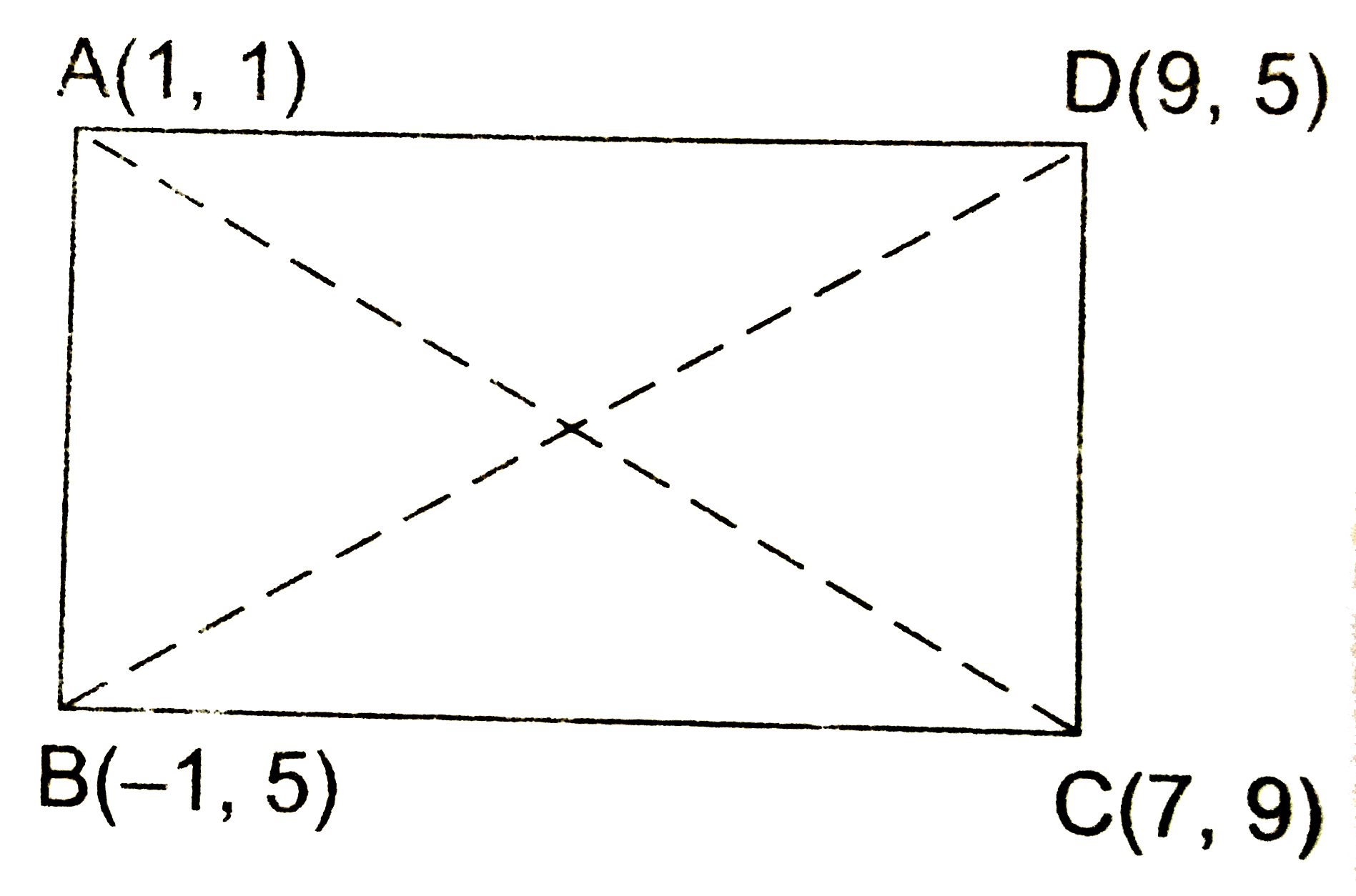

Let A(1, 1), B (-1, 5), C(7, 9) and D(9, 5) be the vertices of quad. ABCD. Then,
`AB^(2) = (-1-1)^(2) + (5-1)^(2)`
`= (-2)^(2) + 4^(2) = 4+16 = 20.`
`therefore AB = sqrt(20) "units"= sqrt(4 xx 5)` units.
` = 2sqrt(5)` units.
`BC^(2) = (7+1)^(2) + (9-5)^(2)`
`= 8^(2) + 4^(2) = 64 + 16 =80`
`therefore BC = sqrt(80) "units" = sqrt(16 xx 5) "units" = 4sqrt(5)` units.
`CD^(2) = 9-7^(2) + 5-9^(2)`
` =2^(2) + (-4)^(2) = 4 + 16 =20`
`therefore CD = sqrt(20) "units" = sqrt(4 xx 5) "units" = 2sqrt(5) "units. "`
`AD^(2) = (9-1)^(2) + (5-1)^(2)`
` = 8^(2) + 4^(2) = 64 +16 =80`
`therefore AD = sqrt(80) units = sqrt(16 xx 5) "units" = 4sqrt(5)` units.
Thus, `AB =CD = 2sqrt(5) " units and "BC = AD = 4sqrt(5)` units.
Also, `AC^(2) = (7-1)^(2) + (9-1)^(2)`
` = 6^(2) + 8^(2) = 36+64 = 100`
`therefore AC = sqrt(100) "units" = 10 "units"`
`"And,"BD^(2) = (9+1)^(2) + (5-5)^(2) = 10^(2) +0^(2) = 100`
`therefore BD = sqrt(100)` units = 10 units.
`therefore` diagonal AC = diagonal BD.
Thus, ABCD is a quadrilateral whose opposite sides are equal and the diagonals are equal.
Hence, quad. ABCD is a rectangle.
Area of rectangle ABCD `= "length" xx "breadth"`
` = 4sqrt(5) xx 2sqrt(5)` sq units
=40 sq units.
Promotional Banner

Similar Questions

Explore conceptually related problems

Prove that points (-3, -1), (2, -1), (1, 1) and (-2, 1) taken in order are the vertices of a trapezium.

Show that the ponts (1, -1), (5, 2) and (9, 5) are collinear.

Prove that the point A(1,3,0),B(-5,5,2),C(-9,-1,2) and D(-3,-3,0) taken in order are the vertices of a parallelogram.Also,show that ABCD is not a rectangle.

Show that the points (1,-1),(5,2) and (9,5) are collinear.

Show that the points (1, 1), (2, 3) and (5, 9) are collinear.

Show that the points (4, 2), (7, 5) and (9, 7) are collinear.

The points (2,-2),(8,4),(5,7) and (-1,1) taken in order constitute the vertices of a

Show that the points (4,2) , (7,5) and (9,7) are collinear.

Show that the points (0, 7, 10), (-1, 6, 6) and (-4, 9, 6) are the vertices of an isosceles right angled triangle.

Using direction numbers show that the points P(4,7,8) and Q(2,3,4),R(-1,-2,1) and S(1,2,5) taken in ordethe vertices of a parallelogram.Is the parallelogram rectangle?

