A
B
C
D
Text Solution
Verified by Experts
The correct Answer is:



Topper's Solved these Questions
LAWS OF MOTION
MTG-WBJEE|Exercise WB JEE PREVIOUS YEARS QUESTIONS (CATEROGY 1: SINGLE OPTION CORRECT TYPE (1 MARK))|10 VideosLAWS OF MOTION
MTG-WBJEE|Exercise WB JEE PREVIOUS YEARS QUESTIONS (CATEGORY 2: SINGLE OPTION CORRECT TYPE (2 MARKS))|1 VideosLAWS OF MOTION
MTG-WBJEE|Exercise WB JEE WORKOUT (CATEGORY 2: SINGLE OPTION CORRECT TYPE (2 MARKS))|15 VideosKINETIC THEORY OF GASES
MTG-WBJEE|Exercise WB JEE PREVIOUS YEARS QUESTIONS (MCQ)|7 VideosMAGNETIC EFFECT OF CURRENT
MTG-WBJEE|Exercise WB JEE Previous Years Questions|22 Videos
Similar Questions
Explore conceptually related problems
MTG-WBJEE-LAWS OF MOTION -WB JEE WORKOUT (CATEGORY 3: ONE OR MORE THAN ONE OPTION CORRECT TYPE (2 MARKS))
- A string of negligible mass going over a clamped pulley of mass m supp...
Text Solution
|
- A rope of negligible mass can support a load of M kg. What will be the...
Text Solution
|
- A reference frame attached to the earth
Text Solution
|
- Two ships are 10sqrt(2) km apart on a line running south to north. Th...
Text Solution
|
- Two masses of 0.25 kg each moves towards each other with speed 3 ms^(-...
Text Solution
|
- A ball hits the floor and rebounds after an inelastic collision. In th...
Text Solution
|
- A particle is acted upon by a force of constant magnitude which is alw...
Text Solution
|
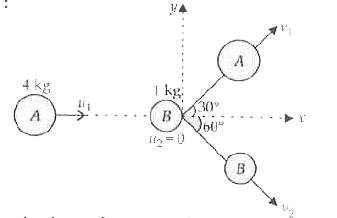
- A spherical ball A of mass 4 kg, moving along a straight line strikes ...
Text Solution
|
- A train is moving north with speed 20 m s. If it turns west with same ...
Text Solution
|
- Four blocks each of mass M connected by a massless strings are pulled ...
Text Solution
|