

Home
Class 11
PHYSICS
A siphon has a uniform circular base of ...

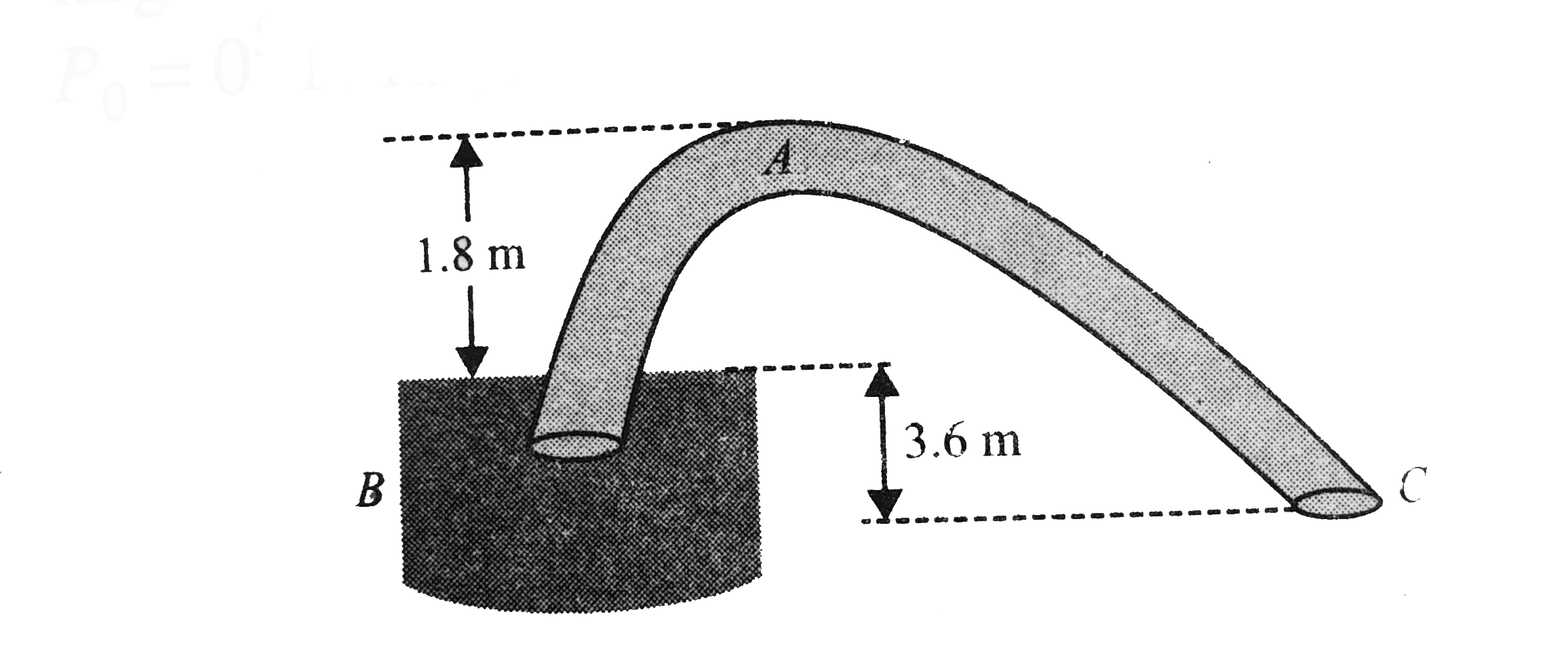
A siphon has a uniform circular base of diameter `8//sqrt(pi) cm` with its crest `A, 1.8 m` above the water level vessel `B` is of large cross section (`g= 10 m//s^(2)` and atmospheric pressure `P_(0) = 0^(5) N//m^(2))`.

Promotional Banner

Similar Questions

Explore conceptually related problems

A siphon has a uniform circular base of diameter 8//sqrt(pi) cm with its crest A, 1.8 m above the water level vessel B is of large cross section ( g= 10 m//s^(2) and atmospheric pressure P_(0) =1 0^(5) N//m^(2)) .

A siphon has a uniform circular base of diameter 8//sqrt(pi) cm with its crest A, 1.8 m above the water level vessel B is of large cross section ( g= 10 m//s^(2) and atmospheric pressure P_(0) = 10^(5) N//m^(2)) .

A glass capillary tube of inner diameter 0.28 mm is lowered verically into water in a vessel. The pressure to be applied on the water in the capillary tube so that water level in the tube is same as that in the vessel is lambda xx 10^(5) N//m^(2) . Then find lambda in nearest integer (surface tension of water = 0.07 N//m and atmospheric pressure = 10^(5)N//m^(2) ) :

Find the load on wire of cross section 16 mm to increase its length by 0.3%(Y=5 xx 10^(9)N//m^(2),g=10m//s^(2))

A glass capillary tube of inner diameter 0.28 mm is lowered vertically into water in a vessel. The pressure to be applied on the water in the capillary tube so that water level in the tube is same as the vessel in (N)/(m^(2)) is (surface tension of water =0.07(N)/(m) atmospheric pressure =10^(5)(N)/(m^(2))

A glass capillary tube of inner diameter 0.28 mm is lowered vertically into water in a vessel. The pressure to be applied on the water in the capillary tube so that water level in the tube is same as the vessel in (N)/(m^(2)) is (surface tension of water =0.07(N)/(m) atmospheric pressure =10^(5)(N)/(m^(2))

The U-tube acts as a water siphon. The bend in the tube is 1m above the water surface. The tube outlet is 7m below the water surface. The water issues from the bottom of the siphon as a free jet at atmospheric pressure. Determine the speed of the free jet and the minimum absolute pressure of the water in the bend. Given atmospheric pressure =1.01xx 10^(5)N//m^(2),g=9.8 m//s^(2) and density of water =10^(3)kg//m^(3) .

The U-tube acts as a water siphon. The bend in the tube is 1m above the water surface. The tube outlet is 7m below the water surface. The water issues from the bottom of the siphon as a free jet at atmospheric pressure. Determine the speed of the free jet and the minimum absolute pressure of the water in the bend. Given atmospheric pressure =1.01xx 10^(5)N//m^(2),g=9.8 m//s^(2) and density of water =10^(3)kg//m^(3) .

A vessel full of water has a bottom of area 20 cm^(2) , top of area 20 cm^(2) , height 20 cm and volume half a litre as shown in figure. (a) find the force exerted by the water on the bottom. (b) considering the equilibrium of the water, find the resultant force exerted by the sides of the glass vessel on the water. atmospheric pressure =1.0xx10^(5) N//m^(2) . density of water =1000 kg//m^(3) and g=10m//s^(2)