

Home
Class 11
PHYSICS
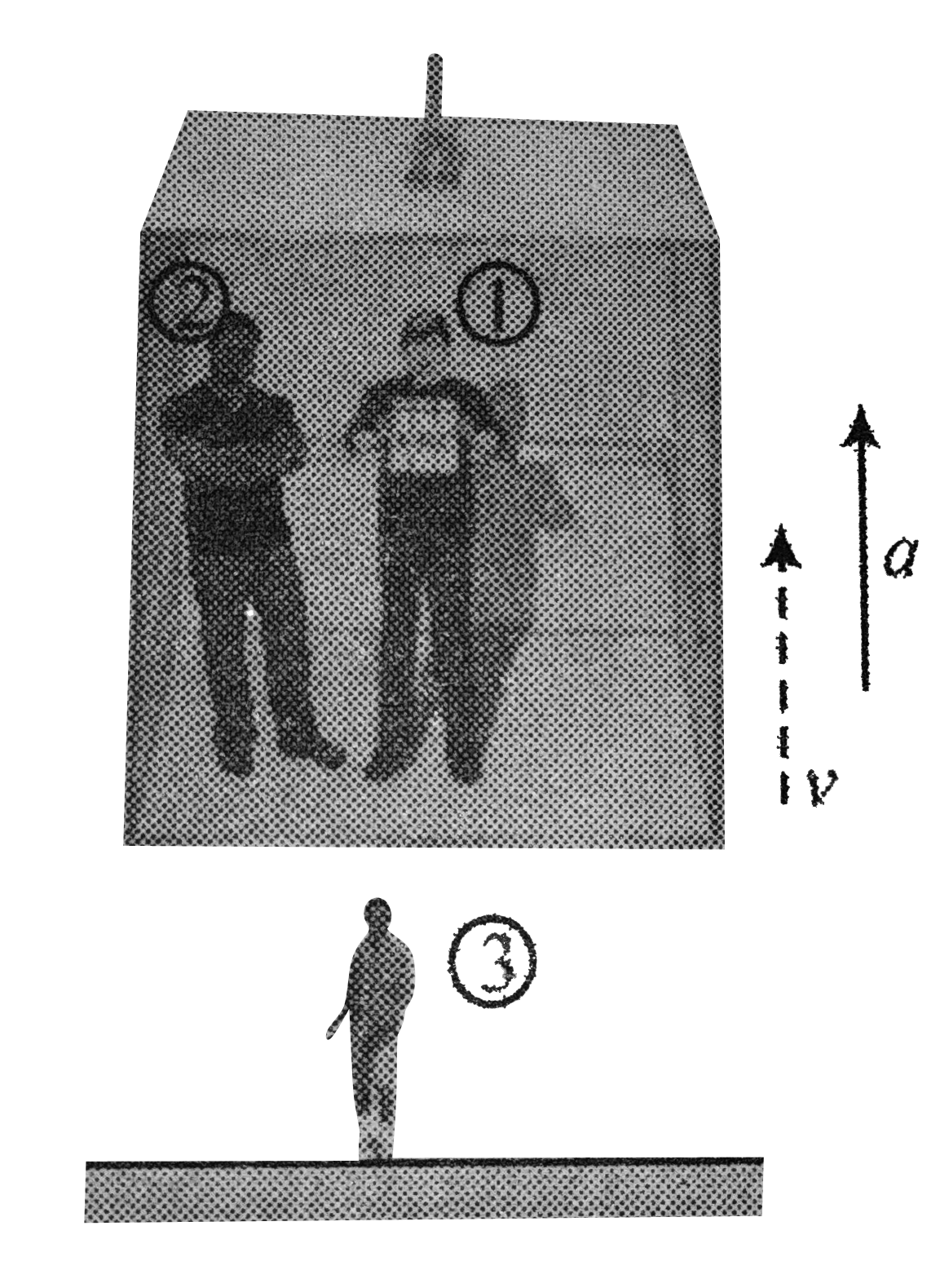
A man(1) of mass m strands on an elevato...

A man(1) of mass `m` strands on an elevator moving with upward acceleration `a`. A man(2) is standing on the elevator. Elevator starts with initial velocity `v_0` at time `t=0`. Consider time interval t from beginning.
a. What is the work done by normal contact force and gravity on the man(1) as observe by man(2) standing on the elevator and man(3) standing on ground?
b. What is the net work done by normal contact force between man(1) and elevator?

Promotional Banner

Similar Questions

Explore conceptually related problems

A man of mass m is standing in an elevator moving downward with an acceleration (g)/(4) . The force exerted by the bottom surface of the elevator on the man will be

A man of mass m is standing in an elevator moving downward with an acceleration (g)/(4) . The force exerted by the bottom surface of the elevator on the man will be

A man of mass 75 kg is standing in an elevator which is moving with an acceleration of 5 m//s^2 in upward direction.The apparent weight of the man will be (g=10 m//s^2)

A man of mass 80 kg stands in an elevator. Calculate his apparent weight when, (i) elevator is at rest

A man (mass =50 kg) is in an elevtor with is moving with acceleration 0.49 m//s^(2) upwards. Find normal reaction exerted by man on floor of the elevator.

A man (mass =50 kg) is in an elevtor with is moving with acceleration 0.49 m//s^(2) upwards. Find normal reaction exerted by man on floor of the elevator.

An elevator is moving upward with an acceleration a it has velocity v when a man inside the elevator lifts a body of mass m through a height h ( in time t). The average power developed by the man is

A man of weight 80 kg is standing in an elevator which is moving with an acceleration of 6m//s^(2) in upward direction. The apparent weight of the man will be (g=10m//s^(2))

A man of weight 80 kg is standing in an elevator which is moving with an acceleration of 6m//s^(2) in upward direction. The apparent weight of the man will be (g=10m//s^(2))