

Home
Class 11
PHYSICS
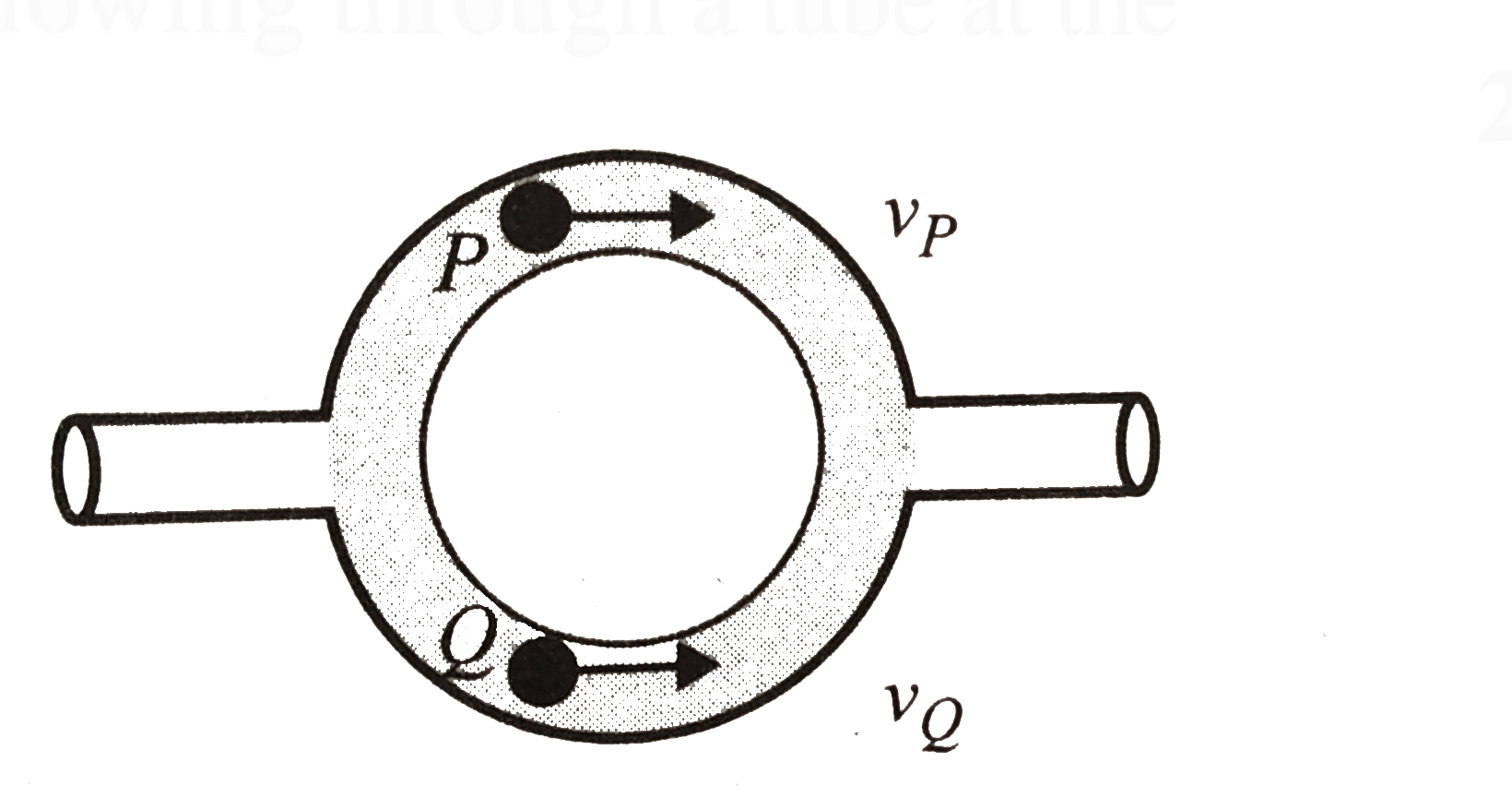
Figure shows a liquid flowing through a ...

Figure shows a liquid flowing through a tube at the rate of `0.1 m^(3)//s`. The tube is branched into two semicircular tubes of cross-sectional area `A//3` and `2A//3`. The velocity of liquid at `Q` is (the cross section of the main tube is `A =10^(-2) m^(2)` and `v_(p) = 20 m//s`)

Promotional Banner

Similar Questions

Explore conceptually related problems

If cross- sectional area of limb I is A_(1) and that of limb II is A_(2) then velocity of the liquid in the tube will be, (cross- sectional area of tube is very small)

If cross- sectional area of limb I is A_(1) and that of limb II is A_(2) then velocity of the liquid in the tube will be, (cross- sectional area of tube is very small)

How does the pressure of liquid depend on the area 'of cross section of tube of flow?

A liquid flows through a horizontal tube. The velocities of the liquid in the two sections, which have areas of cross section A_(1) and A_(2) are v_(1) and v_(2) respectively. The difference in the levels of the liquid in the two vertical tubes is h . Then

A liquid flows through a horizontal tube. The velocities of the liquid in the two sections, which have areas of cross section A_(1) and A_(2) are v_(1) and v_(2) respectively. The difference in the levels of the liquid in the two vertical tubes is h . Then

A liquid flows through a horizontal tube. The velocities of the liquid in the two sections, which have areas of cross section A_(1) and A_(2) are v_(1) and v_(2) respectively. The difference in the levels of the liquid in the two vertical tubes is h . Then

Liquid is flowing throgh a tube of nonuniform cross section ratio of the radius at entry a and exit end B of the tube is 3 :2. Then the ratio of velocities at entry A and exit B of liquid is ……

(a) What is meant by the principle of continuity ? Show that velocity of a liquid is inversely proportional to the area of cross-section of a pipe or tube.

A liquid flows through a horizontal tube as shown in figure. The velocities of the liquid in the two sections, which have areas of cross-section A_(1) and A_(2) and v_(1) and v_(2) respectively. The differnece in the levels of the liquid in the two vertical tubes is h . then