

Home
Class 11
PHYSICS
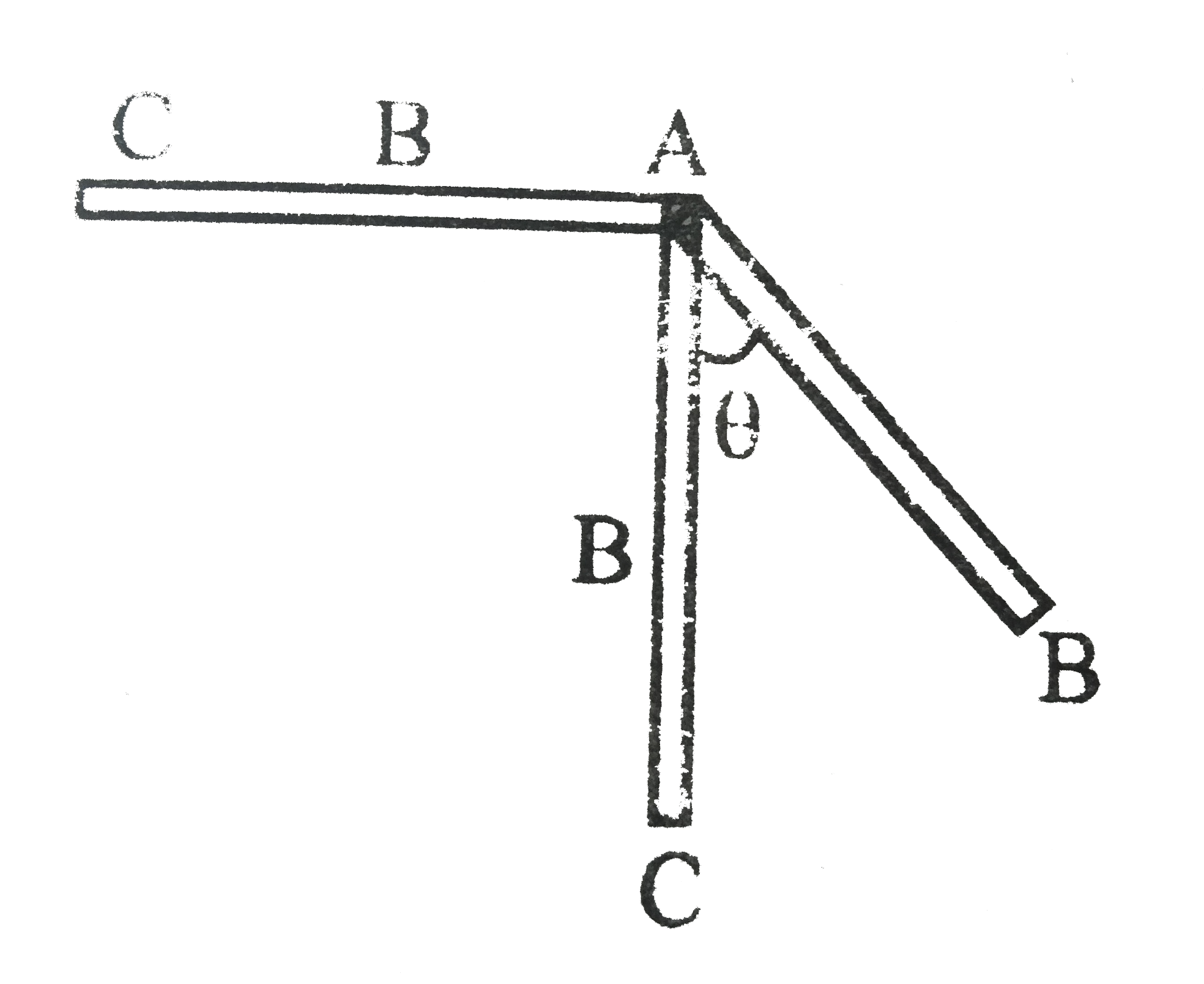
A rod hinged at one end is released from...

A rod hinged at one end is released from the horizontal position as shown in the figure. When it becomes vertical its lower half separates without exerting any reaction at the breaking point. The find the maximum angle `theta` made by the hinged upper half with the vertical.
.

Promotional Banner

Similar Questions

Explore conceptually related problems

A rod is released from the horizontal position as shown. It is free to rotate about hinge. Find angular velocity of rod when it become vertical?

A simple pendulum A and a homogeneous rod B hinged at its enda are released from horizontal position as shown in figure.

A simple pendulum A and a homogeneous rod B hinged at its enda are released from horizontal position as shown in figure.

A uniform rod of mass m, hinged at its upper end, is released from rest from a horizontal position. When it passes through the vertical position, the force on the hinge is

A uniform rod of mass m, hinged at its upper end, is released from rest from a horizontal position. When it passes through the vertical position, the force on the hinge is

Uniform rod AB is hinged at the end A in a horizontal position as shown in the figure ( the hinge is frictionless that is , it does not exert any friction force on the rod ) . The other end of the rod is connected to a block through a massless string as shown. The pulley is smooth and massless . Masses of the block and the rod are same and are equal to 'm' . Then just after release of block from this position, the magnitude of reaction exerted by hinge on the rod is

Uniform rod AB is hinged at the end A in a horizontal position as shown in the figure ( the hinge is frictionless that is , it does not exert any friction force on the rod ) . The other end of the rod is connected to a block through a massless string as shown. The pulley is smooth and massless . Masses of the block and the rod are same and are equal to 'm' . Then just after release of block from this position, the magnitude of reaction exerted by hinge on the rod is

A rod of mass m and length l is hinged at 'its' end and released from rest in position shown. Find the force exerted by the hinge when the rod becomes horizontal

A rod of mass m and length l is himged about one of its ends. The rod is released from horizontal position. When the rod becomes vertical, calculate (i) angular speed of the rod (ii) Hinge reaction.