

Home
Class 11
CHEMISTRY
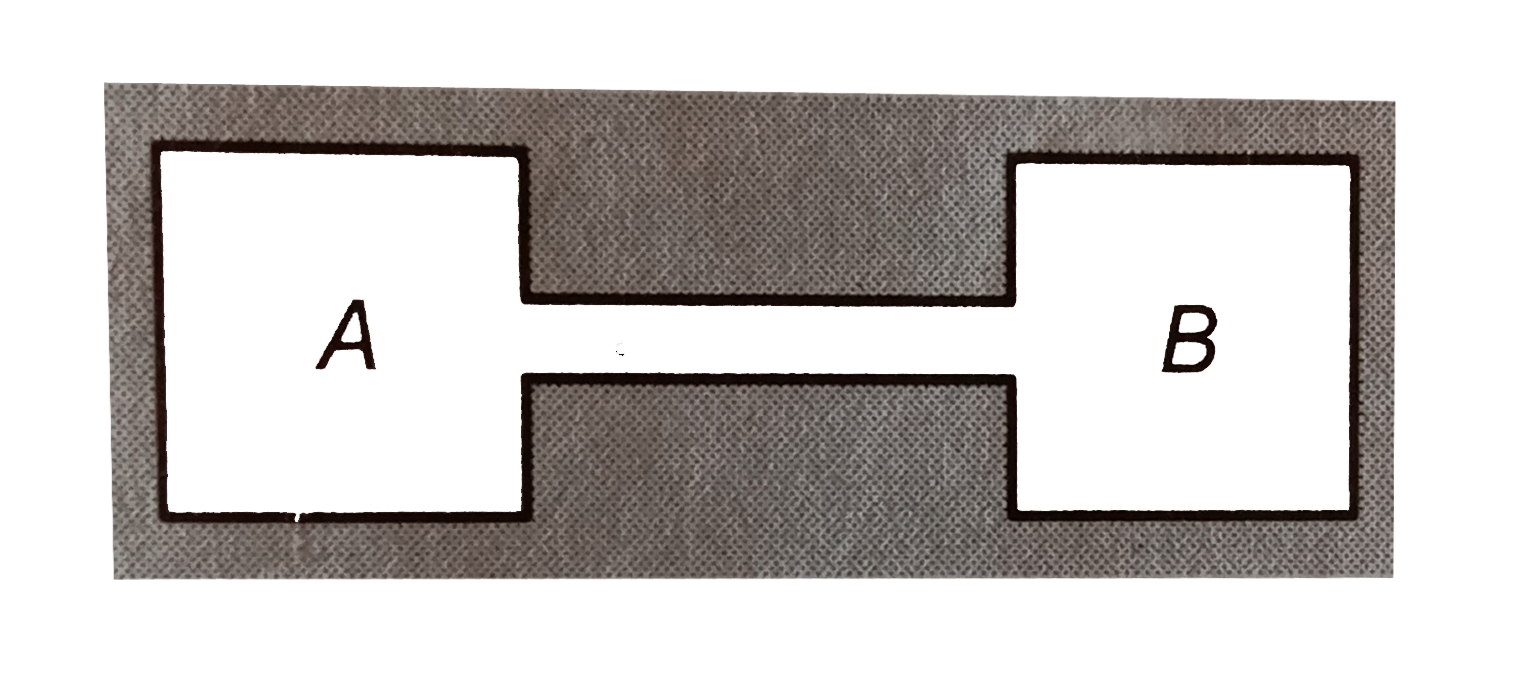
shows two vessels A and B with rigid wal...

shows two vessels `A` and `B` with rigid walls containing ideal gas. The pressure volume and temperature in vessel A are `P_(A), V` and `T_(A)` whereas in vessel `B,P_(B) V` and `T_(B)` The vessel are now connected through small tube of negligible volume Show that the final pressure `P` and temperature `T` satisfy the equation
`(P)/(T) =(1)/(2)[(P_(A))/(T_(A)) +(P_(B))/(T_(B))]`
.

Promotional Banner

Similar Questions

Explore conceptually related problems

Shows two vessel A and B with rigid walls containing ideal gases. The pressure, temperature and the volume are P_(A),T_(A),V in the vessel A and P_(B),T_(B),V in the vessel B. The vessels are mow connected through a small tube. Show that pressure p and the temperature T satisfy (P)/(T)=(1)/(2)((P_(A))/(T_(A))+(P_(B))/(T_(B)) when equilibrium is archieved .

Two vessels A and B with rigid walls containing ideal gases. The pressure, temperature and the volume are P_(1), T_(1), V in the vessel A and P_(2), T_(2), V in the vessel B . The vessels are now connected through a small tube. In equilibrium, pressure P and temerature T becomes same in two vessels. Find the value of P//T .

Two thermally insulated vessels are filled with an ideal gas. The pressure, volume and temperature in the two vessels are P_(1), V_(1), T_(1) and P_(2), V_(2), T_(2) respectively. Now, the two vessels are connected using a short insulating tube. (a) Find final temperature of the gas. (b) Express the final pressure of the gas in terms of P_(1), V_(1), P_(2) and V_(2) only.

Two vessels A and B have volumes V and 4V respectively Both vessels contain some water The pressure in the space above water is P^(1) in vessel A and P_(2) in vessel B at temperature T which one is correct ? .

Two closed bulbs of equal volume (V) containing an ideal gas initially at pressure P_(i) and temperature T_(1) are connected through a narrow tube of negligible volume as shown in the figure below . The temperature of one of the bulbs is then raised to T_(2) . the final pressure Pf is

An ideal gas with pressure P, volume V and temperature T is expanded isothermally to a volume 2V and final pressure P_(I) . The same gas is expanded adiabatically to a volume 2V and final pressure in this case is P_(A) . In terms of the ratio of the two specific heats for the gas gamma , the ratio P_(I)//P_(A) is