

Home
Class 12
PHYSICS
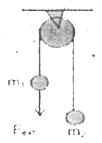
(i) Two bodies of masses m(1)(m(2) gt m(...

(i) Two bodies of masses `m_(1)(m_(2) gt m_(1))` are connected by a light inextensible string which passes through a smooth fixed pulley. What is the instantaneous power delivered by an external agent to pull `m_(1)` with constant velocity `vec(V)`?

(ii) A small body of mass m is located on a horizontal plane at any point O. The body acquires a horizontal velocity `v_(0)` . Find the mean power developed by the friction force during the motion, if the coefficient of friction `mu=0.27, m=1.0` kg and `v_(0)=1.5m//s`.

Promotional Banner

Similar Questions

Explore conceptually related problems

Two bodies of masses m_(1) and m_(2) (m_(2) gt m_(1)) are connected by a light inextensible string which passes through a smooth fixed pulley. The instantaneous power delivered by an external agent to pull m_(1) with constant velocity v is :

A small body of mass m is located on a horizontal plane at the point O. The body acquires a horizontal velocity v_0 . Find the mean power developed by the friction force during the whole time of motion, if the frictional coefficient mu=0.27 , m=1.0kg and v_0=1.5ms^-1 .

A small body of mass m is located on a horizontal plane at the point O. The body acquires a horizontal velocity v_0 . Find the mean power developed by the friction force during the whole time of motion, if the frictional coefficient mu=0.27 , m=1.0kg and v_0=1.5ms^-1 .

An object of mass (m) is located on the horizontal plane at the origin O. The body acquires horizontal velocity V. The mean power developed by the frictional force during the whole time of motion is ( mu= frictional coefficient )

A small body of mass m moving with velocity v_(0) on rough horizontal surface, finally stops due to friction. Find, the mean power developed by the friction force during the motion of the body, if the frictional coefficient mu =0.27,m=1 kg and v_(0)=1.5 ms^(-1) .

Two masses m_(1) and m_(2) are connected by light inextensible string passing over a smooth pulley P . If the pulley moves vertically upwards with an acceleration equal to g then .