

Home
Class 11
PHYSICS
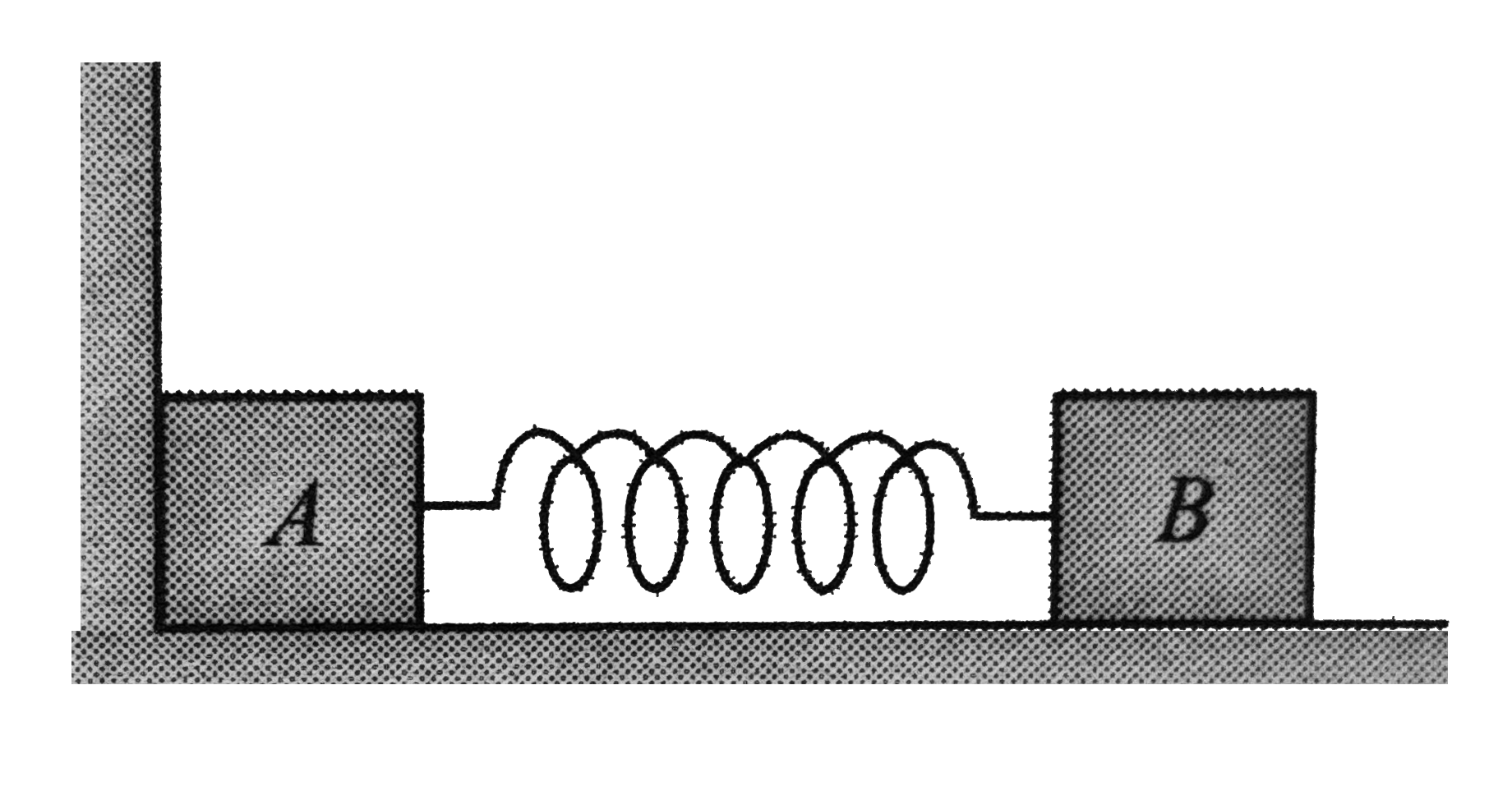
Two identical blocks A and B, each of ma...

Two identical blocks A and B, each of mass `m=2kg` are connected to the ends of an ideal spring having force constant `K=1000Nm^-1`. System of these blocks and spring is placed on a rough floor. Coefficient of friction between blocks and floor is `m=0.5`. Block B is passed towards left so that spring gets compressed.

Calculate initial minimum compression `x_0` of spring such that block A leaves contact with the wall when system is released.

Promotional Banner

Similar Questions

Explore conceptually related problems

A block of mass 50 kg is projected horizontal on a rough horizontal floor. The coefficient of friction between the block and the floor is 0.1. The block strikes a light spring of stiffness k = 100 N//m with a velocity 2 m//s , the maximum compression of the spring is

A block of mass 50 kg is projected horizontal on a rough horizontal floor. The coefficient of friction between the block and the floor is 0.1. The block strikes a light spring of stiffness k = 100 N//m with a velocity 2 m//s , the maximum compression of the spring is

Two blocks of mass 10 kg and 2 kg are connected by an ideal spring of spring constant 1000 N/m and the system is placed on a horizontal surface as shown. The coefficient of friction between 10 kg block and surface is 0.5 but friction is assumed to be absent between 2 kg and surface. Initially blocks are at rest and spring is unstretched then 2 kg block is displaced by 1 cm to elongate the spring then released. Then the graph representing magnitude of frictional force on 10 kg block and time t is : (Time t is measured from that instant when 2 kg block is released to move)

A block of mass m is attached to one end of a mass less spring of spring constant k. the other end of spring is fixed to a wall the block can move on a horizontal rough surface. The coefficient of friction between the block and the surface is mu then the compession of the spring for which maximum extension of the spring becomes half of maximum compression is .

A block of mass m is attached to one end of a mass less spring of spring constant k. the other end of spring is fixed to a wall the block can move on a horizontal rough surface. The coefficient of friction between the block and the surface is mu then the compession of the spring for which maximum extension of the spring becomes half of maximum compression is .

A 2kg block is dropped from a height of 0.4 m on a spring of force constant 1960Nm^(-1) . The maximum compression of the spring is