

Home
Class 12
PHYSICS
An electron of kinetic energy K is proje...

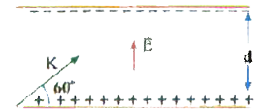
An electron of kinetic energy K is projected between two charged plats at an angle `60^(@)` as shown in figure. If electrons doesn't reach to the upper plate just before striking then the magnitude of electric field will be more than:

Promotional Banner

Similar Questions

Explore conceptually related problems

An electron is projected as in figure with kinetic energy K, at an angle theta=45^(@) between two charged plates. The magnitude of the electric field so that the electron just fails to strike the upper plate, should be greater than:

An electron is projected as in figure with kinetic energy K, at an angle theta=45^(@) between two charged plates. The magnitude of the electric field so that the electron just fails to strike the upper plate, should be greater than:

An electron is projected as in figure with kinetic energy K, at an angle theta=45^(@) between two charged plates. The magnitude of the electric field so that the electron just fails to strike the upper plate, should be greater than:

A uniform electric field E is created between two parallel ., charged plates as shown in figure . An electron . enters the field symmetrically between the plates with a . speed v_(0)'. The length of each plate is l. Find the angle of . deviation of the path of the electron as it comes out . of the field.

A uniform electric field E is created between two parallel ., charged plates as shown in figure . An electron . enters the field symmetrically between the plataes with a . speed v_0. The length of each plate is l. Find the angle of . deviation of the path of the electron as it comes out . of the field.

A uniform electric field E is created between two parallel ., charged plates as shown in figure . An electron . enters the field symmetrically between the plataes with a . speed v_0. The length of each plate is l. Find the angle of . deviation of the path of the electron as it comes out . of the field.

A uniform electric field E is created between two parallel ., charged plates as shown in figure . An electron . enters the field symmetrically between the plataes with a . speed v_0. The length of each plate is l. Find the angle of . deviation of the path of the electron as it comes out . of the field.

A charged particle having kinetic energy E enters normally a region of uniform magnetic field between two plates P_(1) and P_(2) as shown in the figure. If the particle just misses hitting the plate P_(2) , then the magnetic field B in the region between the plates is

A charged particle having kinetic energy E enters normally a region of uniform magnetic field between two plates P_(1) and P_(2) as shown in the figure. If the particle just misses hitting the plate P_(2) , then the magnetic field B in the region between the plates is

A uniform electric field E is established between two parallel charged plates as shown in figure. An electron enter the field symmetrically between the plates with a speed u. The length of each plate is l. if the electron does not stricke any of the plates, find the angle of deviation of the electron as it comes out of the field at the outer end of plates. [tan^(-1) ((eEl)/(mu^(2)))]