

Home
Class 11
PHYSICS
The ends of a metallic bar are maintaine...

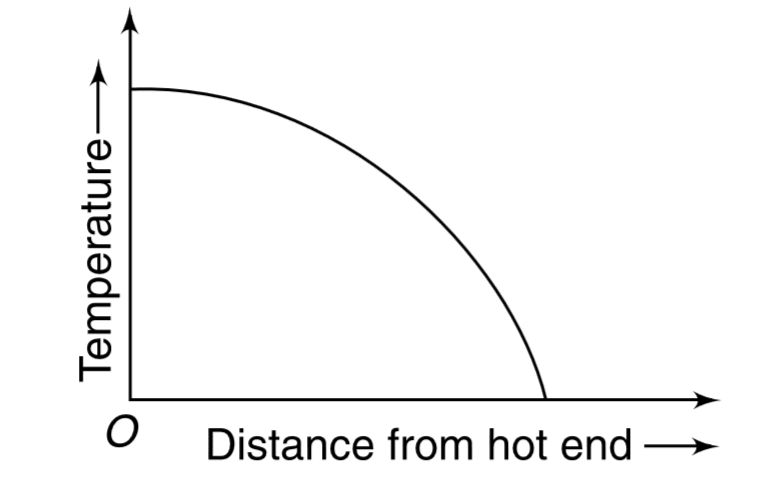
The ends of a metallic bar are maintained at different temperature and there is no loss/gain of heat from the sides of the bar due to conduction or radiation. In the steady state the temperature variation along the length of the bar is a shown in the figure what do you think about the cross sectional area of the bar?

Promotional Banner

Similar Questions

Explore conceptually related problems

The ends of a long bar are maintained at different temperatures and there is no loss of heat from the sides of the bar due to conduction or radiation. The graph of temperature against distance of the bar when it has attained steady state is shown here. The graph shows (i) the temperature gradient is not uniform. (ii) the bar has uniform cross-sectional area. (iii) the cross-sectional area of the bar increases as the distance from the hot end increases. (iv) the cross-sectional area of the bar becreases as the distance from the hot end increases

The ends of a long bar are maintained at different temperatures and there is no loss of heat from the sides of the bar due to conduction or radiation. The graph of temperature against distance of the bar when it has attained steady state is shown here. The graph shows ltimg src="https://d10lpgp6xz60nq.cloudfront.net/physics_images/ALN_PHY_R03_E09_009_Q01.png" width="80%"gt (i) the temperature gradient is not uniform. (ii) the bar has uniform cross-sectional area. (iii) the cross-sectional area of the bar increases as the distance from the hot end increases. (iv) the cross-sectional area of the bar decreases as the distance from the hot end increases

In Searle's method for finding conductivity of metals, the temperature gradient along the bar

In the steady state, the rate of flow of heat through any section of a metal bar is ____.

A long metallic bar is carrying heat from on eof its ends to the other end under steady-state. The variation of temperature theta along the length x of the bar from its hot end is best described by which of the following figures?

A long metallic bar is carrying heat from one of its ends to the other end under steady-state. The variation of temperature theta along the length x of the bar from its hot end is best described by which of the following figures?

A long metallic bar is carrying heat from one of its ends to the other end under steady-state. The variation of temperature theta along the length x of the bar from its hot end is best described by which of the following figure.

A long metallic bar is carrying heat from one of its ends to the other end under steady-state. The variation of temperature theta along the length x of the bar from its hot end is best described by which of the following figures?

The ends of a thin bar are maintained at different temperatures. The temperature of the cooler end is 11^(@)C , while the temperature at a point 0.13m from the cooler end is 23^(@)C and the temperature of the warmer end is 48^(@)C . Assuming that heat flows only along the length of the bar ( the sides are insulated), find the length of the bar.