

Home
Class 11
PHYSICS
Two blocks of equal mass have been place...

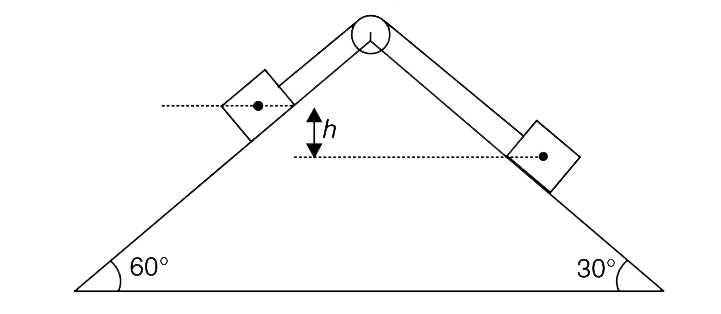
Two blocks of equal mass have been placed on two faces of a fixed wedge as shown in figure. The blocks are released from position where centre of one block is at a height h above the centre of the other block. Find the time after which the centre of the two blocks will be at same horizontal level. There is no friction anywhere.

Promotional Banner

Similar Questions

Explore conceptually related problems

Two blocks A and B of equal masses are released on two sides of a fixed wedge C as shown in figure. Find the acceleration of centre of mass of blocks A and B. Neglect friction.

Two blocks A and B of equal masses are released on two sides of a fixed wedge C as shown in figure. Find the acceleration of centre of mass of blocks A and B. Neglect friction.

Two blocks A and B each of equal masses m are rleased from the top of a smooth fixed wedge as shown in the figure. Find the magnitude of the accelertion of the centre of mass of the two blocks.

Two blocks of equal masses m are released from the top of a smooth fixed wedge as shown in the figure. Find the magnitude of the acceleration of the centre of mass of the two blocks in m//s^(2) if g =10 m//s^(2)

Two blocks, each having mass m, are connected with an ideal string through ideal pulleys on a frictionless fixed wedge as shown in the figure. The acceleration of the blocks is

Two blocks, each having mass m, are connected with an ideal string through ideal pulleys on a frictionless fixed wedge as shown in the figure. The acceleration of the blocks is

Two blocks of equal mass are tied with a light string, which passes over a massless pulley as shown in figure. The magnitude of acceleration of centre of mass of both the blocks is : (neglect friction everywhere)

A block of mass m is placed on a smooth wedge of mass M, as shown in the figure . Just after placiing block m over wedge M.