

Home
Class 12
PHYSICS
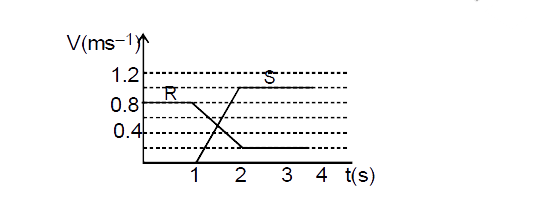
The diagram shows the velocity - time gr...

The diagram shows the velocity - time graph for two masses R and S that collided elastically. Which of the following statements is true ?

I. R and S moved in the same direction after the collision.
II. The velocities of R and S were equal at the mid time of the collision.
III. The mass of R was greater than mass of S.

Promotional Banner

Similar Questions

Explore conceptually related problems

Figure shows the velocity-time graph for two masses R and S that collided elastically. Which of the following statements is true? i. R and S moved in the same direction after the collision. ii. The velocities of R and S were equal at the mid time of the collision. iii. The mass of R was greater than mass of S . Which of the following is true?

Figure shows the velocity-time graph for two masses R and S that collided elastically. Which of the following statements is true? i. R and S moved in the same direction after the collision. ii. The velocities of R and S were equal at the mid time of the collision. iii. The mass of R was greater than mass of S . Which of the following is true?

Figure shows the velocity-time graph for two masses R and S that collided elastically. Which of the following statements is true? i. R and S moved in the same direction after the collision. ii. The velocities of R and S were equal at the mid time of the collision. iii. The mass of R was greater than mass of S . Which of the following is true?

The diagram to the right shows the velocity-time graph for two masses R and S that collided elastically. Which of the following statements is true? [I] R and S moved in the same direction after the collision. [II] Kinetic energy of the system (R & S) is minimum at t=2 milli sec. [III] The mass of R was greater than mass of S .

A ball of mass m moving with a velocity collides head on elastically with another of the same mass m but moving with a - in the opposite direction). After the collision

Two balls of masses m and 2m moving in opposite directions collide head on elastically with velocities v and 2v . Find their velocities after collision.

Two balls of masses m and 2m moving in opposite directions collide head on elastically with velocities v and 2v . Find their velocities after collision.

Two balls of masses m and 2m moving in opposite directions collide head on elastically with velocities v and 2v . Find their velocities after collision.

The car A of mass 1500 kg, travelling at 25 m/s collides with another car B of mass 1000 kg travelling at 15 m/s in the same direction. After collision the velocity of car A becomes 20 m/s. Calculate the velocity of car B after the collision.

A ball of mass M moving with a velocity v collides perfectly inelastically with another ball of same mass but moving with a velocity v in the opposite direction. After collision