

Home
Class 11
PHYSICS
Two identical blocks P and Q have mass m...

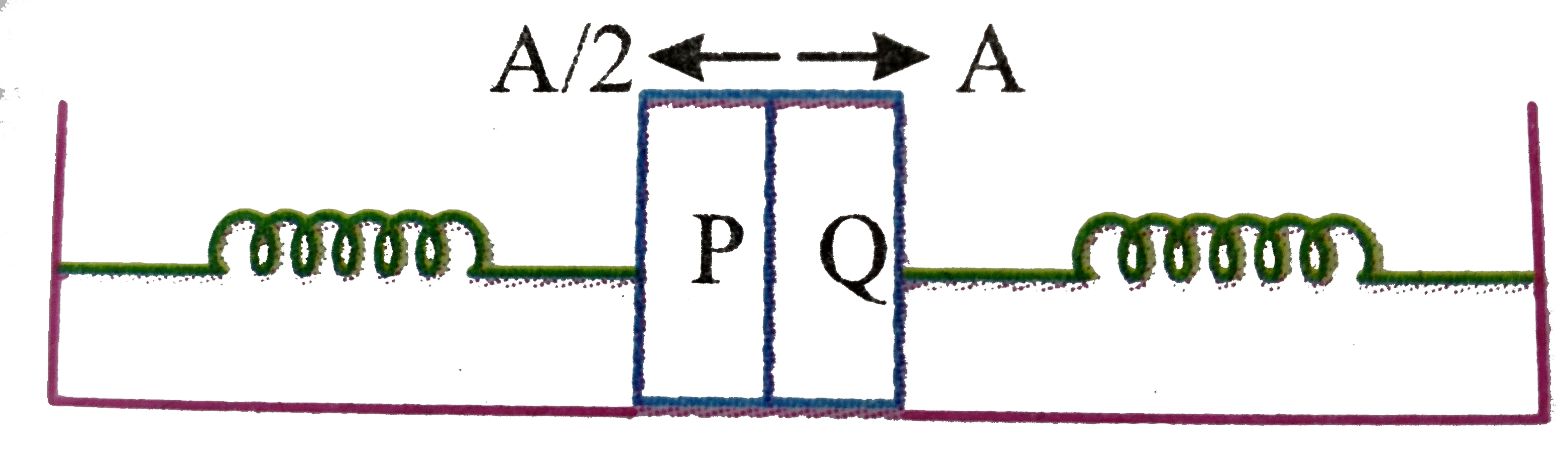
Two identical blocks `P` and `Q` have mass `m` each. They are attached to two identical springs initially unstretched. Now the left spring (along with `P)` is compressed by `A//2` and the right spring (along with `Q`) is compressed by `A`. Both the blocks are released simultaneously. They collide perfectly inelastically. Initially time period of both the blocks was `T`.

The time period of oscillation of combined mass is

Promotional Banner

Similar Questions

Explore conceptually related problems

Passage II) Two identicla blocks P and Q have masses m each. They are attached to two identical springs initially unstretched. Now the left spring (along with P) is compressed by A/2 and the right spring (along with Q) is compressed by A. Both the blocks are released simultaneously. They collide perfectly inelastically. Initially time period of both blocks was T. The time period of oscillation of combined mass is

Passage II) Two identicla blocks P and Q have masses m each. They are attached to two identical springs initially unstretched. Now the left spring (along with P) is compressed by A/2 and the right spring (along with Q) is compressed by A. Both the blocks are released simultaneously. They collide perfectly inelastically. Initially time period of both blocks was T. The time period of oscillation of combined mass is

Two identical blocks P and Q have mass m each. They are attached to two identical springs initially unstretched. Now the left spring (along with P) is compressed by A//2 and the right spring (along with Q ) is compressed by A . Both the blocks are released simultaneously. They collide perfectly inelastically. Initially time period of both the blocks was T . The energy of oscillation of the combined mass is

Two identical blocks P and Q have mass m each. They are attached to two identical springs initially unstretched. Now the left spring (along with P) is compressed by A//2 and the right spring (along with Q ) is compressed by A . Both the blocks are released simultaneously. They collide perfectly inelastically. Initially time period of both the blocks was T . The amplitude of combined mass is

Passage II) Two identicla blocks P and Q have masses m each. They are attached to two identical springs initially unstretched. Now the left spring (along with P) is compressed by A/2 and the right spring (along with Q) is compressed by A. Both the blocks are released simultaneously. They collide perfectly inelastically. Initially time period of both blocks was T. What is energy of osciallation of the combined mass?

Passage II) Two identicla blocks P and Q have masses m each. They are attached to two identical springs initially unstretched. Now the left spring (along with P) is compressed by A/2 and the right spring (along with Q) is compressed by A. Both the blocks are released simultaneously. They collide perfectly inelastically. Initially time period of both blocks was T. The amplitude of combined mass is

Passage II) Two identicla blocks P and Q have masses m each. They are attached to two identical springs initially unstretched. Now the left spring (along with P) is compressed by A/2 and the right spring (along with Q) is compressed by A. Both the blocks are released simultaneously. They collide perfectly inelastically. Initially time period of both blocks was T. What is energy of osciallation of the combined mass?

Passage II) Two identicla blocks P and Q have masses m each. They are attached to two identical springs initially unstretched. Now the left spring (along with P) is compressed by A/2 and the right spring (along with Q) is compressed by A. Both the blocks are released simultaneously. They collide perfectly inelastically. Initially time period of both blocks was T. The amplitude of combined mass is

The period of oscillation of a mass M suspended from a spring of spring constant K is T. the time period of oscillation of combined blocks is