

Home
Class 12
PHYSICS
the focal length of the two thin convex ...

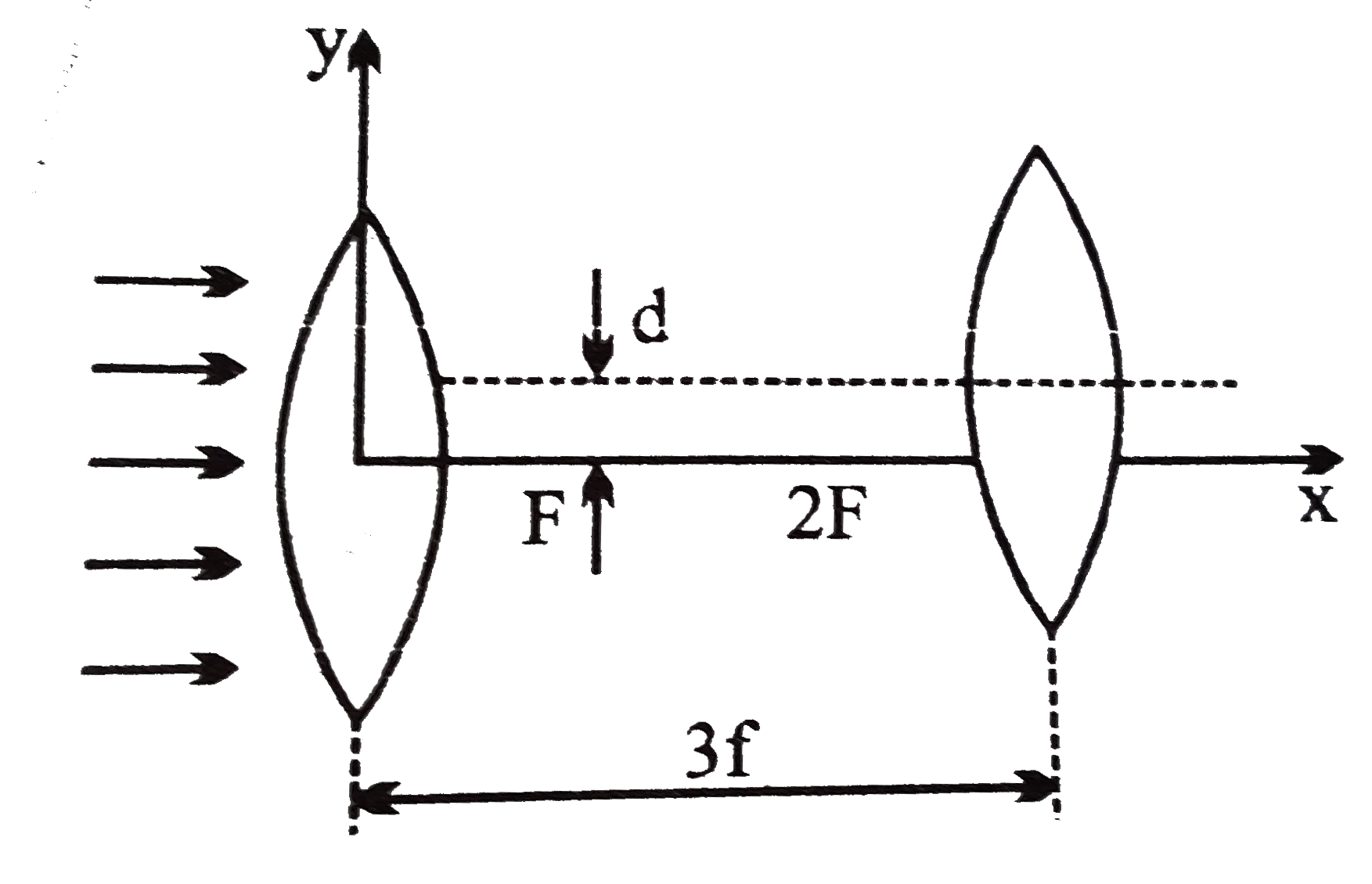
the focal length of the two thin convex lenses is the same`=f`They are separated by a horizontal distance`3f`and their optical axes are displaced by a vertical separation`'d'(dltltf)` .Taking the origin of coordinates`O`at the centre of the first,lens ,find the xand y coordiates of the point where a parallel beamof rays coming from the left finally get focused?

Promotional Banner

Similar Questions

Explore conceptually related problems

In the figure- it is shown,the focal length f of the two thin convex lenses is the same. They are separated by a horizontal distance 3f and their optical axes are displaced by a vertical separation 'd'(d lt lt f) as shown. Taking the origin of coordinates O at the centre of the first lens , find the x and y coordinates of the point where aparallel beam of rays coming from the left finally gets focussed ? ((5f, 2d)]

Two thin convex lenses of focal lengths f_(1) and f_(2) are separated by a horizontal distance d (where dltf_(1) , dltf_(2) ) and their centres are displaced by a vertical separation triangle as shown in the fig. Taking the origin of coordinates O, at the centre of the first lens the x and y coordinates of the focal point of this lens system, for a parallel beam of rays coming form the left, are given by:

Two thin convex lenses of focal lengths f_(1) and f_(2) are separated by a horizontal distance d (where dltf_(1) , dltf_(2) ) and their centres are displaced by a vertical separation triangle as shown in the fig. Taking the origin of coordinates O, at the centre of the first lens the x and y coordinates of the focal point of this lens system, for a parallel beam of rays coming form the left, are given by:

Two thin convex lenses of focal lengths f_(1) and f_(2) are separated by a horizontal distance d (where dltf_(1) , dltf_(2) ) and their centres are displaced by a vertical separation triangle as shown in the fig. Taking the origin of coordinates O, at the centre of the first lens the x and y coordinates of the focal point of this lens system, for a parallel beam of rays coming form the left, are given by:

Two thin convex lenses of focal length f_(1) and f_(2) are separated by a horizontal distance 'd' where (dltf_(1) "and" dltf_(2)) and their optical centers are displaced vertically by x_(0) .Taking the origin at the centre of lens L_(1) consider the following cases when a parallel beam of paraxial rays are coming form left. x coordinate of the final image is

TTwo thin convex lenses of focal length f_(1) and f_(2) are separated by a horizontal distance 'd' where (dltf_(1) "and" dltf_(2)) and their optical centers are displaced vertically by x_(0) .Taking the origin at the centre of lens L_(1) consider the following cases when a parallel beam of paraxial rays are coming form left. Y coordinate of the final image is given by:

Two thin convex lenses of focal length f_(1) and f_(2) are separated by a horizontal distance 'd' where (dltf_(1) "and" dltf_(2)) and their optical centers are displaced vertically by x_(0) .Taking the origin at the centre of lens L_(1) consider the following cases when a parallel beam of paraxial rays are coming form left. for the lens1 L_(2) ,object distance is

Two converging lenses of the same focal length f are separated by a distance 2f. The axis of the second lens is inclined at angle theta=60^@ with respect to the axis of the first lens. A parallel paraxial beam of light is incident from left side of the lens. Find the coordinates of the final image with respect to the origin of the first lens.

Two converging lenses of the same focal length f are separated by a distance 2f. The axis of the second lens is inclined at angle theta=60^@ with respect to the axis of the first lens. A parallel paraxial beam of light is incident from left side of the lens. Find the coordinates of the final image with respect to the origin of the first lens.

Two thin convex lenses of focal lengths f_1 and f_2 are placed at a distance d between them. For the power of combination to be zero, the separation d should fee :